Ideas turned into research. Research turned into a manual. The manual turned into a project. The project turned into an interactive website for a future city. Each section below is one phase in that sequence.
books on the desk
Hamilton photographs
AI-generated chapter images
screen captures, 4 phases
deployed provotypes
Triangulating the world
The materials below are what I kept returning to: municipal plans, climate strategies, academic reports, transit timelines, and AI research syntheses. Several are downloadable as PDFs at the bottom of the page. Full APA-7 bibliography with 87 sources is at Research Citations.
The baseline for how water moves through Hamilton today. Every 2092 harbour claim is calibrated against this.
The municipal horizon for mitigation and adaptation. I used this to decide which future claims were within a single-generation stretch and which needed a cultural shift first.
Published feasibility and timeline speculation for a Great Lakes maglev corridor. The spine of the Coast Rail chapter.
Architectural precedents for what gets built here and why. Informed the Residential and Civic chapters.
Master factual index. Every world domain with citations. The backstop for every 'by 2092' claim.
Environmental timeline (2025 to 2092), fauna/flora, Indigenous stewardship, transit futures. The integrated synthesis doc.
50 speculative species grounded in Canadian flora/fauna plus evolutionary precursors.
Three frontier models asked the same research prompts. I kept all three and cross-checked.
The course-level workbook that set the futures-thinking frame: scan signals, identify drivers, compose scenarios.
First-order, second-order, third-order consequences of one change. Used to stress-test each speculative claim.
The preferred / plausible / possible / preposterous classification. Hamilton 2092 sits in the preferred-plausible overlap.
The 3D-projected version of the cone for presenting to a studio audience. Used in the final phase 2 deck.
The HTML setup partner. Days and nights of coding alongside, across the full thesis site: zone system, chapter shell, four labs, process.html itself.
Ideation and conversational drafts. Testing how speculative claims sounded out loud. Early chapter-structure spitballing.
Research syntheses, especially on Indigenous governance and climate adaptation. Cross-checked against OpenAI and Kimi in the worldbuilding cluster.
Last-month re-verification pass. Caught several research gaps and let me define new areas where the thesis was thin.
Image editing and touch-ups. Quick variants of MidJourney outputs without restarting the prompt.
Short video cuts and motion tests for the labs and the process-page videos.
Full APA-7 bibliography (87 sources, catalogued by chapter) lives at Research Citations.
Five voices
Five voices carry the project. They didn't arrive at once. Each went through multiple POV drafts (first, second, third person), friction scenes, secondary-moment sketches, and an ensemble-relationship pass before the final chapter prose was written. The briefs below are the consolidated masters. The drafts and vignettes live in the downloads folder.
Spent forty years learning to optimize and engineer. Now learning to surrender to processes she doesn't control. Leadership through questions instead of answers.
Source notes ↗Lives between Ministry credentials and Indigenous knowledge, instruments and intuition. Never fully belongs in either world.
Source notes ↗Worries MELA will replicate the good parts (food security) while losing the radical parts (community autonomy, extraction refusal).
Source notes ↗Embodies the shift from corporate surveillance AI to OI-enabled autonomy. Not anti-technology; pro-agency. Drafted as 'Ah Her' before the final rename.
Source notes ↗Teaches that precision doesn't require instruments. That listening is rigorous. That relationships with water accumulate over lifetimes.
What I was learning from
Articles, essays, and book pages I kept coming back to. The books are the ones that shaped the thesis before any of the writing started. Four I own. Eleven I borrowed from the Terryberry branch of the Hamilton Public Library.
The clearest working taxonomy of speculative/critical design I've found. This is the book that gave me permission to call Hamilton 2092 a project and not a daydream.
Sits next to Tharp as the other foundational text. Malpass's history of critical design from Dunne & Raby onward helped me locate myself inside the tradition.
Norman's caution about 'smart' things that outpace the humans using them shaped how MELA and Orenda were written: participatory, legible, opt-outable.
A method reference, kept close while scoping the research phase. Read it backwards, from methods to premise.
To ground the future-transit speculation in first-principles physics before writing about MELA and the Coast Rail maglev.
Kingwell on attention and the screen. A counterweight while writing about 2092's ambient interfaces.
Before I wrote about the Harbour Heron and the Glasswing Dragonfly I needed to know which species actually live here now.
Background for thinking about how the Multi-Lens and OI wearables interface with the body.
What gets built here and why. Helpful for the Residential and Civic chapters, especially for reasoning about what a MELA structure inherits from Ontario vernacular.
Primary source on the state of biofabrication today. Grounds the mycelium and bioelectric speculation in what's already lab-proven.
Smil's anti-hype stance kept the thesis honest. Many of my 'by 2092' claims got shorter or slower after reading this.
For the argument that analog is not obsolete. It directly shaped the paper/ink choices in the printed project and the handwritten feel of the field notes.
Reference for the Coast Rail and MELA transition arc from auto-dependence to shared maglev.
A quick-reference for technologies I only name-checked in the book (e.g. solid-state batteries, perovskite PVs).
A cautionary tour of 20th-century futurism. Read this before finalizing any 2092 claim that felt too clean.
Images I kept near me
Reference points. Stock archives, municipal records, and the internet. I kept them near while drafting.
Walking the city
I grew up here. To imagine what Hamilton becomes in 2092, I kept walking. The escarpment, the harbour, the east-end industrial flats. The photographs below are what survived. They are not ordered.
Bench work
Physical artifacts. The thesis has three provotypes: Orgobot, Multi-Lens, Orenda Coil. Plus a mycelium narrative and a printed project. Below: the initial sketches, the parametric models, and the 3D prints that came off the Bambu Labs printer until the geometry was honest.
First pen-and-paper drafts of the provotypes and the book spread. PDF, 22 MB.
Download PDF ↗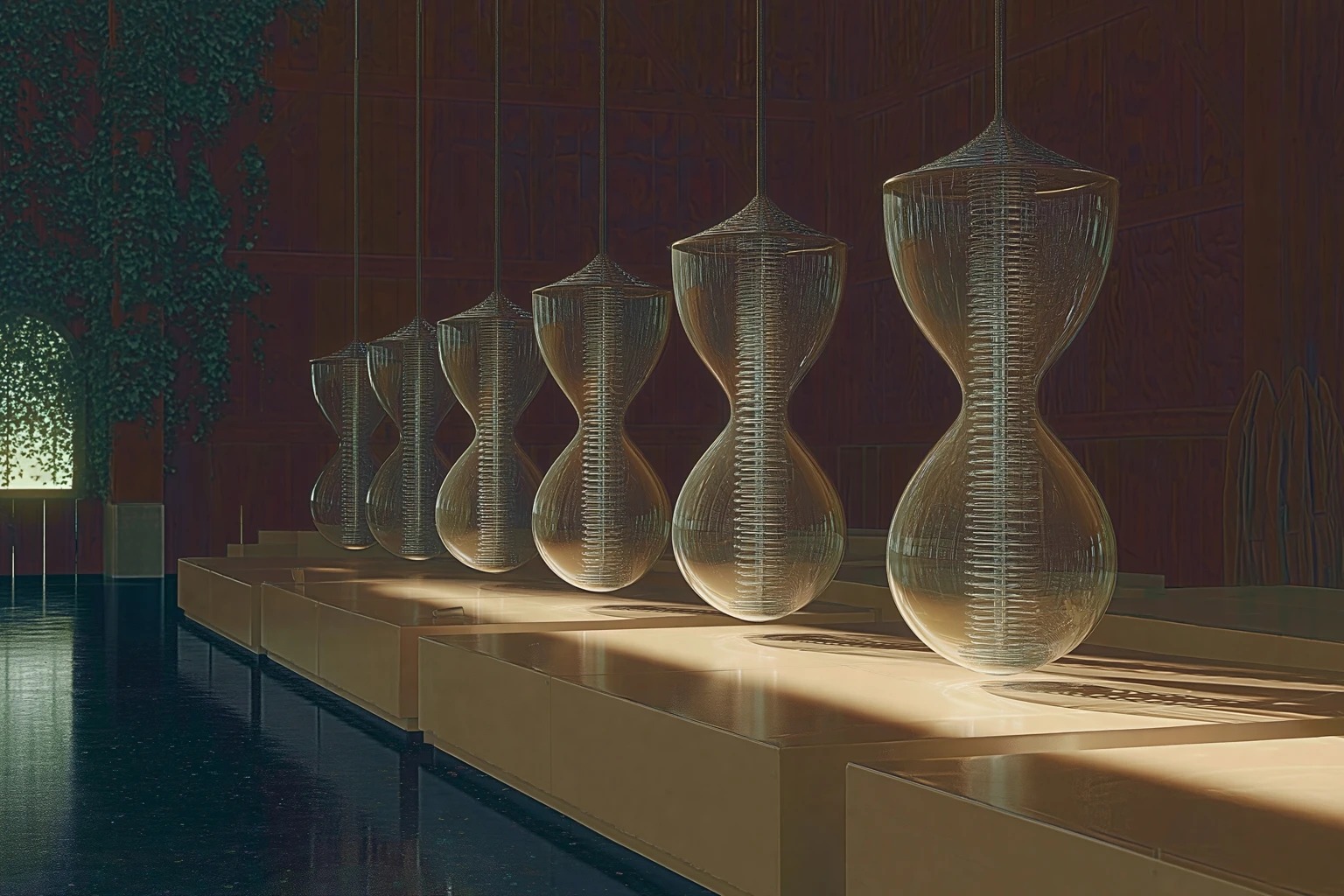
Orange PLA on a Bambu Labs A1. From first proof to the seated helix took about a dozen slices.
View full ↗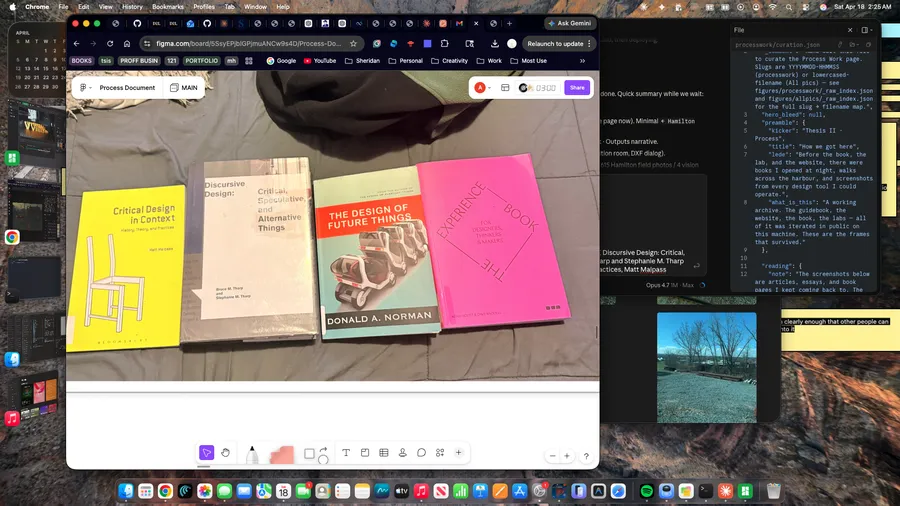
Multi-Lens, MidJourney, and SketchUp running at the same time. The full sequence lives in the Work section under Design · polish.
View full ↗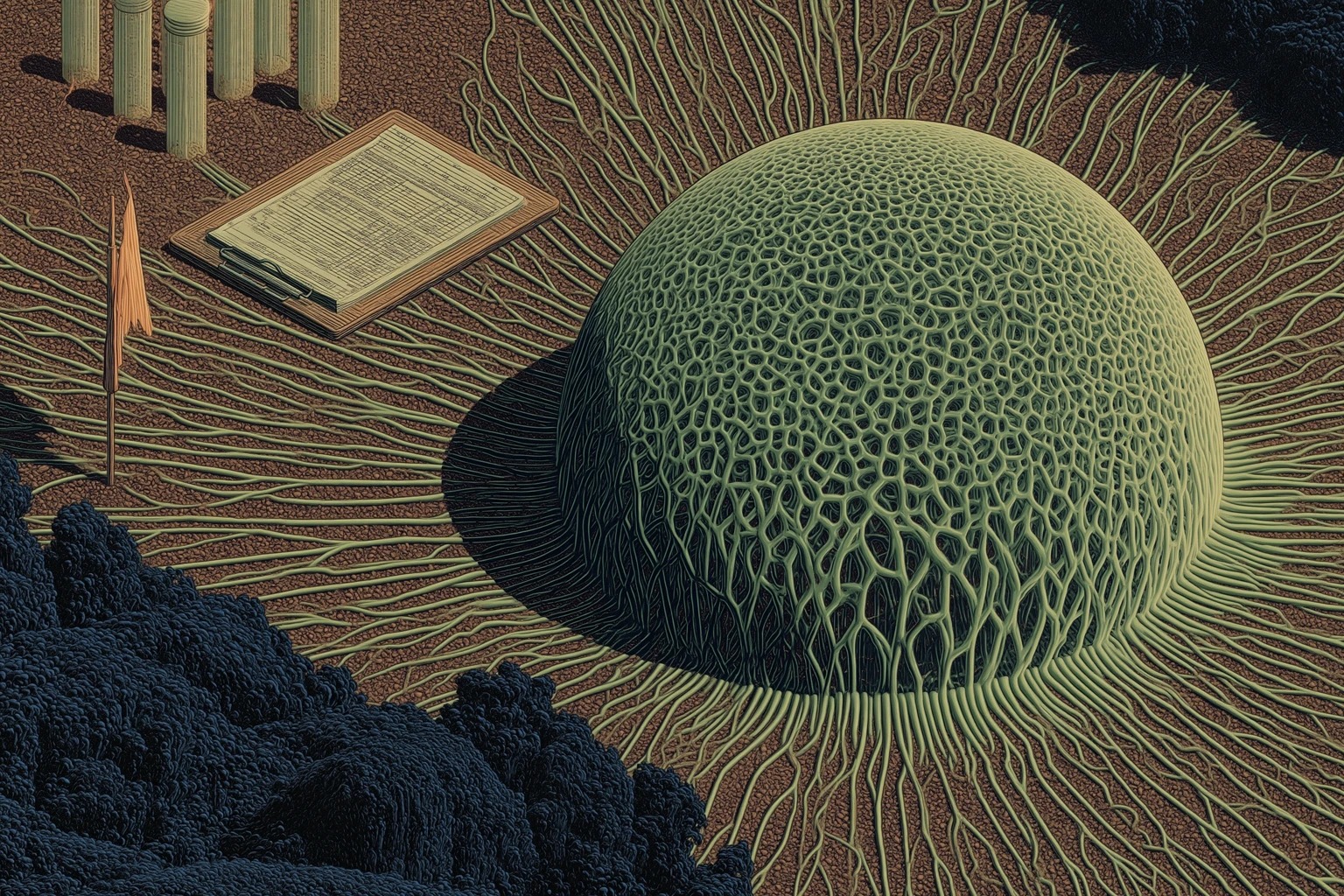

Three photos live in Multi-lens/Images/: 1x, 2x, and post-processed. CAD source in Multi-lens/multi-lens-cad/stl/ (14 STL files).
The fungal ecological succession logic that underpins the Orenda Coil and the Ecology chapter. A five-organism essay: Evernia prunastri → Parmotrema → Trametes versicolor → Pleurotus ostreatus → Hericium erinaceus.
Parametric-lens-designer screens (v1, v2, v3) and the goggle prototype views before the 2092 glasses form settled.
Seven-step zoom from visible scale down to molecular. Plus the canonical single-unit portrait.
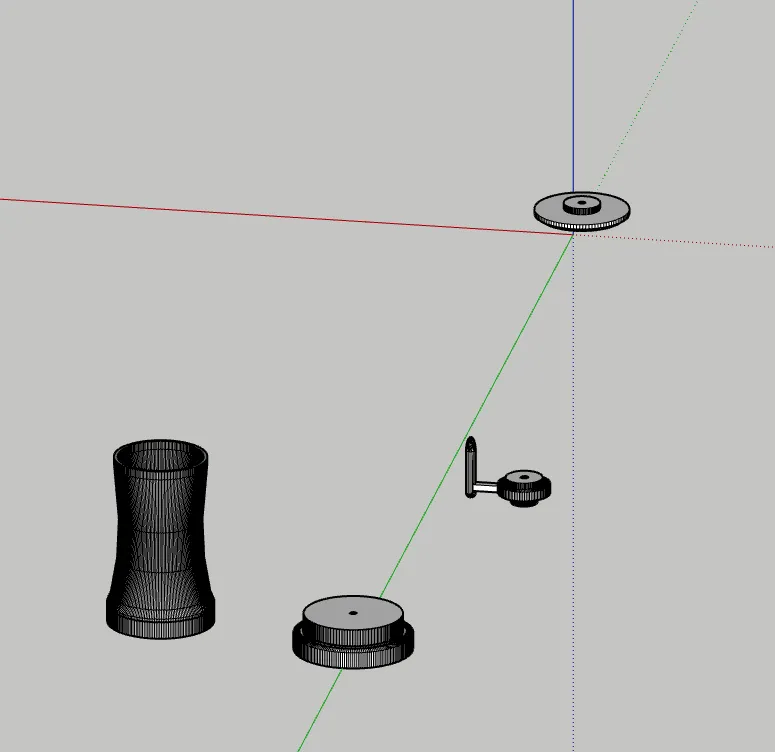
Physical prints of the coil at multiple revisions. Threaded shafts, bottom shells, lid assemblies. Printed PLA on the Bambu A1 over several weeks.
The v6 Orgobot in multiple sizes. White skeleton cage around orange tentacled core. Infant (50 mm) and adult (76 mm) prints, plus the grid on the print bed.
The objects, rotated
The five objects I modelled and printed, with source OBJ files you can download and open in any 3D viewer. Each card lists what it is and links to its story and the lab that generated it.
This is the form the OrgoBot took after roughly twenty procedural iterations. The radial leg array and the sensor crown came out of the lab, not a sketchbook.
The device each household uses to listen to the network. Ten versions of the helix core before the threaded shaft held against the rotor gear.
The part that carries the signal. Isolated so the tolerance on the shaft and the thread pitch were visible during iteration.
One of the two kinetic parts of the citizen visor. Held in hand, this is the size that told me the visor could be printed.
Printed twice. The second version backed off the inner diameter by 0.2 mm to let the rotor move.
Renderings
Every chapter image was written as a prompt first, then iterated with MidJourney and Adobe Firefly. The grid shows the final chapter images grouped by chapter. The 15 exhibition prompts at the bottom are the canonical text I fed the model for 'Speculating with the Tenth' (exhibition imagery). Filenames preserve the chapter-concept key (ch03_orenda, ch04_transit) so you can read the source relationship.
The Steward provotype, weathered and partially overgrown, sitting unobtrusively within a restored Carolinian forest patch near Hamilton, 2092. Organic, natural light, focus on texture and natural integration. Quiet vigilance.
The Multi-Lens provotype casting intricate, shifting light patterns onto a permeable urban surface in Hamilton, 2092. Dynamic light and shadow, geometric patterns, urban backdrop, hint of speculative function.
A bustling, verdant public plaza in Hamilton, 2092. At its center, a subtle, elegant Orenda Energy Fountain gently pulses with soft, internal light, circulating water and clean energy. Utopian realism, warm light, slight ethereal glow.
A sleek, biomimetic Coast Rail train glides silently into a Sea-Level Adaptive Station in Hamilton, 2092, at dawn. The station is integrated with marshland and reflects the rising sun. Serene, futuristic, natural light, emphasis on seamless integration with nature.
A typical street scene in Hamilton, 2092. Former roadways are now lush pedestrian pathways and cycle superhighways. Buildings are covered in green walls. Clean, bright, active but serene, emphasis on pedestrian scale.
An open-air assembly beneath the Orenda Fountain Plaza, 2092. Diverse Hamilton citizens and luminous OI entities engage in collaborative governance discussions. Atmospheric, warm and cool tones, emphasis on community interaction.
A close-up, artful shot of the hand-bound User Manual for the Sentient City (the actual thesis project) open to a page with subtle annotations. Light catches the texture of the paper and binding. Still life, warm, tactile, focus on the artifact and its symbolic importance.
- Orenda Fountain Plaza (Day)
- Community Assembly (Evening)
- Market Day at the Plaza
- Coast Rail Arrival (Dawn)
- Coast Rail Eco-Corridor (Aerial)
- Interior of Coast Rail Car
- The Orenda Coil in situ
- Orenda Network (Abstract)
- The Steward Provotype
- The Multi-Lens Provotype
- Hamilton Harbour Reclaimed
- OI Entity in Cityscape
- Future Hamilton Street View
- The Seventeenth Generation
- User Manual for the Sentient City
Every figure you see in the printed project came from a MidJourney session. Below is the exact prompt that generated each one, paired with the image itself. Fifty-five figures, fifty-five prompts.
Scientific illustration of a speculative wearable perceptual interface device worn over the eye. Bio-conductive gel layer visible in cross-section. Mycelium-threaded circuitry with soft cyan glowing neural pathways. Multiple lens layers showing thermal and electromagnetic data overlay. Organic-synthetic hybrid materials. Labeled anatomical diagram on aged paper --ar 16:9
Scientific illustration of a cylindrical biosynthetic household device. Cross-section showing three layers: outer mycelium casing, inner bio-conductive gel core glowing amber, micro-fungal communication threads extending outward. Device sits on a shelf in a futuristic dwelling. Labeled technical diagram on aged paper --ar 16:9
Scientific illustration of small synthetic-organic hybrid repair robots in various sizes. Some beetle-like and some amoeboid. Cutaway of one unit showing mycelium neural network and micro-fabrication mandibles. Swarm shown repairing cracked concrete. Labeled entomological-style diagram on aged paper --ar 16:9
Illustrated birds-eye view map of Hamilton Ontario in 2092. Seven distinct bioregional districts visible. Elevated maglev rail lines in teal connecting districts. Lake Ontario at top and Niagara Escarpment ridge bisecting the city. Green remediated industrial zones and kelp beds in harbour. Annotated illustrated map on aged paper --ar 16:9
Diagram of seven bioregional districts on a simplified city map. Each district labeled with a small icon. Industrial remediation zone at northeast. Harbour district along water. Lower city dense urban core. Escarpment cliff forest band. Upper city residential. Agricultural belt and watershed conservation. Transition zones marked between districts. Infographic illustration on aged paper --ar 16:9
Split panel illustration comparing Hamilton in 2026 on the left and 2092 on the right. Left shows industrial waterfront with steelworks and highway-dominated downtown. Right shows same view transformed with kelp beds in harbour and elevated rail and grove housing and green escarpment. Birds-eye from above lake looking south. Sepia for 2026 and warm teal-green for 2092 on aged paper --ar 16:9
Transit network map of Hamilton 2092 maglev system. Heavy lines as bold teal on elevated guideways along former rail corridors. Light lines as thin cyan embedded in roads. Major stations labeled. Central hub at Confederation Complex. Inset showing heavy vs light cross-section. Transit map illustration on aged paper --ar 16:9
Cross-section illustration of central transit hub showing three levels. Underground energy coils glowing amber. Ground level pedestrian plaza with living wall filtration and citizens. Elevated maglev platform with sleek train car. Bioluminescent wayfinding on corridors. Tiny detailed figures throughout. Architectural cross-section on aged paper --ar 16:9
Elevated maglev guideway hugging Lake Ontario shoreline. Train car in sleek organic bio-composite form. Restored shoreline ecology with kelp beds and wetlands. Toronto skyline in distance and escarpment behind. Warm golden light on teal water. Landscape illustration on aged paper --ar 16:9
Scientific illustration of bioluminescent fungal wayfinding system installed in transit corridor wall. Mycelial mat with synthetic LED nodes in mushroom-like caps. Fiber optic pathways connecting nodes. Color-coded light patterns cyan amber and green. Cross-section of single node. Dark corridor with glowing patterns on aged paper --ar 16:9
Architectural cross-section of nested housing system. Smallest scale is a courtyard cluster of 8-24 units with shared kitchen and energy. Middle scale is a neighbourhood of 200-2000. Cutaway showing interior courtyard with living walls and basement energy room. Surrounding landscape integrated with escarpment forest. Architectural diagram on aged paper --ar 16:9
Illustrated plan view of former steelworks land transformed into mixed-use neighbourhood. Remediated soil zones marked. Grove housing clusters and community fabrication workshops. Repair stations and central fountain plaza. Transit stations connected by green corridors. Contamination depth markers. Urban planning illustration on aged paper --ar 16:9
Atmospheric illustration of a natural burial forest where human remains nourish tree growth. Towering trees with plaques in bark. Winding paths through dappled light. Mushroom circles marking burial sites. Families walking paths. Escarpment cliff in background. Golden-green light filtering through canopy on aged paper --ar 16:9
Illustrated diagram of four nested governance scales. Smallest is dwelling cluster for daily decisions. Then neighbourhood council. Then district assembly. Then city-wide federation. Concentric circles showing decision flow upward. Four principles annotated: shared resources, equal portions, ecological baseline, long-term thinking. Infographic on aged paper --ar 16:9
Speculative illustration of traditional wampum belt pattern reinterpreted for 2092. Purple and white shell beadwork with four rows representing four principles. Subtle bio-conductive data threads woven between traditional shells. Central diamond pattern. Displayed in assembly chamber. Respectful detailed craft illustration on aged paper --ar 16:9
Speculative holographic interface floating above a cylindrical device. Dashboard showing ecological health and social bonds and material sufficiency metrics. Organic flowing data visualization lines rather than rigid charts. Teal and amber glow. Annotated speculative interface design on aged paper --ar 16:9
Ecological map showing Hamilton within its bioregional context. Carolinian life zone highlighted along Great Lakes shoreline. Niagara Escarpment as spine. Wetlands and kelp beds and forest corridor and agricultural belt. Species icons in habitats. Elevation profile from lake to escarpment top. Naturalist ecological map on aged paper --ar 16:9
Large mature sturgeon swimming through restored harbour waters with kelp beds visible. Clean harbour bottom. Inset timeline showing absent in 2026 then delisted in 2058 then wild-spawned confirmed in 2079. Naturalist anatomical detail. Deep blue-green underwater with amber surface light on aged paper --ar 16:9
Scientific illustration of Acipenser fulvescens. Full body lateral view showing bony scutes along body and barbels near mouth and heterocercal tail. Labeled anatomy. Size reference bar. Warm underwater tones on aged paper --ar 4:5
Scientific illustration of bioluminescent moss growing on network infrastructure. Dense carpet with faint cyan glow. Cross-section showing symbiotic relationship with bioelectric field. Spore capsules on stalks. Earth tones with soft cyan on aged paper --ar 4:5
Scientific illustration of Chaetura pelagica. Small cigar-shaped bird with dark plumage and long curved wings. Detail of modified feet for clinging to living walls. Nesting site in hollow tree rather than chimney. Flight silhouette. Warm browns on aged paper --ar 4:5
Scientific illustration of Sistrurus catenatus rattlesnake. Coiled specimen showing dark blotched pattern on gray-brown. Detail of rattle and heat-sensing pit and keeled scales. Limestone outcrop habitat with ferns. Earth tones on aged paper --ar 4:5
Scientific illustration of Danaus plexippus. Wings spread showing orange and black pattern. Detail of wing scales and proboscis. Life cycle inset with egg caterpillar chrysalis adult. Milkweed meadow habitat. Orange and amber on aged paper --ar 4:5
Scientific illustration of Anguilla rostrata. Elongated serpentine body lateral view. Detail of gill structure and pectoral fin. Migration route inset from Sargasso Sea. Harbour channel habitat near kelp. Dark olive-brown on aged paper --ar 4:5
Scientific illustration of Liriodendron tulipifera. Full tree silhouette plus detail panels showing tulip-shaped flower and uniquely shaped leaf and bark texture and seed pod. Trunk cross-section with growth rings. Escarpment forest habitat. Green and amber on aged paper --ar 4:5
Scientific illustration of bioluminescent fungal wayfinding organism. Mycelial mat with fruiting bodies showing integrated LED nodes. Cross-section of fungal-synthetic hybrid structure. Color states cyan amber green. Dark background showing bioluminescence on aged paper --ar 4:5
Scientific illustration of synthetic-organic hybrid pollinator. Dorsal and lateral views showing bee form with visible mechanical components. Exploded view revealing biological eyes and synthetic wings and hybrid pollen baskets and amber energy core. Size comparison with natural bee. Amber and metallic on aged paper --ar 4:5
Scientific illustration of ecological monitoring drone. Small autonomous device with biological sensors for air and water and sound. Bio-composite beetle-like shell. Multiple views dorsal ventral cross-section showing neural processor. Deployed near tree in park. Teal and green on aged paper --ar 4:5
Cross-section of community fabrication workshop. Citizens repairing electronics with bio-tools. Textile mending station. Bio-printer producing parts. Material scanner. Shared tool wall. Upstairs classroom. Basement sorting bay. Timber workbenches and living walls. Tiny detailed figures. Architectural cross-section on aged paper --ar 16:9
Detailed illustration of synthetic bee in fabrication role. Cross-section of hexagonal cell being built with biological polymer. Process diagram showing material intake then processing then deposition then cured panel. Group of bees on fabrication scaffold building a wall. Amber and metallic on aged paper --ar 16:9
Horizontal timeline showing city transformation. Key events marked with icons: 2031 tech collapse, 2041 flood, 2053 hurricane, 2058 harbour delisted, 2060 compact signed, 2074 device launched, 2092 present, 2292 epilogue. Population graph below rising from 750K to 7M. Technology evolution above. Gradient from sepia past through teal present to cyan future on aged paper --ar 16:9
Split panel of two climate events. Left panel aerial view of flooded downtown with contaminated industrial runoff spreading into residential areas. Right panel post-tropical cyclone hitting harbour with storm surge and escarpment wind damage. Dark storm atmosphere. Documentary illustration on aged paper --ar 16:9
Historical illustration of natural harbour circa 1850. Pristine wetland with marsh grasses and waterfowl. Small settlement at head of lake. Newly cut canal. Escarpment fully forested. No industrial development. Natural shoreline with sandy beaches. Sepia watercolor on aged paper with foxing --ar 16:9
Historical illustration of industrial waterfront circa 1920. Blast furnaces belching smoke. Rail yards dominating harbour edge. Ore boats docked. Worker housing in tight rows. Bay turning brown with discharge. Escarpment haze from pollution. Dark grays and rust on aged sepia paper --ar 16:9
Historical illustration at peak industrial output circa 1960. Aerial view of steelworks at full capacity. Entire waterfront industrialized. Highway construction cutting through neighbourhoods. Suburbs spreading up the mountain. Harbour inaccessible. Mid-century blues and grays on aged paper --ar 16:9
Historical illustration during deindustrialization circa 1980. Steel mills reducing operations. Empty lots on waterfront. Downtown storefronts closing. Suburban sprawl continuing. Harbour polluted and designated area of concern. Muted browns and grays on aged paper --ar 16:9
Historical illustration circa 2020 showing early remediation. Bayfront park on former industrial land. Waterfront trail. Harbour water improving. New condos alongside derelict steel site. Transit expansion. Arts district emerging. Warm contemporary tones on aged paper --ar 16:9
Comprehensive illustrated map of Hamilton 2092. All seven districts fully realized. Complete transit network. Restored harbour with kelp beds. Continuous escarpment forest. Industrial zone transformed to green innovation district. Central fountain plaza. All landmarks labeled. Warm teal and green masterplan illustration on aged paper --ar 16:9
Speculative illustration of perceptual interface 200 years evolved. No longer wearable but an ambient field. Invisible perceptual overlay around a person with faint luminous data threads in air. Shared sensory experience between multiple people. Comparison inset showing 2074 patch then 2092 eyepiece then 2292 ambient field. Ethereal cyan and violet on aged paper --ar 16:9
Speculative illustration of household device evolved to city-wide consciousness. Network diagram showing single device to neighbourhood mesh to district nervous system to city intelligence. Central visualization of city as glowing neural network from above with nodes and mycelium axons. Luminous amber and teal on aged paper --ar 16:9
Speculative illustration of repair swarms evolved to self-sustaining ecology. Nano-scale repairing at molecular level. Standard maintaining buildings. Large reshaping landscape. They anticipate and prevent decay. Building surface continuously renewed by visible swarm with material flowing like guided liquid metal. Luminous teal and copper on aged paper --ar 16:9
Design reference showing eight horizontal gradient bands. Each represents a chapter fading from cream at top to chapter accent color at bottom. Green for introduction. Cyan for transit. Apricot for residential. Orchid for civic. Light green for ecology. Yellow-green for fabrication. Violet for timeline. Dark teal for epilogue. Clean graphic on aged paper --ar 16:9
Detailed illustrated map with clear sector boundaries. Each sector colored distinctly. Major transit stations and housing clusters and landmarks within each sector. Transition zones shaded between districts. Topographic contours showing escarpment elevation. Illustrated district map on aged paper --ar 16:9
Geological cross-section from Lake Ontario at 74m elevation up through lower city then escarpment cliff face rising 100m then upper city and agricultural belt. Geological layers labeled including dolomite cap and shale. Ecological zones from harbour wetland through cliff forest to summit meadow. Transit tunnel through escarpment and conduit in bedrock. Geological cross-section on aged paper --ar 16:9
Cross-section of single housing courtyard. Shared central garden with communal dining. Individual dwelling units around perimeter 2-3 stories. Living walls with moss. Rooftop solar. Basement energy room. Rainwater collection. Tiny figures of families cooking and children playing. Warm natural materials timber and stone on aged paper --ar 16:9
Winding path through memorial forest at dusk. Mossy ground and oak trunks with memorial plaques. Bioluminescent root systems glowing faintly below. Butterflies resting on branches. A solitary figure walking. Former industrial foundations as moss-covered ruins. Amber sky through canopy with cyan glow below on aged paper --ar 16:9
Open-air circular gathering space on former steelworks shift-change grounds. Hundreds of citizens in concentric arcs. Central speaking platform with holographic display. Surrounding remediated industrial buildings repurposed as community spaces. Evening amber lanterns. Transit station in background on aged paper --ar 16:9
Close-up of traditional wampum beadwork magnified. Individual shells in purple and white. Bio-conductive threads woven between carrying resource-sharing data. Cross-section showing traditional craft integrated with living technology. Magnified inset of one bead with internal bio-circuit. Shell white and wampum purple with subtle cyan glow on aged paper --ar 16:9
Underwater view of dense kelp forest in harbour littoral zone. Olive-brown fronds swaying with white calcified carbon-storing patches. Sunlight filtering through water surface. Fish swimming between fronds. Crabs climbing stalks. Cross-section inset of carbon storage in frond tissue. Olive-green with amber light shafts on aged paper --ar 16:9
Hundreds of butterflies migrating along transit line in October. Wings shifting from bright blue in clean air to gray in polluted zones creating a living air-quality map. Urban corridor with green walls. Citizens on transit platform watching the passage. Warm autumn light on aged paper --ar 16:9
Cross-section of laboratory in ravine setting. Living mycelium computing substrate in climate-controlled chamber. Researchers monitoring growth patterns on holographic displays. Fungal networks extending through foundation into surrounding soil. Green roof with sensor moss. Ravine forest through windows. Teal and amber biological glow on aged paper --ar 16:9
Speculative holographic interface showing object lifecycle record. Creation date and materials and repair history and disassembly instructions. Material composition breakdown. Carbon footprint. Repair difficulty. Object scanned is a kitchen chair showing bio-composite frame and mycelium cushion. Teal interface glow on aged paper --ar 16:9
Aerial view of waterfront during 2041 flood. Harbour breaching seawall. Industrial site partially submerged with dark contaminated runoff plumes. Downtown streets under water. Emergency boats. Flooded transit station. 2026 shoreline as ghosted overlay. Dark sky with heavy rain. Documentary aerial on aged paper --ar 16:9
Circular open-air plaza with dignitaries and community leaders and elders and citizens gathered. Document being signed at central table. Newly constructed transit line in background. Early housing prototypes. Harbour restoration in progress. Hopeful golden light. Banners with covenant symbols. Ceremonial event illustration on aged paper --ar 16:9
Panoramic view from top of central tower looking over Hamilton in 2292. City below is a living organism. Buildings breathe with green walls. Transit lines pulse with light. Harbour glows with bioluminescent kelp. Escarpment forest extends unbroken. Population millions but feels organic not dense. Distant horizon shows connected cities. Golden hour warm and hopeful on aged paper --ar 16:9
Before the final coil image could sit inside the Residential chapter, it needed a terrain. I generated the cylinder in Firefly, then layered it in Photoshop against a mycelium growth plate, kept re-upscaling the result through Magnific, and re-touched again. Seven captured passes below. The flat export (third image) is the version that shipped into the lab.
First pass on the coil-in-mycelium composite. The orange warms a cool reef of generative growth, the form feels submerged rather than displayed.
Same composite with the glass cylinder lit brighter, the inner filament reads as a resting ember instead of a spark.
Exported flat, this is what shipped into the Orenda Coil lab and the Residential chapter.
Working the shadow side against the coral terrain, pulling out the rim where the cylinder meets the mycelium.
The last review before export, bloom dialled back, subsurface warmth held.
Upscaling and re-rolling the coil through Magnific across dozens of takes. Ends up being a grid of near-siblings, each one a different atmosphere.
Zoomed into a row of the grid. You can see where the prompt held steady and where the model drifted into swarm imagery.
Every screen that led to the book
Grouped by what each screen was actually about, not what week it was taken. I audited all 416 captures visually and re-bucketed them into the twelve groups below. Manifest at processwork/pic-classifications.json.
Setup · shell and tokens
Getting the zone grid, data-chapter tokens, nav, and the base chapter shell right. Evening work. Small-batch.
- Zone system A/B/C/D
- Chapter shell
- First hero-bleed
Research · reading and references
PDFs being read, articles, journal pages, species-ID searches, research material. The backstop for every 2092 claim.
- Academic PDFs and municipal plans
- Species identification
- Climate and transit research
Writing · chapters, characters, figures
Chapter prose being drafted. Map spreads, figure compositions, typography tests. Character profiles and journey maps. Figure-numbering work. Also the InDesign print-book layout that preceded the website.
- Chapter prose drafting
- Character ensemble
- Map spreads
- InDesign print-book
Labs · Orgobot
The Orgobot lab. Three.js parametric geometry, radial leg array, sensor crown. Slider sweeps. Bambu Studio slicer sessions for the physical prints. Heaviest lab in the archive.
- Three.js procedural geometry
- Slider parameter sweeps
- Bambu Studio print slicing
Labs · Orenda Coil
The Orenda Coil lab. SketchUp helix, vase, gear geometry. Threaded shaft iteration. 3D-print CAD for the domestic artifact.
- SketchUp CAD iteration
- Helix core threading
- Print-ready geometry
Labs · Multi-lens
The Multi-lens parametric designer. Goggle, visor, chassis forms. Dead-moon-demon skull-goggle sub-thread that became a substantial modelling pass.
- Parametric designer UI
- Goggle/visor forms
- Dead-moon-demon skull
Labs · MELA network
The MELA Orenda Network visualization. MapLibre, Kepler.gl/deck.gl earlier, Hamilton region 3D buildings. Author and viewer modes.
- MapLibre base layer
- Kepler.gl early prototype
- Hamilton 3D buildings
Labs · Timeline visualizer
The Timeline visualizer. Three.js, Hamilton evolution scroll, mycelium and deep-time streams. On-screen framing critique to re-compose the layout.
- Three.js timeline streams
- Mycelium stream
- Hamilton evolution
MidJourney · prompt iterations
MidJourney Discord captures. Prompt boxes, gridded AI variants, sweeping visual research. The scaffold that carried every chapter image.
- Discord prompt sessions
- Variant grids
- Visual research sweeps
Design · polish and visual language
Glass effects, holographic patterns, carousel, index hero, typography fine-tuning. Glossary popups. The visual grammar that ties the site together.
- Holographic prismatic glass
- Hero polish
- Typography fine-tuning
- Glossary popups
Deploy · terminal and infra
Terminal, Vercel CLI, shell deploy. The infrastructure under every iteration.
- Vercel deploys
- Shell and CLI
Misc · stray captures
Screenshots that slipped into the archive without a clear home. Surfaced for transparency, not polish.
The Labs
Four interactive provotypes built alongside the book. Each lab is a working tool, not a mockup. It lets you touch one layer of Hamilton 2092's ecosystem. They are deployed as subpaths of this site via the deploy pipeline.
Design an OrgoBot. The biological-substrate monitoring organism that keeps the city's soil honest.
Tune the domestic interface that connects each household to the Orenda Network.
How the book changed shape
The drafts inside processwork/chapters/ are not the deployed project. Between the two, characters got renamed, chapters got reordered, and terminology settled. Below are the shifts worth naming.
She started as Ah Her, the protagonist of the Fabrication chapter.
She's Jem Her now, and her home moved to the Chedoke Ravine node in Transit.
She stopped being about one person's ethics. She became about how a system actually runs.
The first draft opened with 'You hold in your hands something that does not yet exist.' A speculative frame.
The deployed version opens 'This is a project to a city that listens.' Less theatrical.
Hamilton came first. Time came second.
The first epilogue was short. 2292 barely showed up.
It grew into a letter written from 2292 looking back at 2092. The Tenth Generation writing to the First.
A second horizon opened. Two futures instead of one, and the book stretches 266 years now.
The first drafts had no front matter. Straight into Chapter 1.
Now there are eight front-matter pages, from dedication to methodology.
It stopped being a prototype and started being a book.
Intro → Transit → Residential → Civic → Ecology → Fabrication → Appendix → Epilogue.
Intro → Timeline → Transit → Residential → Civic → Ecology → Fabrication → Epilogue. The Appendix moved to the back.
Timeline went from last-minute addendum to the spine readers walk in on.
The timeline was a paragraph in the appendix.
Now it's its own chapter: the interactive visualizer at 07.1-timeline-visualizer.html.
If the book claims a city changes across 266 years, you shouldn't just read about it. You should be able to scrub it.
The appendix was one file. Everything piled in.
It split into five: glossary, citations, urban research, figure list, historical maps.
Reference material wants to be browsed, not read straight through.
None of the core vocabulary was there yet. No Orenda, no Steward, no Coil.
Orenda carries the Ecology chapter now. Steward runs through the Epilogue. Coil is the name on a deployed lab page.
You don't name a thing until you know what it is. The naming came once the thinking was ready.
In the earlier drafts MELA was one word. The system's only name.
In the 2292 Epilogue it also answers to Lifeblood Array and Breathing Grid.
By 2292 MELA is old. Old things accumulate names.
The Transit chapter started as a short concept sketch.
It grew into an operational manual: field notes, neighborhood input, day-to-day protocols, accessibility features.
From 'what is this' to 'how does it actually run.'
Before this site existed, the project lived in two earlier formats that did not scale. The thumbnails below are the InDesign layout that stalled. Beside them are the first-pass HTML drafts and the very early prompt-generated illustrations. Surfaced here as the raw prior art, not the thesis.
InDesign layout · first five spreads. The publication started in InDesign. The page skeletons below are where the layout phase stopped. I had too much content and not enough time to finish it in a print-first pipeline, so the project moved to the web.
First HTML draft. Plain-text chapters with structural markup. Images were references, not inline. This was the bridge from InDesign to the current project.
Even earlier HTML draft, exported from a PDF pipeline. Includes a 2292 epilogue that was later rewritten from scratch as the 635-line Tenth-Generation letter.
Very early prompt-generated illustrations. Book covers, chapter title pages, early MELA diagrams, orthographic attempts, Gemini-generated chapter headers. These were part of the image-brief phase, before MidJourney settled into the final canon.
Download the package
All the files a reader might want to take: decks, briefs, the world-building source truths, the research bibliography. Links open or download directly.
Project, and everything that fed it
What this became
Everything upstream fed into the project: the research bibliography (87 sources, APA-7), five characters carried through months of POV drafts, the world bible and its map, the species catalog, the four provotype labs that ship as their own interactive pieces of the site. The final printed book is 93,500 words across 8 chapters. The process folder stays as the long version of the story: research, walks, renderings, reading, and the late nights that made the short version possible.