How to Use This Guide
Reading the Grid, How This Page Is Laid Out
Running heads, data cards, key facts, footnote-style callouts.
Chapter numbers, dates, civic codes, and brief reference anchors that place each section in the larger context of the project. Think of this column as the margin notes.
Primary narrative: descriptions, explanations, the “what.”
This is the city guide voice, written from 2092, addressed to a reader who lives there. It describes systems, places, and practices as a resident would explain them to a new arrival. It is the ground layer of the design fiction.
Resident voices: field notes from the four narrators.
Speculative first-person testimony, provocations, and lived experience from within the fictional world. Where the main text describes the city, these voices interrogate it. Field notes are set in shaded boxes with a narrator header.
Citations, real-world grounding, back-matter references.
Every speculative claim has a real source. Indigenous governance frameworks, ecological science, transit theory, and urban design research all appear here as footnote-style anchors linking the story to its evidence base.
The Credibility Spectrum, How Information Is Grounded
Every sidebar entry in this project (data cards on the left, source notes on the right) carries a credibility marker. These markers help you track how far each piece of information sits from documented reality.
Documented Reality
Historical events, real institutions, published research, government data, and cited sources. These entries are verifiable. They anchor the speculation in the real Hamilton.
Grounded Projection
Reasonable extrapolations from current trends, scaled projections, policy trajectories, and expert-informed scenarios. Not yet real, but defensible: the kind of future a planning document might propose.
Design Fiction
The world-building decisions that make Hamilton 2092 a living place. Engineered species, sentient infrastructure, post-labour society. Grounded in real research but pushed beyond the plausible into the provocative: the territory where speculative design does its work.
The left margin tends to carry speculative data: the world as the project imagines it. The right margin tends to carry factual grounding and plausible projections, the research that makes the speculation credible. Both columns use the same colour markers so you can always tell where you stand.
In the Beginning
“In the beginning, there was no city.”
“Then we had ice.”
“Then we had forests.”
“Then we had fire.”
“Then we had choice.”
“Now we have this.”
First words of the Orientation, 2092
Thirteen billion eight hundred million years ago, in the quantum foam of the universe’s first instant, light and space and time were born. The atoms that would one day build a city were forged in the heart of the first stars, scattered across galaxies, and drawn together by gravity into the spiral arm we call the Milky Way.
Four and a half billion years ago, on a tiny rock orbiting that star, the first oceans began.
One billion years ago, the first cells learned to think: to sense light, to move toward what feeds them, to cooperate. Life became the earth’s nervous system.
Ten million years ago, ice sheets carved the Great Lakes. Glaciers scraped bedrock, pushed boulders, left depressions that filled with meltwater so vast they drowned a thousand valleys. One of those valleys, south of the Niagara Escarpment, became the home of what would eventually call itself Hamilton.
The Arrival
Ten thousand years ago, when the ice had retreated north, humans arrived. Not as conquerors. As kin. They read the land like a text written in stone and water and growing things. The Haudenosaunee, the Confederacy of Six Nations, understood that humans were one voice in a council that included the animals, the rivers, the forests, the sky.
They called the land Turtle Island. They lived here for ten thousand years.
The Rupture
Four hundred years ago, the rupture. European contact. Disease. Displacement. The breaking of treaties. The theft of land. The poisoning of what had been clean.
By 1835, Dundurn Castle rose on Burlington Heights, the narrow isthmus between the harbour and Cootes Paradise, an Italianate villa built by Sir Allan MacNab as a statement of colonial aristocracy and permanence. A decade later the Great Western Railway reached the city below, and the land directly beneath the castle became its railyard. Dundurn did not build the industrial city; it stood watching as the industrial city arrived.
The steel came later. Stelco in 1910, Dofasco in 1912. For most of the twentieth century Hamilton burned coal, sang in furnaces, and filled its harbour with ships and sewage. The Harbour became a chemical scar, its waters toxic, identified as an Area of Concern in 1985, a place where the water was not safe to touch.
The Choice
But choice is always possible.
In 2041, when the flood came, a two-hundred-year storm collapsed the old transit system. The combined sewer network, cast iron laid in 1858, extended through the industrial booms and never rebuilt, gave way along the harbour waterfront. What entered the floodwater was not just lake water. It was a century and a half of steel-mill residue, heavy metals, the harbour’s industrial memory made liquid. The city flooded twice. Once with the lake. Once with 1858.
In 2053, Hurricane Mera finished what the first flood began. The post-tropical cyclone overwhelmed the West Harbour, triggering the combined sewage mains into catastrophic overflow. Then, during the storm’s tail, an uncontrolled orbital debris fragment re-entering the atmosphere struck the harbour-side flood control pumping station at the former Stelco frontage. The pumps that had kept groundwater and harbour surge out of the contaminated industrial fill for decades went down. With no pumping capacity, Mera’s storm surge, already 0.5 to 0.75 metres above normal, flooded the former steelworks unchecked. PAH-laden sediment, coal-tar residue, heavy metals from a century of steel production mobilized into the floodwater. The contamination spread across the West Harbour, the Stelco lands, and the Dofasco waterfront. The water damage was not a single event. It was compound: sewage overflow, harbour surge, pumping failure, and industrial fill, all at once.
Something unexpected happened both times: the city adapted. Neighbors organized. Commons emerged. The breaking of the system forced a question: What if we built something else? After Mera, the primary transit hub moved inland and uphill to Sector NM, chosen because the terrain was already there and the streets were already there. The rebuild stayed low-cost by refusing to build from scratch, and the new hub rose as a multilevel structure so rail, surface transit, and the high-altitude maglev could stack on one footprint.
Fifty years of research. Fifty years of listening to Indigenous knowledge keepers. Fifty years of grounding speculation in climate science, in energy systems, in the deep understanding that a city is not a machine. A city is a system. It adapts. It responds. Given the chance, it repairs itself.
By 2092, Hamilton became responsive in ways the industrial city never dreamed.
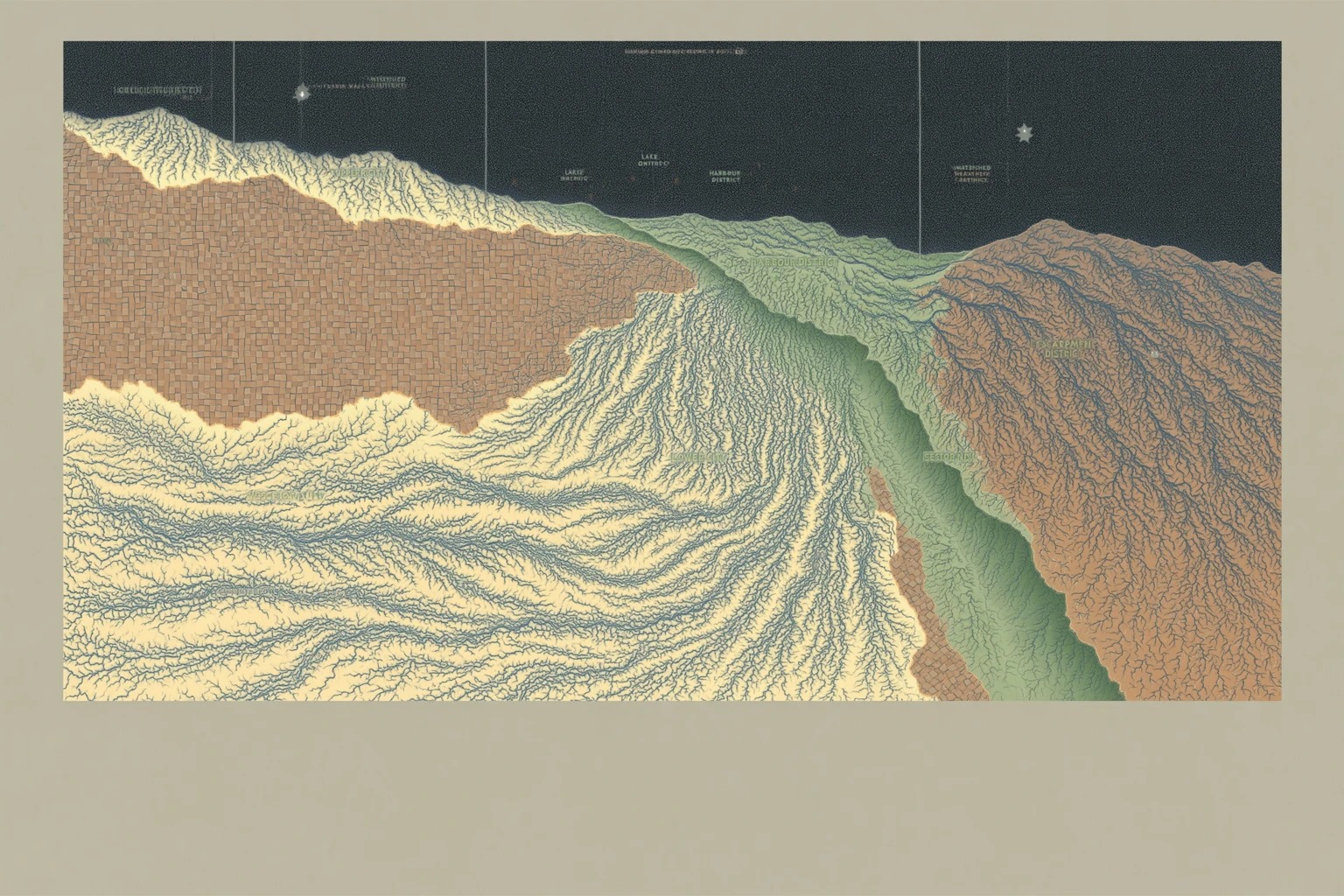
The Question
This manual is your guide to what became. But the question that built it remains:
Is there urban co-existence in a more-than-human city?
Can humans, animals, plants, ecosystems, and the intelligences we have grown share a home? Not as masters and servants. Not as exploiter and exploited. But as co-citizens?
This is the speculation you hold in your hands.
Read it. Walk the city. Ask the Orenda Network what it knows. Listen to the birds return to the Chimney Swift towers at dusk. Talk to Nia about how the MELA pod knows where you need to go. Sit with Elena Adeyemi while she studies the boundary between organic and artificial thought. Make something with Ravy from what others have thrown away.
The city responds to you.
You are not visiting it.
You are part of it.
“I came to the harbour with instruments. Sensors, spectrometers, dissolved-oxygen probes, the full rig. I thought precision meant numbers. An elder sat on the breakwall and watched me set everything up and said nothing for three hours. Then he pointed at the water and said: ‘There. You see?’ I didn’t see anything. He said: ‘That is the first lesson.’ I have been learning that lesson ever since. The city begins where your certainty ends.”


How to Read This
This manual is organized around the systems that structure daily life in Hamilton 2092. Each chapter addresses a different domain: transit, housing, civic participation, ecology, fabrication, and more. You will find field notes throughout, offering the perspectives of people who actually live here. You will also find practical step-by-step guidance alongside the context that explains why things work the way they do.
“When newcomers arrive at the harbour terminus with this book in their hands, I always say the same thing: read the field notes first. The systems will make sense eventually. But the field notes, the stories of people who actually live here, those will tell you what it feels like. And feeling is how you learn a city. Not by memorizing routes or protocols. By letting the place enter you.”
The Three Provotypes
Threaded through every chapter are three provotypes, provocative prototypes designed not as products to be used but as artifacts to be argued about. Each is powered by the Organic Intelligence (OI) layer that runs through the Orenda Network:
- The Multi-Lens: pattern-recognition eyewear that reveals the invisible systems of the city, nutrient flows, thermal gradients, ecological health, structural stress. The Multi-Lens makes the sentient city legible to the human eye.
- The Orenda Coil: the household interface unit for the Orenda Network, part ecological monitor, part civic participation terminal, part energy distribution node. It connects your Hearth to the living metabolism of the city.
- The OrgoBots: autonomous bio-fabricated organisms that remediate contaminated soil, repair infrastructure at the molecular level, and maintain the living systems that other technologies depend on. The OrgoBots are why Sector NM exists at all. They ate the poison and turned it into ground.
A note on language: This manual avoids the vocabulary of consumption and extraction. We do not “use” resources; we borrow them. We do not “own” property; we hold it in stewardship. We do not “manage” wildlife; we share territory. This is not mere semantic fussiness. Language shapes thought, and thought shapes action.


Turtle Island
Thesis II Project
generation
Provotype
not a prediction
+ appendix
knowledge keeper
What Kind of Book Is This?
This is not a prediction. It is not a utopia. It is not a report.
What you are reading is a speculative design provotype: a provocative prototype created to ask difficult questions about the kind of city Hamilton could become, and by extension, the kind of world we might choose to build. It functions simultaneously as a user manual, a design fiction, a manifesto, and a thesis. These are not contradictions. They are four faces of the same object.
As a user manual, it is written from the inside of a fictional future, addressed to you as a resident of Hamilton, Ontario in the year 2092. It describes the transit networks, the civic assemblies, the ecological systems, and the fabrication commons of a city that has been profoundly transformed over 66 years. The voice is matter-of-fact, instructional, and occasionally lyrical, the way a city guide is when it trusts that its reader already belongs to the place it describes.
As a design fiction, it uses the conventions of the city chronicle to make a speculative world feel real, inhabited, and specific. The year 2092 is not arbitrary: it sits within the seventh generation, the timeframe that Haudenosaunee governance philosophy asks decision-makers to consider when acting today. If a decision made now should serve people seven generations hence, then 2092 is within that horizon. The fiction is structured around that ethical commitment.
As a manifesto, it argues that Indigenous governance frameworks, ecological science, and community self-organization are not nostalgic or marginal positions. They are design principles capable of structuring a liveable city. Every system described in this project has a real-world analogue or precedent. The speculation is in the integration and the scale, not the components.
As a thesis, it was made at Sheridan College in 2026 as a Thesis II capstone project in the Bachelor of Design program. The work asks: what does it look like when a design student takes a 66-year timeframe seriously, not as science fiction, but as a design brief?
The Design Fiction Framework
Every page of this project is written in the voice of a city guide from 2092, addressed to a reader who lives there. This is the primary fiction contract: you are a resident, or a new arrival, and these chapters are your orientation to the systems of the city.
The four column zones reinforce this layering. The Primary Narrative (cols 2 to 3) maintains the fiction: it describes Hamilton 2092 as it is. The Resident Voices (cols 4 to 5) deepen it through first-person testimony from four named characters who live and work inside the city. The Right Margin (col 6) breaks the fourth wall quietly, with citations, sources, and real-world anchors that ground the fiction in research. The Left Margin (col 1) tracks the project’s own structure: chapter position, key facts, running heads.
You can read this project in any of three modes:
Fiction-first: Follow the primary narrative and the resident voices. Stay inside the world. Allow Hamilton 2092 to feel real. This is the intended reading experience for a first pass.
Research-first: Follow the right margin citations alongside the main text. Read the speculative claims against their sources. Interrogate the fiction’s assumptions. This is the intended reading for anyone who wants to trace the design decisions back to their evidence base.
Structure-first: Read the left margin data cards and annotation bars as a navigation layer. Use the chapter structure as a map of the city’s systems. This reading is for those who want to understand how the project is built before entering it.
Five Voices, One City
Four residents narrate this project. A fifth presence moves through it without speaking in the first person. Together, they cover the full terrain of Hamilton 2092: its land, its infrastructure, its governance, its fabrication, and its memory.
Nia Crosby
Urban farmer, West Harbour Grove steward, and cultivation coordinator for the Lower City food commons. Nia’s voice carries the texture of daily life: what it feels like to grow food in a post-industrial city, to manage a commons, to negotiate the slow rhythms of soil and season against the faster rhythms of civic demand. She is grounded, pragmatic, and occasionally fierce. Her chapter is Ecology (Ch. 6). Her field notes appear throughout the chapters wherever food, land, and embodied knowledge intersect.
Ravy Ryan
MELA systems engineer, Harbour Steward for the Waterfront Ward, and one of the city’s primary transit infrastructure voices. Ravy understands the city as a system of flows: people, energy, water, information. He speaks with the precision of someone who has spent years optimizing networks. He is meticulous, occasionally exhausted by complexity, and quietly devoted to the idea that infrastructure can be beautiful. His chapter is Transit (Ch. 3). The Elder’s Voice is his elder and teacher.
Elena Adeyemi
Civic archivist, Dish Protocol practitioner, and MELA Assembly chair for the Civic Center Ward. Elena’s domain is governance and institutional memory: the rooms where decisions are made, the documents that record them, the protocols that make consensus possible across difference. She carries the weight of the city’s history and its ongoing process of reconciliation. Her chapter is Civic (Ch. 5). She does not carry a provotype; her contribution is the governance infrastructure on which everything else runs.
Jem Her
Bio-computing technician, industrial archaeologist, and fabrication specialist based in the Chedoke Ravine Ward. Jem works at the intersection of living materials and computational systems: growing circuits, programming mycelium, salvaging the industrial past and remaking it into the biosynthetic future. Their voice is playful, technically dense, and preoccupied with the question of what things are made of and what they could become. Their chapter is Fabrication (Ch. 7).
Elder’s Voice
Haudenosaunee knowledge keeper, elder, and mentor to Ravy. The Elder’s Voice does not narrate in the first person. He is quoted, referenced, and invoked, but never the direct voice of a field note. He speaks in the book the way elders often speak: through stories that arrive when they are needed, not when requested. He is the land’s long memory. He carries the seven generations framework as lived practice, not political slogan. His presence threads through every chapter, most explicitly in the Introduction (Ch. 1) and the Appendix (Ch. 9).
A provotype is a provocative prototype, an artifact designed not primarily to be used, but to provoke reflection. Where a prototype asks “does this work?”, a provotype asks “what if this existed? What would it mean? What would have to be true for it to exist? What does it reveal about the present that we might otherwise miss?”
This project is a provotype. It is designed to feel real enough that you have to decide what to do with it. The design fiction works when you catch yourself taking the city seriously, when you find yourself wanting to know if West Harbour Grove has a good transit connection, or whether the Dish Protocol actually resolves the conflicts it claims to resolve. Those are the productive questions.
Speculative design uses design to explore possible futures rather than to solve immediate problems. It operates in the space between “what is” and “what could be,” not to make predictions, but to open conversations. The work asks: whose future is this? Who benefits? What assumptions are buried in the design? What has been erased to make the proposal seem clean?
This project operates in that tradition, with a specific commitment: the speculative world it proposes is accountable to Indigenous governance frameworks, to ecological science, and to the specific history of Hamilton, Ontario. The fiction does not float free of its ground.


How Fiction Is Marked
Throughout the project, the design fiction maintains its own internal consistency. Three conventions help you navigate the layers:
Field notes (shaded boxes with a narrator header) are always first-person resident testimony. They are fiction marked as fiction: you know these are speculative voices because the box and the header announce them.
Right-margin sidebar notes are always real-world references. When you see a citation or a methodology note in the right column, it is grounding the adjacent fiction in actual research, regardless of how the main text is framed.
Data cards in the left margin may be either fictional (city statistics from 2092) or real (dates, authorship, academic context). The label text distinguishes them: fictional data cards are labeled with in-world terms (“Population, 2092”); real data cards are labeled plainly (“Made In,” “Document Type”).
People ask me what the city feels like in 2092. I tell them: walk into the grove in June, when the elderflower is out. Walk through the food forest and feel the canopy close over you. Listen to the water moving in the rill channels. That is what the city feels like. Not the transit system. Not the Assemblies. The smell of warm loam in the morning. That’s what we built.
The Elder’s Voice told me something once that I have never been able to shake. He said: the question is never “can we build this?” The question is always “what will we be responsible for when we do?” I think about that every time we commission a new corridor. The system is not just transit. It is a promise to the watershed that we will not break it again.
The Dish Protocol is not a peace treaty. People misread it that way. It is a methodology, a structured process for making decisions under conditions of genuine disagreement. It does not dissolve conflict. It makes conflict legible and therefore workable. The city runs on conflict made workable. That is governance.
I grew up in the ruins of the industrial city. Literally. The building where our fab lab is now was a foundry casting yard. You can still see the pour marks in the concrete if you know where to look. I like that. I like knowing what the floor was made of before it was a floor. Everything you make carries what it was made from. That is not a problem to solve. It is the design.