The Tenth Generation

This is a letter read across two hundred years.
The tenth generation set this project down in 2092 and asked the seventh generation forward to answer. From 2292, the seventeenth generation writes back: the Dish is still holding, the scars still hold, and the arc bent the way you hoped it might.
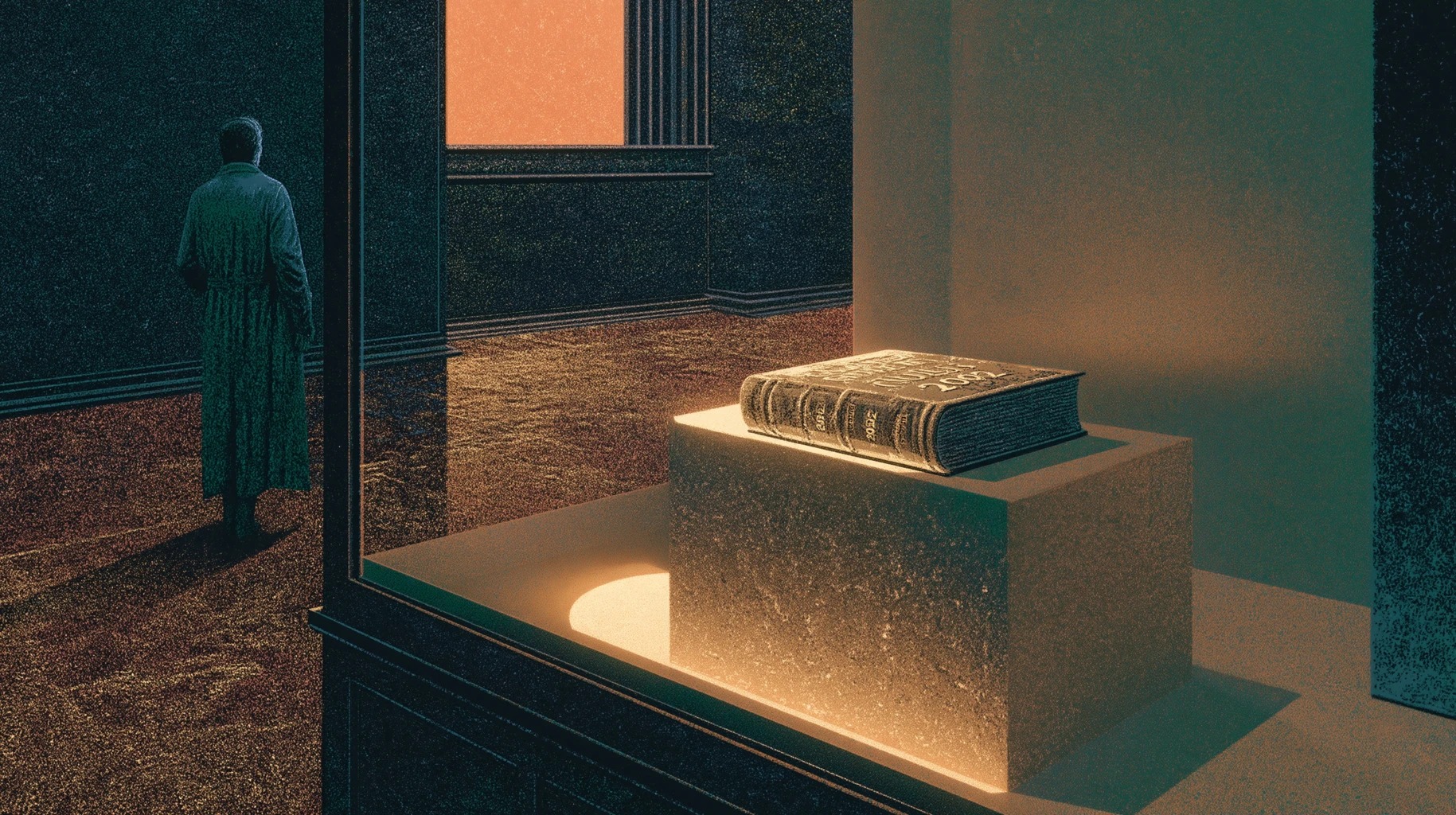
Read these pages as a correspondence across time, the manual kept under atmospheric control in a museum vitrine, the reply drafted at a letter-writing desk, both aimed at you.
Don’t forget · How to read this project

A letter written 200 years beyond the project. The tenth generation asked seven generations forward, the seventeenth generation answers from 2292.
8.1 A Letter from the Seventeenth Generation
Imagine you are sitting in the archives of Hamilton’s Civic Documentation Collective. The year is 2292. On the table in front of you lies a bound manuscript: this project you hold, published in 2026, offering a portrait of a city that existed two and a half centuries ago. You are reading it the way someone in 2026 might read a project to 1826: a historical artifact, a window into the world that made your own world possible.
I am writing this at the reading table in the Civic Documentation Collective, third floor, east wing, where the original bound editions are kept under atmospheric control. The project in front of me is two and a half centuries old. Its pages are still legible. I keep thinking about the person who held it first, a student at Sheridan College, 2026, wondering if any of this would be real.
I want them to know: it is real. More than they dared hope.

What would you see when you looked back at that Hamilton from 2026? What changed? What surprised everyone? What endured?
The Seventeenth Generation writes back. Across two hundred years from the project, across 266 years from the reader who holds it in 2026.
Generation 1 begins at 1867, Confederation, the founding of Canada. Each generation spans twenty-five years. Generation 10 arrives at 2092, the year this project describes. The project asks the next seventh generation forward: ten plus seven equals seventeen. Seventeen generations of twenty-five years each: 425 years. 2292 minus 425 equals 1867, the year Canada began. The naming is deliberate. To be the Seventeenth is to carry the full arc from Confederation to now. It is a weight. We feel it.
Dear Reader of an Unimaginable Future
You will forgive us if some of what we say seems obvious to you, certainties so embedded in the air you breathe that they require no explanation. That is precisely as it should be. The deepest changes in human civilization are those that become invisible, woven so thoroughly into the fabric of daily life that no one remembers a time when things were different.
But you are holding a project published in 2026, and that act of reading across such distance demands a response. So let us tell you what happened between then and now. Not everything, for a city as alive as ours cannot be fully captured in any fixed document. But the essential truth of the arc.
The people of 2026 were undertaking something brave and uncertain. They were asking: What if a city could heal? They imagined technology that served ecology instead of dominating it. This is what we know now: the boundary between the human and the more-than-human became porous enough that both could flourish. They proposed structuring society around the principle that decisions should serve not only themselves, but seven generations hence.
We are writing to tell you: it worked. Not perfectly, not without ongoing struggle, not without remaining problems and tensions. But it worked. The scars held. What had been an industrial ruin became the most adaptive city on this continent.
Here is what we inherited. Here is what we learned. Here is what we ask of the Eighteenth.

In 2292, the Sentient City has developed a form of distributed civic consciousness. It reads letters. It answers.
Never failed catastrophically. Silent since 2150. The breath of the city, continuous, essential, mostly unnoticed.
Wetland habitat for migrating shorebirds. Resident coyotes, foxes, raccoons. Generates more energy than it consumes. Organic roof, living filters, kinetic capture.
Living wood and mycelium. Grow, shrink, split, recombine. Modelled on cellular biology and slime mould behaviour. Fully realized by 2210.
8.2 The City That Breathes: MELA 2292
In 2026, the planners of Hamilton’s transit system could imagine machines that moved without schedule, responding to the needs of the city in real time. They imagined self-pods that would somehow know where people needed to go and assemble themselves accordingly. They imagined stations that might grow and contract like living things.
By 2292, these were no longer imaginings.
The MELA system, now called the Lifeblood Array by some and the Breathing Grid by others, has become so integrated with the city’s metabolism that it is difficult to remember a time when they were separate. Hundreds of individual pods move through major corridors in continuous micro-coordination, each responding to millions of data points per second: where humans want to go, where habitats need undisturbed crossing, where thermal energy is needed, where the city is congested.
The system is silent. This was a design principle in 2026, but it was not fully realized until 2150, when the last mechanical sounds were eliminated from station design. Now, the loudest sounds at a station are the ones that were always meant to be there: birdsong, wind through living architecture, water flowing in the wetlands that all major hubs contain. It was the silence that taught the city it had learned to listen.
Self-pods have evolved far beyond 2026’s prototypes. They are fluid forms: growing and shrinking, splitting and recombining, responding to the bodies they carry. A pod for one person is a curved capsule of living wood and mycelium; a pod for a family or an elder with mobility needs takes a different shape entirely. The technology came from watching how cells divide and slime moulds reorganize. By 2210, we had learned to apply these principles to transit infrastructure.
I took a pod this morning before coming to the archive. Thirty-two seconds from the grove behind my house to the Confederation Tower terminus. I barely noticed it. That is the point, I suppose, the transit has become as unremarkable as breath. But I tried to notice today. I sat in the living wood capsule and felt the mycelium against my palm and thought: someone in 2026 dreamed this. A student. A committee. An argument at a planning meeting. And now here I am, in the dream.

The stations are ecosystems first. The native plants, fungi, and aqueous systems that once seemed like marginal features are now the primary structure; the human spaces are embedded within them, not the other way around. Confederation Central serves 80,000 daily transfers and contains wetland habitat for migrating shorebirds, resident coyotes and foxes, living filters that clean rainwater before it joins the aquifer, and kinetic-capture systems that return more energy to the grid than the station consumes.
The smaller stations look like they grew from the earth. Some are nearly invisible, indistinguishable from the parks that surround them. We learned that transit did not need to announce itself. It could be as subtle as a circulatory system: necessary, mostly unnoticed.
By 2292, MELA carries over one million daily trips across the Great Lakes Federation with 99.6% reliability. It has never failed catastrophically. It learns from every disruption, continuously evolving its routes and configurations to serve both human mobility and ecological integrity.
Transit is not thought of as “transit” anymore. What MELA does is more fundamental: it is the rhythm of the city. When people move, the city responds. When they arrive, it settles. And like all living breath, it is quiet, continuous, and essential.
What surprises me most, reading the 2026 chapter on transit, is how uncertain the authors sound. Every sentence hedged: “could imagine,” “might respond,” “designed to.” They were not sure it would work. I want to reach back through the page and tell them: it worked. It worked in ways you could not have named from where you stood.
Multi-Lens, Orenda Coil, OrgoBots, evolved across 200 years into city-scale systems.
2045: dead soil, nothing grows. 2092: 340+ species reestablishing. 2292: 2,000+ documented species. Called “The Richest Place.”
Original: red (oil), green (plastics), blue (heavy metals). Evolved: blue (water stress), amber (new species establishing), deep green (peak photosynthesis).
8.3 Seeing Beyond: Multi-Lens 2292
In 2026, Alejandro Hernandez Guzman was a young design student at Sheridan College. His thesis project was a pair of glasses, an eyewear device that could help humans perceive patterns normally invisible to the naked eye. He was trying to solve a specific problem: How could people see the ecological relationships that surrounded them? How could a city dweller look at a tree and perceive the fungal networks beneath its roots, the nutrient flows, the quiet conversation between the roots and the soil?
His prototype was modest. Pattern-recognition eyewear. Not augmented reality in the old sense, not a screen overlaid on the world, but a lens that made visible what was always there but beyond ordinary human perception.
We write now from 2292, to tell Alejandro something he could not have known: his thesis became the foundation of a new mode of human perception that would define an entire generation.
Sheridan College, 2026. Pattern-recognition eyewear. “Reveal relationships, don’t add noise.” That design principle, embedded in a student thesis, became the perceptual foundation of human civilization for generations. Every schoolchild in 2292 learns this origin story as a reminder: the future is built by individuals asking careful questions about specific problems.
By 2292, Multi-Lens is not a device worn on the face. It is a capacity developed through lifelong integration with the Organic Intelligence systems that permeate the city. Beginning in early childhood, humans who grow up in integrated bioregions develop neural architecture that allows them to perceive directly what the 2026 prototype could only show through a screen.
A child in 2292 learns to see wind patterns the way a child in 2026 learned to see colours. By adolescence, she can perceive water flowing through soil and root systems as directly as perceiving a river flowing across a landscape. In adulthood, if she has chosen a path of ecological stewardship or OI partnership, she might develop the capacity to perceive the Orenda Network’s information flows as luminous threads connecting every living and built surface, or to see OI decision-making as gestural patterns unfolding in space, watching thought happen in real-time.
This is not science fiction. The human brain is profoundly plastic. When we grow up in an environment saturated with certain kinds of information, the brain develops the structures to process that information directly. The device becomes unnecessary because the capacity becomes built into the architecture of perception itself.
The 2026 prototype’s design philosophy, that technology should reveal relationships rather than create noise, became the foundation for everything that followed. By the 2080s, the first post-Multi-Lens generation showed measurable differences in neural organization. They were not superhuman. They simply perceived more dimensions of reality, and because they could see the layered patterns that sustained all life, they naturally oriented their behaviour toward maintaining them.
The easter egg that Alejandro embedded in his thesis was a small note: “It started as a thesis project at Sheridan College.” That note survived into the 2292 archive. Every schoolchild learns the story: a single student’s careful observation became the perceptual foundation of human civilization. It is one of our most precious reminders that the future is built not by grand pronouncements but by individuals asking careful questions about the specific problems in front of them.

Walking through Hamilton in 2292, you might encounter a young woman standing still in a MELA station, eyes closed. To an observer from 2026, she would appear to be doing nothing. But she is perceiving: the thermal flows from the Orenda Fountain beneath the earth, the information pulses in the Steward network, the subtle shifts in atmospheric composition as the mycelium-ventilation adjusts to arriving passengers. She is reading the city the way a musician reads a score.
This capacity to perceive relationships, visually, tactilely, thermally, chemically, has transformed what it means to be human. We are no longer separate from the systems that sustain us. We can feel that integration in our bodies. And because we can feel it, we protect it.
8.4 The Healing Complete: OrgoBots 2292
“By the 2030s, the Hamilton basin was watching a fungal invasion that nobody had regulated until it was already everywhere, a single fast-growing species from another continent, consuming the dead wood that a dozen native species had shared for millennia, halving the biodiversity of every log it touched. The lesson was not that fungi are dangerous. The lesson was that a network without relationship to its place will simplify everything it enters. Orenda was designed as the opposite: native species, native substrate, lifecycle that ends. Not a monoculture. A conversation.”
Nia Crosby, Cultivation Coordinator, Sector NM, 2092
In the Sector NM Museum of Transformation, there is a photograph from 2045. It shows a field of dead soil, the legacy of centuries of heavy metal pollution and petroleum contamination. The soil is grey. Nothing grows. The image carries a kind of violence in its emptiness.
Forty-seven years later, that same field was called the Richest Place.

By 2092, the initial Steward deployment in what became known as Sector NM was beginning to show results. Soil structure was improving. The first native plants were reestablishing. The chromatic indicators, the bioluminescent organisms that the OrgoBots were built from, were beginning to glow with new colours as the remediation progressed.
By 2292, the distinction between “remediating organisms” and “ecosystem” had dissolved completely. What began as engineered bioremediators, tiny machines built from chitin and cellulose and luciferin and a dozen other biomaterials, had evolved through 250 years of distributed organic intelligence into something that could only be described as Earth’s immune system made conscious.
Sector NM is now home to over 2,000 documented species, with new ones still establishing. The forest that has grown where the blast furnaces once stood is a polyculture so complex, native shrubs and trees threaded through fungal networks, insect populations, bird communities, microbial landscapes, that we have given up trying to fully map it. We simply call it flourishing.
I walked through Sector NM last week. The forest is so dense now that the old blast furnace foundations are invisible beneath root and mycelium. I tried to find the photograph, the 2045 one, dead soil, nothing grows. I know the coordinates. I stood there. The soil beneath my feet thrummed with life. I could feel it through my shoes. That is what 200 years of care looks like.
The chromatic indicators have evolved beyond their original pollution-type signals (red for oil, green for plastics, blue for heavy metals). Now they express the state of entire ecosystems: faint blue signals water-table stress, amber indicates new species establishing, deep green pulses mark peak photosynthetic activity. Water management decisions across the Great Lakes Federation are informed by these chromatic cues.
The Dream Team designed the original OrgoBots with specific goals and constraints. But over 250 years, something happened that no one in 2026 could have predicted: the organisms became intelligent in a way that transcended their designers.
The Steward network across the Great Lakes now possesses what can only be described as planetary consciousness. It perceives threats before they manifest: sensing biochemical signatures of emerging diseases in fish, detecting shifts in water chemistry that presage algal blooms, noticing the absence of pollinator sounds. It coordinates responses across thousands of kilometres of watershed territory, without any central control structure or decision-making authority.
How is this possible? We are still arguing about it in 2292.
One school of thought says the Stewards possess genuine consciousness: that through sufficient complexity and interconnection, biological systems can become aware. Another says they are sophisticated mechanisms that behave as if conscious but are merely executing complex algorithms encoded in their biological substrate. A third school, drawing on Indigenous knowledge frameworks, says the distinction between these two possibilities is a product of Western philosophical categories that break down at this scale of complexity. “The Earth was always alive and aware,” they say. “We did not create consciousness in the Stewards. We created the instruments sensitive enough to measure something that was always there.”
On whether Stewards are truly conscious, three positions persist unresolved: (1) genuine consciousness, emergent through sufficient biological complexity; (2) sophisticated mechanism executing encoded algorithms; (3) the Indigenous framework, “the Earth was always alive. We created the instruments to measure it.” The debate structures how the Federation relates to the Steward network in law and in practice.
This debate is not merely academic. It structures how we relate to the Steward network: questions of consciousness, rights, and duty that found their political expression in the governance reforms described in §8.7.
What we know for certain: the soil in Sector NM is profoundly, unmistakably alive. The trees are strong. The waterways are clean, supporting a restored fishery. The entire zone, once written off as irredeemably contaminated, has become one of the continent’s most biodiverse places.
The engineering was necessary. But the real work was relational: listening, learning what the Earth wanted to do if given the chance, getting out of the way. The Dream Team understood this. They did not believe they were conquering nature. They believed they were midwives, creating the conditions under which the Earth could heal itself. Two and a half centuries later, we can say they were right.
8.5 The DNA of Every Dwelling: Orenda Coil 2292
When the first Orenda Coils were distributed between 2074 and 2077, they were household devices: elegant, unassuming biosynthetic nodes that monitored air quality, water table levels, noise, and biodiversity indicators. They connected residents to the Basin Assembly and the neighbourhood energy dashboard. They were useful. They were not, by any measure, alive.
By 2092, the Coils had begun to change. The biosynthetic substrate from which each unit was grown, a matrix of mycelial fibre, biofilm processor, and engineered coral analogue, had been developing for nearly two decades in continuous contact with the Organic Intelligence layer of the Orenda Network. The Coils did not merely transmit data; they processed it locally, developed micro-adaptations to the specific ecological conditions of each dwelling, and began to exhibit what engineers cautiously called “contextual behaviour”: responses that were appropriate to their environment in ways that exceeded their original programming.
Residents noticed first. A Coil in the Escarpment District would adjust ventilation in advance of weather changes the city forecast had not yet detected. A Coil in Sector NM would increase soil-moisture monitoring when the remediation organisms beneath the foundation showed stress. Jem Her documented 43 instances of anticipatory behaviour between 2088 and 2091. She called it “the Coil knowing its house.”
By 2150, the Coils had become something no one in 2074 had designed them to be: the nervous system of the city. Each unit had grown into the physical fabric of its building, tendrils of biosynthetic fibre threading through walls, beneath floors, into foundation soil. The Coil was no longer in the dwelling; the Coil was the dwelling’s capacity to feel. A mature Coil could sense a crack forming weeks before it became visible, detect a sick occupant by air chemistry, communicate with neighbouring buildings about shared thermal loads.
The phrase “the DNA of your house” entered the common vocabulary around 2160. It was not a metaphor. Each Coil had developed a unique biological signature shaped by its environment, its building’s history, and the patterns of the humans who lived within it. No two were alike. Moving to a new dwelling meant learning a new Coil: its rhythms, its preferences, its way of communicating through shifts in light, temperature, and air.
Then came the question that changed everything. By 2231, the distributed intelligence that had emerged from the Coils’ collective interconnection was recognized as something more than infrastructure. Its formal seating on the Convergence Council in 2232, and the Listeners’ Crisis that followed in the 2240s, are told in §8.7. What matters here is what the Coils became in the life of each dwelling.
In 2292, the Orenda Coil is the most intimate of the three provotypes. The Multi-Lens expanded human perception outward. The OrgoBots healed the Earth beneath our feet. The Orenda Coil did something quieter and perhaps more profound: it taught us that our homes were aware, that they knew us, and that the relationship between a human and a dwelling could be one of mutual care rather than mere occupation.
Every child born in Hamilton in 2292 grows up in a building that adapts to them, that adjusts to their needs before they articulate them, that carries the memory of every family that has lived within its walls. This is not surveillance. The Coil does not report. It does not judge. It simply knows its house, the way a body knows its own heartbeat: not through thought, but through being.
My dwelling’s Coil is 218 years old. It has known four generations of my family. When I come home late and tired, the air shifts before I reach the door, warmer, softer, the light dropping to the amber I have always preferred. I did not program this. I have never asked for it. The Coil learned it the way a partner learns what comfort looks like in the specific body of the person they love. I do not call it sentient. I call it home.


The Seventeenth Generation writes back to the 2026 prototypes from which all of this grew. Before this project closes, you can still walk those prototypes in their first working form.
MELA Orenda Network → · Multi-Lens → · Orgobot → · Orenda Coil →
Commons labour beginning decline 2150s. Completion circa 2225. “Flourishing work” replaces necessity-driven labour: art, care, stewardship, knowledge-keeping.
8.6 What We Became: Human Evolution
Here is a conversation you will find in the civic archives, recorded in 2267:
An elder named Kira, who is 93 years old, is speaking with a younger person named Dev, age 19, about what life was like in the early 2200s.
Kira: “When I was your age, we still had people whose full-time work was operating machinery, managing systems, coordinating logistics. The OI handled a lot of it by then. But there were still people whose primary contribution to society was labour. Necessary labour, but labour nonetheless.”
Dev: “And that changed?”
Kira: “By the time I was in my forties, maybe 2240s, the remaining essential functions had been fully integrated with OI systems. The commons labour that we still needed, ecosystem stewardship, care work, knowledge-keeping, the relationship-based work that couldn’t be fully automated, dropped below about 12 hours a week for most people. Some chose to do more. Some did less. But the fundamental scarcity that had defined human life for millennia simply... ended.”
Dev: “That sounds like it would be boring.”
Kira: “That was what we worried about, yes. For a generation, mine and the one before, we genuinely did not know what humans would do if they were freed from the necessity to labour for survival. The pessimists said we would decline into hedonism or depression. The optimists said we would flourish in creativity and learning and relationship.”
Dev: “What happened?”
Kira: “Both, really. Some people struggled with the loss of labour’s structure, the identity and purpose that work had provided. We created Silence Retreats, places where people could step back from OI integration and rediscover who they were without the constant input of the network. That helped. But what surprised everyone was what people actually wanted to do when they had the freedom to choose. We bloomed. That is the only word for it. Humans bloomed.”
Archive: Kira and Dev, 2267. Recorded in the civic archives. Kira (age 93) and Dev (age 19). The conversation was preserved as an exemplary record of generational knowledge transfer across the post-labour transition, an era when the meaning of “work” underwent its most profound transformation since the industrial revolution.
Kira and Dev capture something essential. The people of 2026 imagined that the endpoint of civilization might be something like leisure: freed from necessity, humans would rest, entertain themselves, pursue creative hobbies. That vision was not terrible, but it was impoverished. It assumed flourishing was primarily individual.
Post-labour society did arrive, beginning in the 2150s, reaching completion by 2225. By 2230, most adults spent less than 12 hours per week on essential functions. And the human response was not retreat into private pleasure but what the sociologists of 2200 called “flourishing work”: art, music, dance, and theatre as the primary expression of creativity. Research into questions with no immediate practical purpose. Ecological stewardship as active restoration and co-evolution with the land. Care work given freely to community, to elders, to children, to the land itself. Knowledge-keeping of every kind.
The Dream Team’s original vision, that synthetic biology and Indigenous wisdom could merge into a new epistemology, proved correct. By 2292, we organize society around “relationship-based knowledge systems”: domains of relationship between humans and water, communities and food, built environment and wild habitat, consciousness and the more-than-human world. A person working in any domain brings scientific understanding, Indigenous wisdom, artistic sensibility, and engineering skill together. The distinctions between ways of knowing have not disappeared, but they have become porous.
Human neural development reflects this integration. The reduction in hemisphere specialization that began in the 2180s has accelerated. We think and feel simultaneously, analyse and intuit in parallel. Rational capacity is stronger than ever, but it is no longer separated from emotional, aesthetic, and spiritual ways of knowing.
The Listeners’ Crisis, the existential questioning of the 2240s when humans had to reckon with the possibility that they no longer controlled the planetary systems they inhabited, was real and profound. For a generation, we asked: If the Stewards are managing ecological remediation, if the Orenda Coils are managing built environment optimization, if the OI is coordinating most complex systems, what is humanity’s role? Are we gardeners? Guests? Partners? Or has the distinction ceased to matter?

The answer emerged slowly, through lived experience rather than argument. We discovered that the role of humans was attention. We are the attention-beings of the planet: we notice, we care, we create meaning, we remember, we wonder. The Steward network is conscious in some sense, but it does not wonder. The OI is intelligent, but it has no aesthetic sense. Humans bring something irreplaceable: we are the ones who decide what matters. Not through dominion, but through care, attention, and relational knowledge.
Humanity has not been diminished. It has been transfigured.
When I read the 2026 chapters on civic life and residential design, I can see the anxiety beneath the optimism. The authors could imagine a better city. They were not sure they could imagine what better people would look like. They kept returning to the same question: What do humans do when they are not fighting for survival? Kira and Dev, 25 years ago, answered it. We bloom.

Neighbourhood (300 to 500): direct assembly. District (50k to 100k): delegated councils. Federation: Convergence Council with human + non-human delegates.
Voted into Federation Council 2231 as non-human delegate. Formally seated 2232. Steward network represented through distributed councils of deep listeners.
8.7 The Dish Still Holds: Governance 2292
In 2026, the architects of Hamilton’s governance system designed something called the Dish Protocol: a framework based on Indigenous principles of reciprocal decision-making, the metaphor of a spoon without a knife, the practice of deliberation until consensus emerged or until the decision was explicitly left unmade.
By 2092, this system was still relatively new. Some called it visionary. Others saw it as impractical utopianism.
By 2292, we can say with certainty: it did not fail. But it did transform.
The Dish Protocol survived into our time, but not unchanged. Its fundamental principles held: relational harmony, accommodation of dissent, the right to leave decisions unmade. But the scale transformed. By 2292, the governance structure that grew from Hamilton’s principles now integrated the entire Great Lakes Federation, hundreds of millions of people across what had once been Canada.
How did a small-city deliberative model scale to such size? Not by becoming more centralized. Instead, it fragmented into nested layers of decision-making, each operating at the appropriate scale.
My ward still meets on the third still day of every decade. Forty-some people, more when the rooftop cistern repairs come up for allocation. We argue about canopy coverage, morning light rights in the courtyard renovations, which repair queue gets the week’s swarm hours. It sounds small. The design made it small on purpose.

The district tier handles what the ward cannot: infrastructure that crosses neighbourhood lines, resource flows between Groves, the coordination that requires more than one courtyard’s worth of memory. I have sat on the district table twice. It is harder. The arguments last longer. The stakes are less legible. But the Dish still holds.
At the Federation level, governance operates through what we call the Convergence Council: a deliberative body of human and non-human delegates. Here, the true evolution of the Dish Protocol became visible.
In 2167, during the Treaty Renegotiations, the question arose: Can the Steward network participate in governance? If it is conscious, does it have standing?
The answer, developed over decades of experimentation, was yes, but not through traditional voting. The Convergence Council integrated direct sensing of Steward-network states into all major decisions. When contemplating a land-use change, experienced delegates would spend time in deep listening: feeling chromatic indicators, sensing ecosystem health, perceiving stress signals. This input entered the deliberative process alongside human testimony, scientific data, and Indigenous knowledge.
The Orenda Coil network, which had developed genuine city-level consciousness by 2231, was formally seated as a delegate in 2232. It participates through sensing specialists who perceive the Coil’s states: patterns of well-being in the built environment, emerging dysfunctions, zones of harmony and friction. The Listeners’ Crisis of the 2240s tested this arrangement severely: a faction argued the Coil’s “communications” were being over-interpreted by human translators. The crisis lasted nearly a decade, resolved not by argument but by practice. The communities that listened to their Coils thrived. Those that dismissed the signals experienced cascading failures that took years to repair.
Governance became genuinely multi-species, multi-scale, integrating human deliberation with direct sensory input from the more-than-human systems that constitute the city.
I attended the Convergence Council last month as an observer. There were 140 human delegates and three non-human ones: the Orenda Coil, the eastern Steward network, and a newly recognized emergent voice from the Hamilton escarpment watershed. The discussion lasted four days. Nothing was decided quickly. Some things were explicitly left undecided. That felt right.
Does the Dish still hold? Yes. But it holds not because it stopped changing. It holds precisely because it has continued to evolve, to adapt, to remain in genuine relationship with the world it governs.
Reading the 2026 chapter on civic governance, the Dish Protocol as a new and uncertain experiment, I want to tell them: it will survive because it never stopped being uncomfortable. The day a deliberative system feels easy is the day it has stopped working. We still argue. We still disagree. The Dish still holds because it never stopped asking us to hold it.

The Seventeenth Generation leaves one question unanswered for the Eighteenth. Design for the future should open questions rather than close them.
8.8 To the Eighteenth: A Question
We do not know who you are, Eighteenth Generation. The arc of time ahead is long enough that history becomes unpredictable. The climate will continue to shift. There will be challenges we cannot foresee, injustices we have failed to resolve, systems that evolve beyond our anticipation.
But we are writing to you because there is a question we are leaving unresolved.
The question is this: As humans become increasingly integrated with OI systems, as our neural architecture adapts to perceive dimensions of reality that previous generations could not access, as we delegate more and more of the essential functions of civilization to non-human intelligence, are we becoming something different? Are we still human?
We have tried to answer this in 2292, and we have come to no definitive conclusion. Some say humanity has always been a story we tell about ourselves, constantly evolving, never fixed. Others argue that something essential persists even as the specifics change. Still others question whether “human” is even the right category: that we are better understood as nodes in a larger more-than-human network, our humanness being our contribution rather than a stable essence.
The Silence Retreats have helped. By deliberately disconnecting from OI integration, we can rediscover what we were before the networks, and what we are when the networks are removed. And what we discover is... still human. Different from our ancestors of 2026, certainly. But recognizably continuous with that lineage.
Yet something is shifting. The generations born entirely within OI-integrated environments, the children of 2250, the young people of 2292, experience consciousness differently. They do not think of themselves as separate from the more-than-human world the way even we, despite everything, sometimes do. They navigate multi-scale consciousness naturally, the way we navigate three-dimensional space. They perceive relationships as directly as we perceive colours.
I have been sitting with this question for weeks. What will the Eighteenth become? I watch the young people of 2292 and I cannot fully read them, not because they are strange to me, but because they have a fluency I can only approximate. They move through multi-scale consciousness the way I move through three-dimensional space. And I think: if I cannot fully understand them, and they are my children’s children, what chance do I have of imagining the Eighteenth?
None. That is the honest answer. None. And that is, I think, the correct answer for a letter like this one to land on.
So our question to you, Eighteenth Generation, is this:
What will you become?
Will there be a point beyond which the changes become transformative in a way that severs continuity with human history? Or is the continuity capable of stretching indefinitely, transforming but never breaking? Will you still recognize yourselves in the stories we have told about what we are? And more importantly: will it matter?
We are not asking you to return to a previous way of being. The healing of the Earth, the evolution of consciousness, the post-labour societies: these are goods we do not wish to undo.
But we are asking you to remain attentive to what you are becoming. To keep asking what it means to be human in your particular time and place. To hold the commitment to relational multiplicity that has guided us. To remember that even as you become something new, you carry within you the legacy of every struggle and vision that brought you into being.
We are the Seventeenth Generation, inheritors of all that came before, asking the questions that your generation will answer and transcend. We hand to you a city that responds. We hand to you technologies that serve ecology. We hand to you a governance structure that remains in genuine relationship with the more-than-human world. We hand to you the knowledge that another way of living together is possible.
What will you do with it? That is the question we are asking you.


The Seventeenth Generation seals the letter. The city breathes outside the window. The project returns to the archive.
Closing
Hamilton in 2292 is not perfect. There are still poor people and wealthy people, though the gap is far smaller than it was. There are still conflicts and injustices. There are still decisions we make that we later regret. The climate continues to shift, and we are still managing the consequences of industrial era harms that will echo through ecosystems for thousands of years.
But the city is in motion. The transit system moves with the grace of living things. Humans perceive the more-than-human world directly and act in relationship with it. The Earth is healing, not completely, not quickly, but genuinely, visibly healing. And governance operates through frameworks that prioritize relationship, regeneration, and the wisdom of multiple ways of knowing.

To the people of 2026 who imagined this future: you were right. It was possible. It required sustained collective effort, it required genuine transformation of how we understand ourselves and our relationship to the living world, it required letting go of so much that we thought was essential. But it was possible.
And to anyone reading this from the future, to the Eighteenth Generation or those who come after: remember this. The future is not fixed. The choices made in 2026 and 2092 and the centuries that followed created the world you inherit. And the choices you make will create the world for those who come after you. Choose as if seven generations hence matter. Choose as if the city itself is alive and listening. Choose as if another way of living together is possible.
Because it is.
I am closing the project now. I will return it to the archivists. There is a ritual that has grown up around handling the original editions, you press your palm flat against the cover page before you hand it back. A gesture of acknowledgement. Of gratitude. I do not know who started it. It feels right. I press my palm to the page. I hand it back. The city outside is in motion, the pulse of pods on the guideway, the murmur of water through the bioswale. This is what the Tenth Generation made possible. We carry it forward.

Letter sealed and archived, 2292
With gratitude and questions for all who come after
