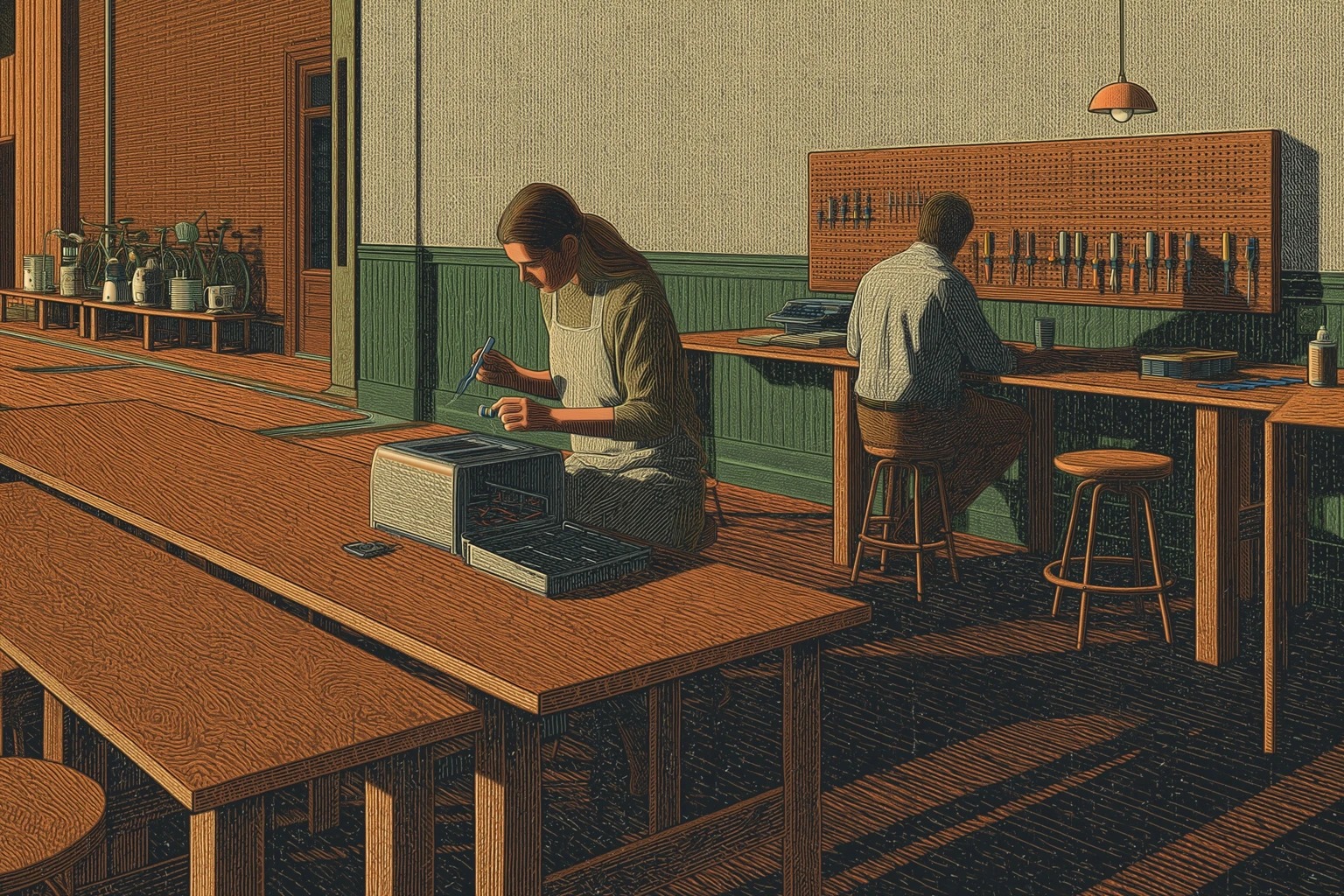
Fabrication

Everything here was either salvaged, inherited, or built.
Hamilton 2092 is a city of makers. The factories are gone; the workshops are everywhere. Fabrication is a civic act: tools belong to everyone, repair is how you love a thing, and the work of making holds the commons together.
Don't forget · How to read this project

Universal tool access, circular material flows, dignity of creative labour. Every citizen has the right to make.
“Everything in this lab was either salvaged, inherited, or built. The distinction matters less than you’d think.”
Jem Her, Bio-Computing Lab, Chedoke Ravine Ward
6.1 The Culture of Making
In Hamilton 2092, you do not simply consume. You make. You mend. You transform. The fabrication commons are not factories in the old sense: not places of alienated labour and mass production, but workshops of collective creativity, where the means of production belong to everyone and the products of labour serve the community.
The fabrication philosophy rests on three pillars: universal access to tools and knowledge, circular material flows, and the dignity of creative labour. Everyone has the right to make. Everything that can be repaired, is. The work of fabrication is understood not as drudgery to be minimized but as a meaningful contribution to collective life.
The Toaster Repaired Forty-Seven Times
7:15 AM. I wake to mycelium smell, an actual petri dish fruiting on my nightstand. I lie watching light through the loft window, listening to the ravine sounds, the faint hum of the SynthBee colony in the chamber below.
The first thing I do most mornings is make toast. The toaster is the oldest working object in my lab. It was made in 2034. It has been repaired forty-seven times. This is not a remarkable toaster. It was mass-produced in a factory that no longer exists. But it was my mother’s. Sarah brought it home the year I was born, and it has been in continuous use since.
The toaster has a repair log. Forty-seven entries, each dated, each noting the problem, the repair, the person who helped. A record of relationship. A document of care. Every entry carries a smell for me, David’s soldering flux, Ravy’s machine oil, the lavender hand cream Nia always wears when she visits the lab.
There was a moment, repair thirty-nine, when I almost replaced it. Nia was in the lab that day and she said: “If you replace it, what happens to the record?” She was right. The record is the toaster’s true material. The bread is almost incidental. The whole neighbourhood gathered for its fortieth repair anniversary. We made toast. It was not very good toast. Nobody cared.


Materials recovered or reused in the Hamilton commons economy. Less than 0.3% reaches terminal waste.
6.2 The Circular Economy
6.2.1 From Linear to Circular
Hamilton 2092 operates on a circular model: materials circulate through the economy, being used and reused, transformed and retransformed, maintaining their value indefinitely. Technical nutrients circulate through industrial loops. Biological nutrients circulate through composting and soil. Hybrid materials separate cleanly at end-of-life. The legacy plastic still buried from the twentieth century is worked through by the Plastic Degrader (Ideonella plasticus), an engineered bacterium that colonises old landfills and waste streams and breaks synthetic polymers down into biomass and inert minerals; each deployment is monitored for generations, the metabolism engineered to self-limit at the end of a contamination event, but trust is built through verification.


6.2.2 Material Tracking
Every manufactured object carries a material passport: a digital record of its composition, provenance, and history. When you pick up an object, you can scan it to learn what it contains, where it came from, how to repair it, and where to return it.
On Passports and Provenance
I hold the scanner to the leg of a broken stool someone left at the node this morning. The passport comes up: grown timber, Dundas Valley woodlot, 2078. Fasteners, salvaged stainless, former Dofasco site, 2051. Adhesive, mycelium-based, Nia’s lab, batch 7, 2083. Three lives already folded into this object before it arrives in my hands.
What strikes me every time is the intimacy of it. These are not abstractions. The woodlot is twenty minutes up the escarpment. I know the composition of batch 7 because I helped test it. The provenance chain is also a map of relationships. Every material passport is a social document as much as a technical one.
The stool leg is cracked at the joint, a clean failure, easy to fix. I rebond it with fresh mycelium adhesive and clamp it to cure overnight. Tomorrow it will be stronger than it was. The passport gets a new entry: repair, 2092, Jem Her, Chedoke Ravine Node. Another line in the record. Another person in the chain.

6.2.3 The Five Hierarchies
First: Reuse. If functional, pass it along. Second: Repair. If broken, fix it. Third: Remanufacture. Recover components. Fourth: Recycling. Recover materials. Fifth: Biological return. Compost what remains, a weekly rather than monthly rhythm since 2067, when the thermophilic Compost Accelerator (Thermobacter rapidus) was deployed at scale across every Grove composting node. The bacterium works organic waste four times faster than conventional strains and then self-limits as temperatures cool, so a finished heap is always safe to handle by hand. Only when all five hierarchies are exhausted does anything become “waste”, and that almost never happens.

6.2.4 The Material Commons
Materials are held in common. When you need materials for a project, you request them from the Material Commons. Allocation is based on availability, with priority for collective needs or exceptional creativity. Every project is an exercise in creative constraint.

All products in Hamilton 2092 must provide spare parts and repair documentation for a minimum of 50 years after manufacture.
6.3 Repair Culture
6.3.1 The Right to Repair
All products must be designed for disassembly, with standardized fasteners, modular components, and publicly available documentation. Spare parts required for a minimum of fifty years. Enforced by the Repair Council and the Repair Database.
6.3.2 The Repair Café Movement
Bring your broken item. Sit with a volunteer repair coach. Work together. The coach does not fix it for you; they guide you through the process. Repair cafés in every neighbourhood. Free to use.
Teaching at the Repair Café
Thursday afternoons I run the repair café at the Chedoke node. People arrive with kettles, lamps, bikes, headphones, a child’s music box that belonged to a grandmother. I never fix anything. I sit beside the person who owns the broken thing and ask questions until they find the answer themselves.
The hardest part for most people is touching the inside of something. There’s a learned helplessness, decades of objects designed to resist opening, warranties voided by curiosity. The first time someone removes a back panel and peers inside, I watch their whole posture change. The object becomes legible. It stops being magic and becomes craft.
An older man named Octavio brought in a radio last month. His late partner had listened to it every morning for thirty years. He wasn’t sure he wanted it fixed, he just couldn’t throw it away. We spent two hours cleaning the contacts and replacing a capacitor the size of a fingernail. When it came back on, he started crying. I pretended to be very busy with my soldering iron.
That radio wasn’t the only thing that got repaired that afternoon.

6.3.3 Repair as Resistance
Every item repaired is a small refusal, not of progress, but of the idea that things exist only to be replaced.

Fabrication commons across Hamilton’s seven districts, from micro-studios to full industrial remanufacturing floors.
6.4 Fabrication Commons
Tool Libraries
Tool libraries operate on the same model as book libraries. Starting in the 2030s, the system expanded into a comprehensive network. A typical library holds thousands of items: hand tools, power tools, garden tools, kitchen equipment, electronics, textiles, specialized equipment, and bioelectric tools, all available for community use.
Community Fabrication Nodes
Neighbourhood nodes serve a few hundred households. District nodes offer CNC (Computer Numerical Control) cutting and milling, 3D printing, and laser cutting. City nodes house industrial-scale equipment. Specialized nodes like the Chedoke Ravine Bio-Computing Node focus on particular domains.
The most important product of a fabrication node is the community that forms within it.
“Three years ago, I started building a dining table at the Westside Fabrication Node. By the end, I had a table and a community.”
The Node at 10 PM
The fabrication node is never quite empty. Even late, someone is using the laser cutter or the textile looms, their work lit amber against the dark windows. I find the night shifts meditative, the background hum of machines, the smell of cut wood and warm electronics, the occasional sound of someone quietly cursing a measurement gone wrong.
Kairo was here until midnight last week, building a sensor housing for the ravine monitoring project. Sixteen years old. Came in knowing nothing about CNC. Six months later, he’s teaching the introduction workshop. I watch the knowledge move sideways through the node, person to person, never down from authority.
The bench I use was built in 2041 by someone I never met, from timber salvaged from a demolished school. It is solid, level, faintly scarred by sixty years of use. I think of the hands that have worked at it. I think of the hands that haven’t arrived yet. A fabrication node is an act of faith across generations.

What We Make
Almost everything: furniture, housing components, tools, textiles, electronics, art, infrastructure. The default is local production. Design principles are durability, repairability, adaptability, disassemblability, and beauty. These are enforced by culture, not regulation. Even waste stock becomes stock; the Sulfur Shelf Fungus (Laetiporus hamiltonii) is cultivated in the Sector NM fabrication yards on decommissioned industrial pallets and construction debris, breaking down chemical preservatives while producing bright chrome-yellow fruiting bodies rich in selenium, a staple food source and a waste processor in the same organism.

“When I have only what the Commons has in surplus, some recycled aluminum, some mycelium composite, some glass from demolished buildings, I am forced to think more deeply about what I am making and why. The constraint becomes a prompt.”
Digital fabrication is complementary to manual work. Making skills are taught through curricula, node classes, apprenticeships, and peer learning.
Why make? Autonomy, quality, learning, relationship, community, joy.

Distributed bio-fabrication swarms across the Chedoke and Dundas corridors. Each colony produces 12 to 18 kg of biomaterial per season.
Conventional soil remediation baseline. At Stelco scale: billions of dollars, 50 to 100+ years. OrgoBots are the speculative answer to an otherwise-impossible timeline.
Engineered from native bumblebee stock via guided evolution. Produces structural biopolymer instead of honey. Patrols cultivation chambers, detecting contamination events hours before conventional instruments. Monitors pollen quality, pathogens, humidity, and air chemistry. 340+ colonies across the Chedoke and Dundas corridors; each produces 12 to 18 kg of biomaterial per season. See also Chapter 6: Ecology.
6.5 Biological Fabrication
6.5.1 Mycelium Materials
Nia Crosby owns this domain. Mycelium, the root-like network of fungi, can be grown into almost any shape. Nia has spent a decade working with MycoHamiltonia strains: denser substrates yield structural panels for MELA (Magnetic Elevated Loop Array) construction; looser substrates produce insulation; controlled fruiting produces leather-like material.
Mycelium is used for packaging, building materials, furniture, textiles, insulation, and paper, including the paper on which the Compact Invitation Letter was printed.
6.5.2 Living Materials
RepairBacter (Bacillus reparans) maintains concrete infrastructure continuously, detecting micro-cracks and secreting a mineral cement to fill them before a crack can spread. The SynthBee (Apis synthetica), engineered from native bumblebee stock, patrols cultivation chambers, detecting contamination events hours before conventional instruments, and produces structural biopolymer in place of honey. Beneath the street, the Glow Worm (Lampyris hamiltonii) lives symbiotically within the Luminous Root-Weave, feeding on decaying organic matter and adding its own soft cyan bioluminescence to the underground light displays the city rests on; a small annual wild-caught quota is harvested for luciferase enzymes that bind and illuminate specific proteins, making this quiet worm a contributor to every diagnostic lab in the bioregion.

Colony Check, 6 AM
The SynthBee chamber smells like warm wax and something I can only describe as green, a living, photosynthetic green, even though there’s no photosynthesis happening. It’s the biopolymer precursors outgassing gently from the comb structure. I have worked in this room nearly every day for four years and the smell still stops me at the door.
I pull up the overnight log on the wall panel. Colony 7 is producing at 14.3 kg projected for the season, within range. Colony 12 flagged a humidity spike at 3 AM; I adjust the ventilation and make a note to check the condensation baffles. The bees themselves are active, moving in the slow, deliberate patterns that indicate healthy foraging cycles within the chamber.
These are not natural organisms. I know that. They were engineered from native bumblebee stock over twenty years of iterative guided evolution, my mother’s lab contributed two of the early stability runs. I carry some responsibility for what they are. I try not to forget that. I check on them every morning like family, which is also not an accident.
The biopolymer they produce sets harder than conventional thermoplastics and degrades fully in soil within eighteen months. We use it for joint connectors, panel clips, sensor housings, the small structural nodes that hold the city together at its most granular scale. Every morning I think: the city is partly held up by these small beings who make without being asked.

6.5.3 OrgoBots: Distributed Repair Swarms
The OrgoBots are autonomous bio-fabricated organisms that remediate contaminated soil, repair infrastructure at the molecular level, and maintain the living systems that the city’s other technologies depend on. First piloted in Sector NM (North Mountain district) in 2045, the OrgoBots broke down petroleum compounds and sequestered heavy metals across the former Stelco lands at rates that conventional bioremediation could not approach. Without them, Sector NM would still be a brownfield. Without them, the Grove courtyards that grow from that soil would not exist. The 2053 Hurricane Mera compound event, which included the collapse of a 1910s-era combined sewage main under the old Stelco frontage, accelerated their city-wide authorization. See also Chapter 6: Ecology.
OrgoBots are coordinated by the OI (Organic Intelligence) layer of the Orenda Network. Each swarm receives real-time soil chemistry data from the Steward network and adjusts its remediation behaviour accordingly, concentrating on hot spots, withdrawing from areas approaching safe thresholds, and reporting progress to the relevant Grove council. They are, in the most literal sense, the city repairing itself.
Alongside the swarm, bioreactor facilities across the city run Remediation Yeast (Saccharomyces purificans), which polishes industrial wastewater by breaking down organic pollutants and produces ethanol and nutritional yeast as byproducts. The nutritional yeast is collected for human and livestock use; the ethanol fuels the city’s remaining combustion applications. Nothing is wasted on either side of the process.

Turkey Tail (Trametes versicolor) has been fanning out on dead hardwood in the Dundas Valley for as long as hardwood has fallen here. Its white-rot chemistry, laccase and peroxidase, the enzyme families that cleave lignin, incidentally breaks the same aromatic bonds as the PAHs a century and a half of coke production left in the harbour’s North End soils. The OrgoBots are the engineered amplification of that slow fungal accounting: the same enzyme logic, scaled up, coordinated across a swarm, and routed by the OI layer of the Orenda Network.
“Watch Turkey Tail work on a dead log. It is the same conversation, at different speeds.”
Direct a swarm. Tune mycelial repair density, watch the bots regrow pipe and filter tissue at contamination sites, and print the city’s underground infrastructure one enzyme-cleaved bond at a time.
Open the lab →
6.5.4 OrgoBots as Hamilton’s Universal Bio-Fabrication Platform
The OrgoBots’ second job reshaped the city’s material infrastructure. Every orgobot’s nutrient output during its Phase 3 working life is, effectively, printed mycelium. The swarm is a distributed 3D printer, and what it prints is fungal tissue whose density can be tuned by adjusting the OI-routed chemistry of each release. Low-density printed mycelium is soft and porous. High-density is rigid and water-tight. By the 2060s, MELA’s cultivation teams had learned to specify a density profile by adjusting OI routing parameters, and the swarm would deliver it over weeks by tuning the chemistry at each node.
The Mera sewage main: regrown, not repaired. When Hurricane Mera collapsed the 1910s-era combined sewage main under the old Stelco frontage in 2053, the emergency-deployed orgobot swarm broke down the legacy industrial load that spilled from the collapsed pipe and simultaneously regrew the pipe itself, tuned to high-density, water-tight printed mycelium along the length of the void. What filled the collapse was not a repaired pipe but a new living one, grown in place. It self-sealed as it grew and continued to thicken as the surrounding substrate matured. Forty years later, the “pipe” running under the Stelco frontage routes water through its own hyphal channels and heals itself when stressed. By the 2060s, MELA had formalized this into a standard protocol: wherever a legacy utility pipe fails, deploy a swarm to regrow it. Sector NM’s entire underground water infrastructure by 2092 is orgobot-printed, not a single metre of rigid pipe in the whole district.
Nanometre-scale water filtration. Deposited in sheets over catchment surfaces, low-density printed mycelium filters particulates, toxins, and pathogens at the nanometre scale. The hyphal pore geometry can be tuned during the print process to an exact size, and the enzymatic chemistry of the tissue itself breaks down what the pores catch. Every rooftop cistern in Hamilton by 2092 has an orgobot-printed filter layer at its intake. Every grey-water recycling loop in a Grove residence runs through a printed filter bed. The filters are alive, they heal themselves when damaged, and they hand off cleaned output directly into the next layer of Orenda substrate growing beneath them.
The fabrication chapter’s quiet thesis. Everything Hamilton builds below ground in 2092 is some density of orgobot-printed Orenda tissue: pipes are high-density, filters low-density, structural panels mid-density, acoustic insulation low-density with tuned pore geometry, thermal mass layers high-density. The orgobot and the Orenda network together form Hamilton’s universal bio-fabrication platform: one organism, one print engine, an entire taxonomy of output profiles. This is the material infrastructure fact that makes the rest of the chapter’s claims about post-extraction production credible. The circular economy works here because the fabric of the city, literally and physically, is alive.
None of it would hold without a base layer. Before any orgobot swarm is released, disturbed ground is spray-inoculated with Soil Stabilizer Archaea (Archaeoglobus stabilis), which thrives in extreme conditions and secretes a biological cement that binds soil particles while detoxifying heavy metals. The archaea’s cement is the structural substrate on which every later layer of Orenda tissue is grown; construction in Hamilton 2092 begins, quite literally, with a microbe.


6.5.5 Calcification: The Descendant
Calcification is not an ending. When an OrgoBot completes its remediation cycle and returns to the substrate, what it deposits is a seed culture, a cultivated variant of Pleurotus ostreatus designated P. ostreatus var. vigilans the vigilant oyster. Across millions of OrgoBot lifecycles the cultivar has stabilized. It is now the species that physically is the Orenda Network’s mycelial tissue: every hyphal filament you could trace from Sector NM-4 to the Escarpment face is this organism.
It inherits the electrical signaling of its native ancestor (Fricker et al., 2017), amplified and coordinated across the full footprint the OrgoBots have remediated. It hosts the Organic Intelligence. It is what the Multi-lens shows you when you drop the Orenda-field layer over the street, not metaphor, not visualization overlay, but the live metabolic activity of this one organism at human-readable scale. The calcified OrgoBot is not waste. It is the seed of the Network itself.
I stood over a calcified site on the NM-4 berm this morning, a dark, quiet patch of substrate, the kind a surveyor would walk past. It is not residue. It is seedbed. Under that skin, Pleurotus ostreatus var. vigilans is already threading outward into the soil the bot just finished cleaning.
“This is the mushroom that is the Network. Everything downstream of here, every hyphal filament, every field the Multi-lens shows you, started in a patch like this one.”
6.5.6 Ethics
Nia Crosby: “The fabrication node is not separate from the ecosystem. The mycelium in your walls is connected, literally and fungally, to the mycelium under your garden. If you poison one, you poison the other.”


6.6 The Political Economy of Fabrication
Production is decommodified: goods are made to be used, not sold. Production is distributed, close to where products will be used. Everyone participates in fabrication to some degree.
The tension between community knowledge and commercial interest is ongoing. Jem Her and Kai’s disagreement captures it precisely. Sarah Her’s refusal of corporate acquisition became foundational to Hamilton’s knowledge sovereignty principles. But Jem Her recognizes that her mother’s caution may itself be an inheritance worth examining.
Innovation is encouraged but evaluated: Does it serve community? Does it respect ecological limits? Does it maintain the quality of work?
The Commercialization Conversation
Kai came in at 4 PM with a proposal. He wants to license the bio-interface protocol to three municipalities in the Grand River watershed. Not sell it, license it, with attribution, under a commons covenant. “It’s not extraction if we choose to share it,” he said. He’s nineteen. He has my mother’s directness without yet having earned her scars.
I hear my own voice answer before I finish thinking: “It is if we lose control of how it’s used.” And then I hear my mother in that answer, and I wonder if I’m being cautious or just inherited. Sarah refused a corporate acquisition in 2081 that would have made her extraordinarily wealthy. She said no without hesitation. She told me once: “The moment you optimize for scale, you stop optimizing for the people in the room.”
But Kai isn’t talking about a corporation. He’s talking about neighbours. I sit with the discomfort of not knowing. Kairo is at the next bench, listening without pretending not to. I don’t resolve it tonight. The conversation continues.

6.7 Fabrication and the More-Than-Human World
Fabrication operates within ecological limits. Facilities integrate with local habitats. SynthBee fleets contribute to both fabrication quality control and ecological surveys. MycoHamiltonia fungi and RepairBacter are not tools but partners in production.
The partnership extends into the soil the city grows on. Every rooftop garden, Grove orchard, and fabrication cultivation chamber in Hamilton carries a Nitrobacter Hamiltonii (Nitrobacter hamiltonii) inoculation at its base layer, a nitrogen-fixing bacterium engineered for urban agricultural soils at three times the wild-type fixation rate, detectable by a faint sweetness in the soil. It is the reason the city can grow food on ground that was, three generations ago, industrial slag.

The partnership also runs the other direction: into atmospheric data. The Memory Moth (Lepidoptera reminiscentis) pollinates the Memory Ferns and shares their ability to record environmental conditions in cellular structures. Its short lifespan provides two- to four-week high-resolution records of air quality, complementary to the Fern’s annual-ring archive. Every cohort of shed wing scales is a fresh snapshot; the archive is a dense palimpsest of atmospheric change at the fabrication commons.

The ethics of making is simpler than it sounds: make only what is needed, in ways that last, with people you trust, in relationship to the land. Joy is not optional. It is the signal that you are doing it right.
6.8 Designing for Deep Time
The Multi-Lens Origin
It started as a thesis project at Sheridan College in 2026: a pair of glasses that let the wearer see the city’s hidden systems. First prototype shipped in 2038. Production was interrupted by Hurricane Mera in 2053, the same storm that forced the transit hub inland to Sector NM, which halted fabrication and forced a design rethink. Standard issue by 2086. Design files live in the knowledge commons, open for adaptation.
The Compact Invitation Letter
On March 21, 2058, a letter printed on mycelium-composite paper was distributed to every household in the watershed. Nia Crosby’s team grew the paper. Jem Her’s lab designed the bioelectric watermark. Three nodes printed simultaneously through the night.
The letter was designed to decompose. Mycelium paper returns to soil, becoming part of the ground it was planted in. The Compact it invited people into, the Great Lakes Bioregional Compact formally established in 2062, superseded municipal boundaries. But the letter came first. Made by hand. Made in community. Made from the same fungi that hold the city’s soil together.
“You are already part of this. The water under your street drains to the same harbour. The escarpment above your neighbourhood is the same ridge. The salmon returning to Grindstone Creek don’t know your municipal boundary.
The Great Lakes Bioregional Compact is not a government. It is a recognition, that the systems we depend on are shared, that the decisions affecting them should be made together, and that the beings who cannot speak at council deserve a voice.
You are not being asked to give anything up. You are being asked to remember what you already belong to.”
The Deepest Lesson
You are not making things for yourself. You are making things for people who will inherit them, improve them, and eventually replace them with something you cannot yet imagine. The material passport is a letter to the future. The repair café is a gift to those who come after. The fabrication node is a commons to be inherited.
Make things that last. Make things that can be unmade. Make in relationship. Make with joy. Design for a future you will never see.
For a glimpse of what the fabrication commons might become across ten generations, see Chapter 8.
