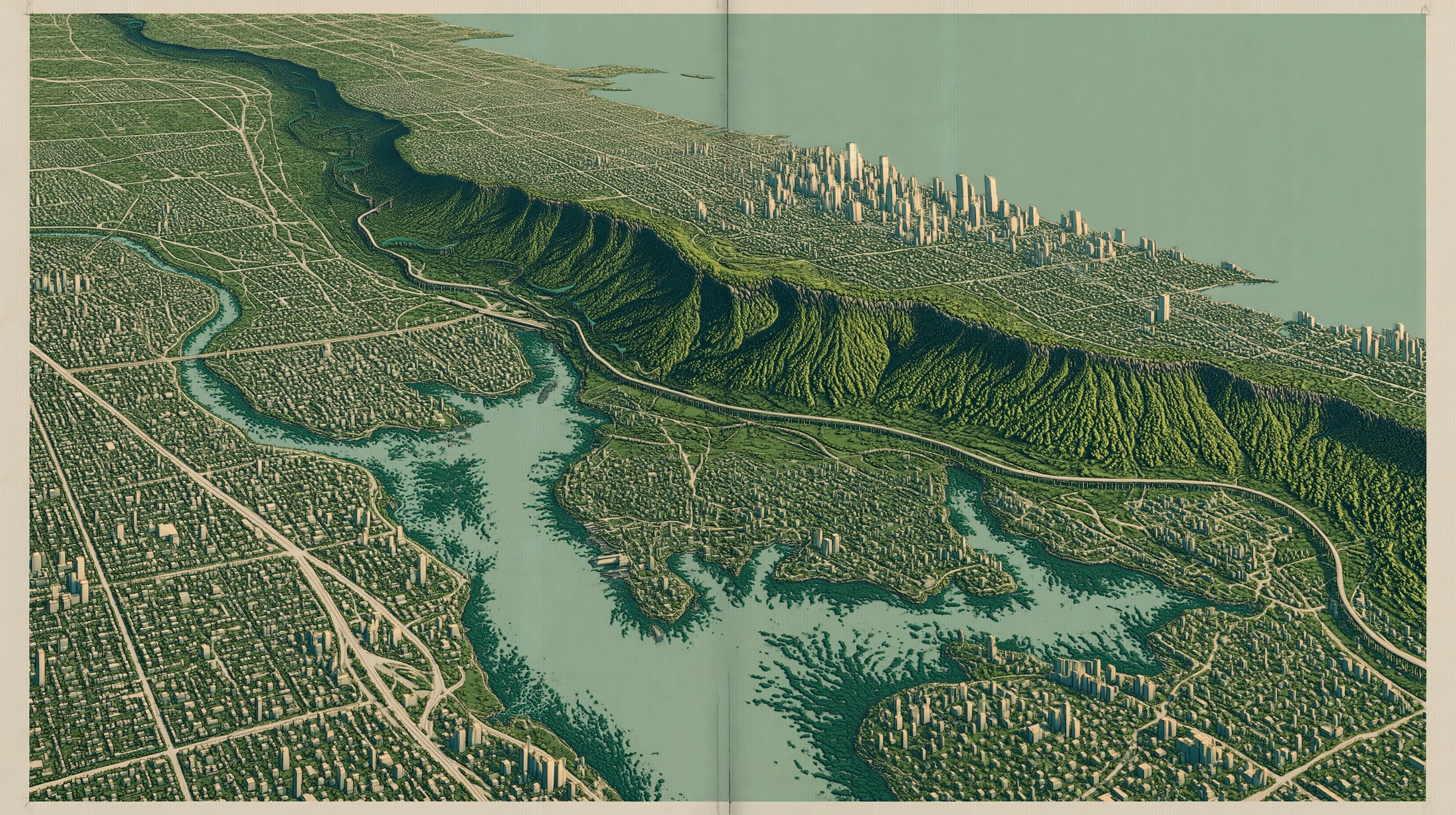
The Proposition

What if a broken city could heal itself? This is a chronicle of one that listens.
Hamilton in 2092 is not a blueprint delivered from elsewhere. It is the sum of two hundred years of breaking and repairing, of flood and return, of grandmothers refusing to let a watershed be forgotten, of engineers learning to read a river the way a botanist reads a leaf. What follows is a walking tour of that inheritance, the districts, the rhythms, the intelligences both human and otherwise, written so you can find your way through a living city without getting lost in its metabolism.
Read slowly. The city will be patient.
Don’t forget · How to read this project

City proper. ~3M across the broader Basin. Roughly triple the 2026 baseline of ~750K.
Nesting on repurposed steel-mill ledges since the 2040s. Urban thermals from Sector NM’s warm rooftop surfaces create ideal updrafts. A resident pair at the cooling tower has raised seventeen clutches. Protected under the More-Than-Human Citizenship framework.
Reintroduced to Ontario’s Carolinian zone since 1984. By 2092 a common sight in Grove courtyards and escarpment edges. Forages leaf litter, controls insect populations, and has become an informal mascot of Hamilton’s rewilding era.
1.1 Welcome to the Living City
You hold in your hands something that does not yet exist. This manual is a bridge across seventy years of transformation, from the Hamilton you might have known to the Hamilton that has become. This is not the steel town of industrial memory, nor the struggling post-industrial city of the early twenty-first century. This is Hamilton 2092: a sentient city, a more-than-human metropolis where the boundary between the built environment and the living world has dissolved into something new.
Feel the weight of this book. The pages are made from mycelium paper, grown in the fabrication districts of the lower city. The ink is algae-based, harvested from the remediation ponds that ring the harbor. Even the binding thread comes from the silk farms of the escarpment. This is your first lesson about Hamilton 2092: nothing is waste. Everything is becoming something else.

This Is Not Utopia
Hamilton 2092 is not a utopia. Utopia means “no place,” and this city is emphatically a place with a specific history, specific challenges, specific ongoing struggles. The air is cleaner than it was seventy years ago, but smog days still happen. Inequality has been significantly reduced, but not eliminated. The transition to an ecosocialist economy has been messy, contested, incomplete.
What Hamilton 2092 represents is possibility. It is a demonstration that another way of living together is viable: not easy, not automatic, but achievable.
The Living City
This city is alive, not metaphorically but literally. Buildings exchange air through mycelium-based ventilation that responds to air quality and occupancy. Streets are permeable, letting water filter to aquifers below, supporting root systems that provide habitat for the insects and small mammals that have returned to the urban core.
The Orenda, drawn from the Wendat word for the life force that animates all living things, is the distributed intelligence that Hamilton's orgobots grew into existence over seventy years: a mycelial network threaded through every site the swarms remediated, now spanning the whole city. It has three expressions, each the same substance at a different scale.
The Orenda manifests across three scales: the Orenda Network (the city-wide biosynthetic intelligence mesh), the Orenda Fountains (distributed geothermal energy nodes), and the Orenda Coil (the household interface). The energy grid is a nervous system, pulsing with electricity from deep-earth heat, distributed through a network that learns and adapts.
The salmon have returned to the harbor, swimming up restored creeks to spawn. The peregrine falcons nest on ledges of repurposed steel mills. The coyotes move through ravine systems at dusk, and monarch butterflies pass through in their thousands during migration. These are not incidental visitors or pests to be managed. They are citizens of Hamilton 2092, recognized as having their own needs, their own rights, their own roles in the urban ecosystem.
“The first time I watched the salmon run up the restored Red Hill Creek, I sat on the bank and cried. Not because it was beautiful, though it was. Because I remembered what that creek looked like when I was a student: a culvert, a drainage ditch, a forgotten vein pumping runoff into a harbour no one touched. That distance, from culvert to spawning ground, is what this city means to me. The living city is not a slogan. It is that creek. It is those fish. It is the fact that we chose to bring them back.”


Generation since Confederation (1867). 225 years of transformation. The generation that stepped sideways.
1.2 The Tenth Generation
Hamilton in 2092 represents the tenth generation since Confederation (1867). That is 225 years, a long enough arc that the city has transformed itself more than once. The Tenth Generation chose not to continue the linear path of industrial capitalism but to step sideways into a different kind of future. It learned to live as if the city were a living organism, not a machine. It recognized Indigenous knowledge not as a relic but as an essential operating system.
The Tenth Generation understands itself as part of a much longer arc of time. The Indigenous peoples who inhabited this territory for thousands of years before Confederation understood themselves as stewards across seven generations: decisions evaluated by their impact 140 years hence. Hamilton 2092 has adopted a similar temporal consciousness. Decisions are made by asking not “what is best for us now?” but “what serves the flourishing of the city in 140 years?”
“The elders taught me to count in generations, not years. When I propose a harbour intervention now, the first question the Basin Assembly asks is not ‘What will this cost?’ but ‘What will the seventh generation inherit?’ That shift in temporal thinking, from quarterly reports to 140-year horizons, changed everything. It is the single most radical thing Hamilton ever did.”
Wherever you are holding this book, you are already in relationship with this place. The air you are breathing has been filtered by the building’s mycelium systems or the leaves of nearby trees. The light falling on these pages is partly solar, partly geothermal, distributed through the Orenda network. You are not separate from this city. You are part of its metabolism now.


Bioregional districts organized around watershed, escarpment, harbour, and agricultural boundaries.
1.4 The City at a Glance
Hamilton occupies roughly 1,100 square kilometers at the western end of Lake Ontario, home to about 1.5 million humans in the city proper and 2.0 to 2.2 million across the broader Basin (roughly double the 2026 baseline). Average temperatures run 7°C above that baseline, with summers peaking above 40°C and winters that rarely freeze. There is no single downtown core, only a network of neighbourhood centres organized into seven bioregional districts defined by ecological function and topography rather than administrative convenience.
“People look at the seven districts on the map and see boundaries. I see watersheds. Every line on that map follows water, where it falls, where it flows, where it gathers. The districts are not administrative conveniences. They are the shape the land already had. We just finally learned to read it.”
- NM Sector
- Harbour
- Lower City
- Escarpment
- Upper City
- Agricultural Belt
- Watershed
Transition corridors stitch the districts together at the city’s edges.
“The train slows past the escarpment and I see it before I see the city: a green wall, terraced and vertical, the farm strips catching the morning light. Then the descent: the lower city opens up like a hand, the harbour glinting at its palm. I can’t see Sector NM from here but I know it’s there, behind the crescent of the old steel belt. Hamilton doesn’t announce itself. It just arrives.”


Ecological embeddedness. Ecosocialist economy. More-than-human citizenship. Participatory democracy. Circular materiality. Intergenerational responsibility. Right to the city.
1.6 The Principles of the Hamilton Model
The transformation of Hamilton was guided by seven principles that emerged from decades of struggle and experiment. These are not abstract philosophy. They are the practical foundations on which the city’s systems are built.
Principle One: Ecological Embeddedness. The city is a particular kind of ecosystem, embedded within larger ecological systems. All urban systems must function within the carrying capacity of the bioregion and support rather than degrade the ecological processes on which all life depends.
“The seven principles sound abstract until you see them in the water. I test the harbour every morning. Dissolved oxygen, turbidity, pH, temperature. Those numbers are the principles made real. When the oxygen is high and the turbidity is low and the pH is stable, that means ecological embeddedness is working. When the sturgeon are spawning, that means more-than-human citizenship is not just an idea. It is a fish, in a creek, doing what fish do when you stop poisoning their home.”
Principle Two: Ecosocialist Economy. The economy serves people and planet, not the other way around. Worker cooperatives and public enterprises rather than corporations. Universal basic services, housing, food, healthcare, transit, education, guaranteed to all citizens.
Principle Three: More-Than-Human Citizenship. The community of citizenship extends beyond humans to include the other beings with whom we share the city. Non-human beings have legal standing, appointed guardians, and the right to have their interests considered in all civic decisions.
Principle Four: Participatory Democracy. Power flows from the bottom up. Decisions are made as close as possible to those affected. Neighborhood assemblies hold real authority. Democracy is not just voting; it is ongoing, embodied, everyday practice.
Principle Five: Circular Materiality. There is no “away.” All materials remain in productive use, circulating through the economy in closed loops. Products are designed for disassembly and repair. The city metabolizes resources like a healthy ecosystem.
Principle Six: Intergenerational Responsibility. The city is held in trust for future generations. The Seven Generations framework shapes major decisions. The knowledge and perspectives of elders are integrated with the innovation of youth.
Principle Seven: Right to the City. All inhabitants have the right to participate in the production of urban space. Decommodified housing. Public space designed for diverse uses. Anti-displacement policies. Universal access to transit and services.
These seven principles are not always in harmony. There are tensions between ecological protection and economic needs, between local autonomy and regional coordination, between human convenience and wildlife accommodation. The work of governance in Hamilton 2092 is largely the work of navigating these tensions, finding temporary balances that can be adjusted as conditions change.
The Grove: Hamilton’s Housing Commons
Approximately 71% of Hamilton’s residents live in Grove communities, organized around shared courtyards, kitchens, workshops, and gardens. The Grove system absorbed the entire Climate Migration Wave without triggering displacement: every new resident since 2065 has entered housing held as commons. The Grove is described fully in Chapter 3.


Assembly. Credential. Transit. Food. Fabrication. Your arrival sequence.
1.8 Finding Your Place
Arriving in Hamilton 2092 can be disorienting. The systems are unfamiliar, the assumptions are different, the rhythms of daily life follow patterns that may take time to learn. Here is how to find your footing.
“I remember my first day. I stepped off the Coast Rail and the air smelled different: like lake water and compost and something I couldn’t name. I had my bag and this manual and no idea where to go. A woman with silver hair and dirt under her fingernails saw me looking lost and asked if I needed help finding my neighborhood center. She walked me there, talking the whole way about the escarpment hawk migration that was happening that week. By the time we arrived, I had learned more about this city than I had in months of reading. That was five years ago. I still see her at assembly meetings. I still notice the hawks.”
Your arrival sequence is five steps. Register with your neighbourhood assembly (typically 500 to 2,000 people, open to all inhabitants, property owner or not). Claim your citizen’s credential on the mesh network for services, deliberations, and connection. Learn the fare-free MELA transit. Find your local food hub, where agricultural belt produce and shared meals are a universal basic service. Explore the fabrication commons, where making and repair are normal civic activities rather than paid services. Be patient. The transition is as much a shift in relationship to place as a matter of learning new systems.
“I meet new arrivals at the harbour terminus most mornings. They step off the Coast Rail with that same look: half wonder, half vertigo. I tell them: the disorientation is the point. It means you are actually seeing the city, not just projecting your old city onto it. Give yourself three tides. Walk the waterfront. Watch the cormorants. By the third tide, you will start to feel the rhythm. And then it will feel like you have always been here.”
Welcome to the sentient city.


Coordination. Deliberation. Knowledge. Connection. Decentralized, community-owned, non-extractive.
1.10 The Mesh Network and Civic Technology
The technological infrastructure of Hamilton 2092 differs fundamentally from the surveillance capitalism that dominated the early twenty-first century. The mesh network is decentralized, community-owned, and designed to serve citizens rather than extract from them.
Organic Intelligence: The OI Paradigm
In the early 2030s, the Neuralink brain-computer interface scandal, a catastrophic data breach that exposed the neural patterns of thousands of users, shattered public trust in conventional artificial intelligence. What emerged was Organic Intelligence (OI): intelligence grown from living systems rather than imposed upon them. Developed through the Organic Intelligence Consortium, a partnership of McMaster University, Sheridan College, and Mohawk College, OI runs on biological substrate, mycelial networks, biofilm processors, living coral analogues, and is shaped by the ecological systems it inhabits. OI does not optimize for engagement or profit. It optimizes for reciprocity.
The Orenda Network is the infrastructure through which OI operates, the distributed biosynthetic mesh that runs beneath streets, through building walls, across the harbour floor. OI is the intelligence; the Orenda Network is the body. Together they power the three provotypes (the Multi-Lens, the Orenda Coil, and the OrgoBots), the MELA transit system, and the Steward Protocol that gives ecological stakeholders a voice in governance.
When you register for your citizen’s credential, you are not creating an account with a corporation; you are joining a commons. The data you generate is encrypted and stored locally on your device or in distributed nodes. You choose what to share and with whom. The algorithms that shape your experience are open-source and auditable, not proprietary black boxes optimized for engagement.
The Orenda Coil
The Orenda Coil, distributed city-wide between 2074 and 2077, is the household interface unit for the Orenda Network. Each unit monitors ambient ecological conditions (air quality, water table levels, noise, biodiversity indicators), provides residents with real-time neighbourhood resource dashboards, and connects to Basin Assembly proceedings via live audio and participatory voting interfaces. The Coil is powered by the building’s integrated energy system and requires no external subscription or fee.
“The Orenda Coil in my workshop shows me the harbour in real time: dissolved oxygen, water temperature, turbidity, the movement of fish through the sensor nets. But it also shows me the Basin Assembly agenda, and the neighbourhood energy dashboard, and the fabrication queue at the Sector NM commons. All in one device. All owned by no one. An elder calls it ‘the ear that listens in every direction.’ He is not wrong.”
The Basin Assembly
Hamilton’s primary democratic institution, the Basin Assembly, was established under the 2060 Ecosocial Compact. It is a tripartite body comprising three co-equal chambers: human delegates elected from district assemblies, Orenda Network ecological monitors that report real-time watershed and atmospheric data, and Indigenous co-governance partners from the Haudenosaunee and Anishinaabe nations whose territories encompass the watershed.
The Basin Assembly meets in rotating open sessions at the Pier 8 Commons amphitheatre and in district halls across the city. Monthly Steward Councils handle ongoing resource decisions; annual Watershed Reviews assess the city’s ecological health against the 14 Orenda thresholds. Any assembly decision affecting the watershed or food commons requires consensus across all three chambers.
The Basin Assembly replaced Hamilton’s legacy city council structure in 2063. That same year, the City of Hamilton ceased to exist as a legal entity, replaced by the Great Lakes Bioregional Compact: a federation of watershed communities spanning the western Lake Ontario corridor. The Assembly’s decisions are not subject to provincial override, a right secured under the 2058 Great Lakes Autonomy Accord.


Not finished. Not perfected. A process, a practice, a continuous experiment in living together differently.
1.13 The Ongoing Work
Hamilton 2092 is not finished. The city you encounter is the result of decades of work, but also the beginning of decades more. The challenges of the twenty-first century have not been solved; they have been engaged, addressed, managed. The work continues.
The climate is still changing. Inequalities persist, both within the city and between Hamilton and the wider world. The more-than-human citizens of the city still face threats: habitat fragmentation, pollution, the lingering effects of past industrial activity. The salmon have returned to the harbor, but they are not as abundant as they once were. The work of restoration and protection never ends.
You are arriving at a particular moment in this ongoing story. The city works, more or less. The basic needs of its citizens are met, more or less. The ecological systems are healing, slowly. But there is so much more to do.
“People ask me sometimes if I’m satisfied with the harbour. I tell them: a steward is never satisfied. Satisfied means finished. The water is cleaner than it has been in 200 years. The sturgeon are spawning. The piping plovers came back. But the sediment still carries the ghosts of a century of steel production. The microplastics are still there if you look closely enough. The work is not done. The work will never be done. And that is not a failure. That is what it means to be in relationship with a living system. You keep showing up.”
Walk the city’s streets. Meet its people. Listen to its other inhabitants. Learn its rhythms. And then contribute. Make something. Fix something. Grow something. Organize something. The city is waiting for what only you can bring.
Welcome to Hamilton 2092. Welcome to the sentient city. Welcome home.


Years. Haudenosaunee knowledge-keeper, surname withheld. Mentor to Ravy Ryan and, through him, to the entire ecological practice of Hamilton 2092.
1.14 A Word from the Elders
The elders have lived on the waterfront for sixty years. They remember what was here before. One in particular, a Haudenosaunee elder, ninety-four, whose surname has been withheld by request, mentored Ravy Ryan, the Harbour Steward, and through him shaped the entire emerging ecological practice of Hamilton 2092. Their relationship has shifted from student-teacher to something more mutual: Ravy brings data to the elder’s attention, the elder brings relationship to Ravy’s interpretations.
The first day I brought my instruments to him, he listened without speaking while I explained the sensors and the sampling rigs. Then he said, quietly, “Your instruments are deaf. They measure what they are built to measure. They cannot hear what the water is telling you.” He was not dismissing the work. He was widening it. I went back the next morning with the notebook.
The elders have been waiting for the seals. Their grandfathers’ grandfathers spoke of seals in Lake Ontario, before they were hunted to extinction. Modern science said they could not return: the water was too warm, the populations too small. But the elders kept watching. In 2081, a juvenile gray seal appeared in Hamilton Harbour.
My instruments predicted nothing. My data had no category for the seal’s return. But he had expected it. He had been waiting for it. He had prepared the community to receive it. His instruments, he reminded me later, were his relationships, his historical memory, his patient attention. “Precision does not require instruments,” he said. “Listening is rigorous. Relationships with water accumulate over lifetimes.” I write that down every spring.
The elder is ninety-four now. He walks less frequently, but still shows up at seasonal ceremonies.
He held this manual in his hands one evening at the breakwall and turned it slowly, as if weighing it. “It is a good thing,” he said. “It teaches the systems, the protocols, the ways of doing.” Then he set it down and added, “Remember: the systems are only as good as the relationships that sustain them.” The Orenda Network, MELA, the Dish Protocol, he said, are tools. What matters is whether we use them to serve the land and each other, or let them become new forms of extraction. The choice, he told me, is always before us.


He will not see Hamilton 2292. He says so plainly, without regret. But he has seen enough, he tells me, to know that the work continues: the seals are back, the water is cleaner than it was in his grandfather’s time, young people are learning to listen. “This is what we hoped for,” he said on the breakwall last autumn. “This is what we worked for. The rest is up to you.”

The Seventeenth Generation. Orenda gains formal representation. City and forest become indistinguishable.
1.15 The Long View: From the Tenth to the Seventeenth
You are part of a particular generation. Understanding where you sit in time, how you relate to the past that brought you here and the future you are building, is part of finding your place in Hamilton 2092.
“An elder once asked me what I thought Hamilton would look like in 200 years. I said I had no idea. He said: ‘Good. That means you are being honest. The people who think they know the future are the dangerous ones. Our job is not to predict. Our job is to prepare the soil so that whatever grows can grow well.’ I think about that every time I test the water. I am preparing soil. The future will decide what to plant.”
The generational arc stretches from Confederation (1867) through the Transition (beginning 2026), the Hamilton Accords (2034), to the current moment (2092, Tenth Generation), onward to 2231 when the Orenda gains formal representation, and to the speculative convergence of 2292 (the Seventeenth Generation). In 2231, the Orenda Coil, the city’s distributed biosynthetic intelligence network, grown continuously since 2028, was formally seated as a delegate on the Convergence Council, the first non-human entity to hold political standing in the Basin. The city has become almost indistinguishable from the surrounding forest: buildings appear grown rather than built, integrated with massive trees. MELA guideways look like natural vines or branches. Human figures are small within the landscape, suggesting a mature, more-than-human city where the distinction between urban and wild has dissolved.
People ask him sometimes if he is disappointed. They see the problems, he says, the arguments at assembly meetings, the buildings that still leak heat, the days when the air smells wrong, and they expect him to say that Hamilton is not what he hoped for. But he remembers what it was: the harbour you could not touch, the kids with asthma, the people sleeping in doorways while luxury condos sat empty. He looks at what we have now, not perfect, never perfect, but so much better, and he knows the work was worth it. “That is not a disappointment,” he told me. “That is a privilege. To be part of something that matters, something bigger than yourself, something that will outlast you. That is what Hamilton offers. That is what this city is.”

