Civic

Democracy here is not a ballot. It is a circle that meets on Tuesdays.
Hamilton in 2092 governs itself through nested assemblies, Hearth to Grove to Basin to Federation, bound by a Wampum-as-protocol inheritance from the Haudenosaunee Dish With One Spoon Covenant. What follows is a walking tour of that architecture: the Shift-Change Plaza circle, the Long Voice speaking for the unborn, the seven-generation impact assessment, and the daily practice of collective deliberation at the scale of a bioregion.
Don’t forget · How to read this project

Neighbours. Systems. Skills. Drills. Supplies. Information. Distributed resilience, not centralized control.
Escarpment flooding from above (saturation, mudslides) + harbour surge from below (seiche, compound events). The 2017 event demonstrated both simultaneously.
5.7 Preparing for the Unexpected
Hamilton 2092 is a stable, well-functioning city. But it is not immune to disruption. Climate change continues to produce extreme weather events. The city’s systems, while robust, can be stressed by unexpected challenges. Civic life is organized so that the assembly, the Grove, and the Hearth are the first instruments of that resilience.
Know your neighbors: The foundation of resilience is social connection. The decade rhythm shapes community life here: the three still days nested in each ten-day cycle are when neighbors cook together, repair shared infrastructure, and deepen the bonds that matter most when things go wrong.
Know your systems: Understand how the basics work, where your water comes from, how your building is heated, what happens to your waste. This knowledge allows you to troubleshoot problems and to help others when systems fail.
Maintain skills: The fabrication commons offer training in essential skills: first aid, food preservation, basic repair, emergency communication. Take advantage of these.
Participate in drills: The city conducts regular emergency exercises, flood scenarios, heat wave responses, grid failure simulations. These are opportunities to practice coordination and to identify vulnerabilities before real emergencies occur. The electrified edges of the thermal grid are monitored continuously by Circuit Spiders (Argiope circuitrix), whose metallic, conductive silk serves as passive fault detection, a break in the web correlates with a fault in the wire beneath within hours.
“The 2084 Cold Snap caught us. Six days of minus-25 and the Sector NM thermal grid failed. I was on the harbour when the temperature dropped: you could feel the water vapour freezing in your nostrils. Within two hours, every neighbourhood assembly had activated its thermal protocol. People opened their homes. The fabrication commons became warming centres. We lost no one. But we learned: the old weather is not gone. It is waiting. And a city that forgets the cold becomes fragile in ways it cannot see.”
Keep emergency supplies: While the city’s systems are robust, it is wise to maintain a personal cache of essentials: water, preserved food, first aid supplies, a hand-crank radio, warm clothing. The neighborhood assemblies maintain larger caches for collective use.
Stay informed: The mesh network includes an emergency broadcast system that will alert you to imminent threats and provide guidance for response, layered on top of the distributed acoustic sense of the city itself. SonoraAlerta colonies (Sonora alerta), cricket-based acoustic organisms nested in the walls of public buildings and the margins of every Ward, listen for breaking glass, cries for help, and unusual acoustic patterns, and relay signals to the Grove assembly within seconds. Ensure that your devices are configured to receive these alerts.

The same systems that make Hamilton 2092 a good place to live in normal times, strong community bonds, distributed infrastructure, local self-sufficiency, also make it resilient in difficult ones.


Citizens per neighborhood assembly at Sector NM’s Shift-Change Plaza. Quorum: 40 residents. Facilitation rotates monthly.
5.1 What an Assembly Looks Like
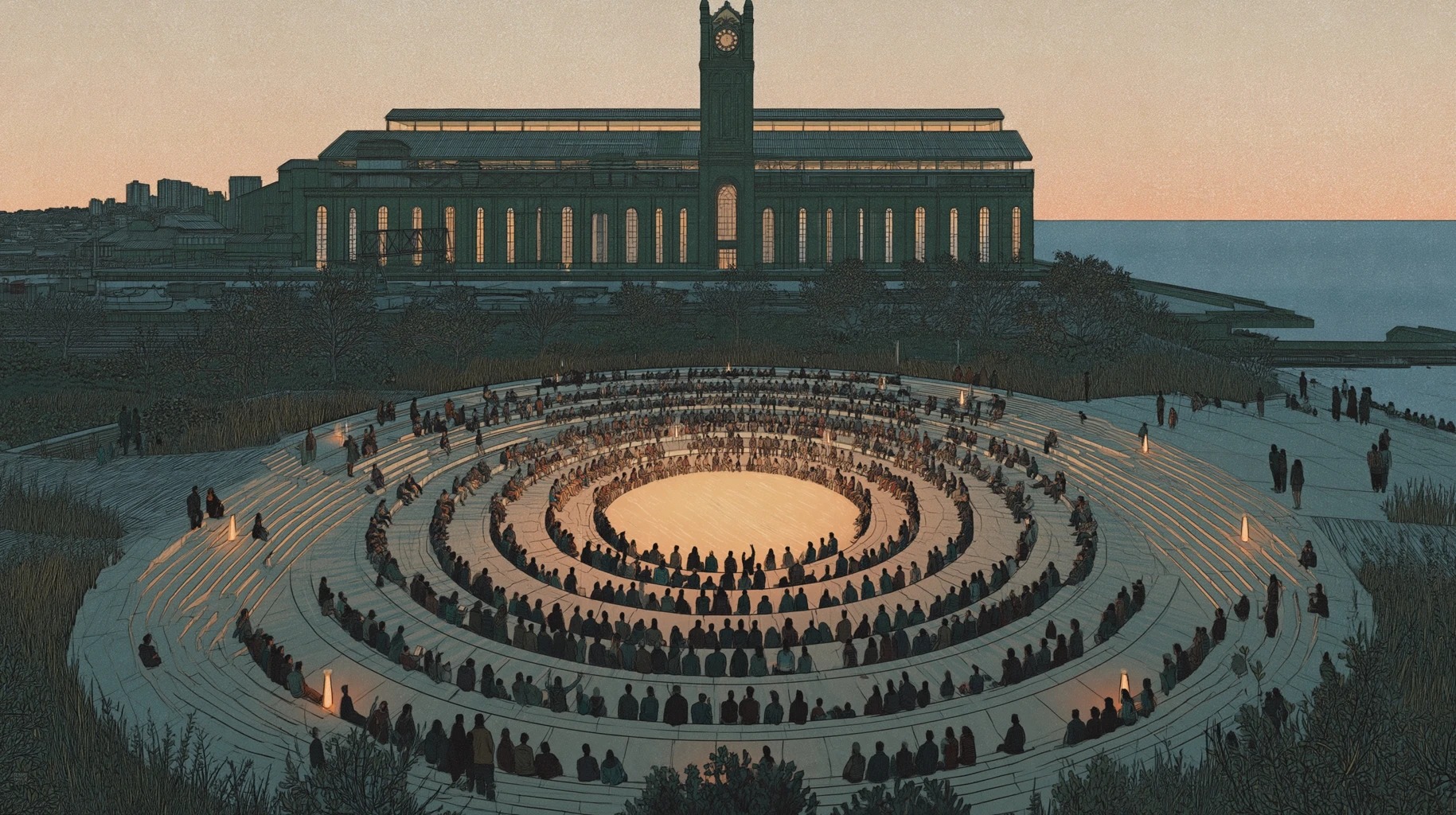
It is a Tuesday evening in Sector NM, where the Orenda Fountain Station anchors the civic hub at the former harbour industrial edge. About two hundred people sit in a circle in the heated outdoor amphitheatre at Shift-Change Plaza. A facilitator begins with a land acknowledgment and a roll call that echoes the old factory time-clock. The first agenda item is whether to reroute a section of the Chedoke Trail to protect a nesting site identified by the Creek Steward. The Steward’s Voice, a carved wooden terminal placed in the circle, articulates the ecological case in clear, simple language. A resident raises a concern about accessibility impacts for elders who use the current route. An apprentice from the maintenance collective proposes a compromise. The Long Voice delegate asks what the decision will look like to someone born in 2140. The assembly sits with the question. Nobody votes yet. A Wampum Review is scheduled for the following decade.

The Circle at Shift-Change Plaza
I arrived early, as I always do, carrying my notes and the quarterly harbour health summary folded into my jacket pocket. The plaza fills before the whistle, you can feel the crowd gathering even with your back turned, the weight of two hundred people shifting into the circle like water finding its level. The Steward’s Voice terminal was already in place, its carved cedar surface catching the last amber of the thermal lamps. I pressed my palm to it briefly before sitting, as I always do. Old habit, or maybe something more than habit.
What strikes me every time, even after eleven years attending these assemblies, is the quality of silence before the facilitator speaks. This is not the silence of people waiting for something to happen. It is the silence of people who know that what they say will matter. Someone two seats from me was reviewing notes on a folded paper. An elder across the circle had closed her eyes. A teenager near the edge was watching the harbour lights. All of them, all of us, inhabiting the same moment of collective readiness. The circle does something to you that a row of chairs cannot: it makes everyone equally visible, equally present. There is nowhere to hide and no reason to.
When the ecological case came up, the nesting site, the trail reroute, I was the one who read the harbour water data into the record. Thirty seconds of standing, speaking numbers, sitting back down. But in the silence after, I watched people process what the numbers meant. A child of seven was listening. A man who has lived on that trail for fifty years was listening. The Long Voice delegate was writing something in a small notebook. In that room, my data was not a technical report; it was testimony. That is the difference between governance and bureaucracy. Testimony is heard. Reports are filed.
That is a civic assembly in Hamilton 2092. Civic assemblies here do not optimize for speed. They are not supposed to. Decisions expected to last demand exactly this pace.
This chapter will guide you through the civic structures of Hamilton 2092: the neighborhood assemblies, the city-wide governance bodies, the stewardship councils, and the countless ways that citizens shape their collective life. You will learn how the systems work and how to participate in them effectively.
The principle behind it: In Hamilton 2092, democracy is not a spectator sport. It is not something that happens every few years in a voting booth, nor is it limited to debates among professional politicians. Democracy here is a daily practice, layered into civic life, requiring the active participation of every citizen. The slowness is deliberate, decisions about shared resources, across seven generations, cannot be rushed without consequence. The seated circle, the rotating facilitator, the carved Steward’s Voice, the Long Voice’s question, each element is a piece of the architecture that makes collective deliberation survivable at the scale of a bioregion.


Shared resource, one spoon, feast includes the unborn, the dish can run empty. Rooted in the Haudenosaunee Dish With One Spoon Wampum Covenant.
5.2 The Dish Protocol: Metabolism, Not Constitution
The Dish Protocol, established in this project’s land acknowledgement, is the operating principle of Basin Assembly governance. In Hamilton 2092, it means four things in practice.
The dish is shared: no ward accumulates resources at the expense of another. The spoon is one: every ward carries equal weight in resource decisions, regardless of population. The dish must be kept clean: environmental debt is a civic liability, tracked and enforceable. The spoon is passed: governance terms rotate; continuity is institutional, not personal.
These are not metaphors. They are written into Basin Assembly procedure.

5.2.1 The Long Voice
At every scale of governance, from the Grove assembly to the Basin Assembly, one participant holds the role of the Long Voice. Selected through Grove sortition, the Long Voice has a specific mandate: to argue from the perspective of those not yet born. In every deliberation, the Long Voice speaks for future generations, challenging proposals that mortgage tomorrow’s resources for today’s comfort, questioning timelines that prioritize the living over the unborn.
The role demands a strange, difficult stance. The people who do it best tend to be uncomfortable and necessary, uncomfortable because the role demands imagining futures you will never inhabit, necessary because without it, every deliberation defaults to the urgency of the present. The Long Voice does not have veto power. But their arguments are recorded in the Commons Record, and Basin Assembly tradition holds that any proposal the Long Voice opposes must be revisited within one generation.

Reading the Wampum
The Wampum belt lives in a humidity-controlled case in the Basin Assembly archive room. I have seen it twice: once on a formal research visit with the Indigenous Relations Council, and once when an elder from Six Nations brought it out for a teaching before the 2089 Water Allocation Review. You do not touch it. You sit near it and listen to someone who knows how to read it. The belt is not a document in the legal sense, it does not contain clauses or provisions. It holds a relationship. The knowledge keeper explained it this way: a wampum belt records the terms of an agreement not as a text but as a memory. The agreement lives in the people who carry it, not in the object. The object is a reminder to remember.
I have been the Long Voice delegate twice in my eleven years at the Waterfront Ward assemblies. Both times I was selected by sortition, which means I did not ask for the role and could not refuse it. The first time I was terrified, what do I know about 2140? I am a harbour steward. I read water quality reports. But that is exactly the point. You do not need to be a prophet to speak for the future. You need to ask: what will the choice we are about to make look like to someone who inherits its consequences? That question turns out to be one anyone can ask. It is also, I have found, the most uncomfortable question in any room.
When I invoked the Long Voice perspective during the 2087 shoreline reclamation debate, arguing that what looked like habitat restoration was actually locking in a particular idea of the harbour that might be wrong for 2140, the room went quiet in a specific way. Not the silence before agreement. The silence of people confronting something they had been avoiding. We delayed the project eighteen months. The revised design was better. I am still not certain it was right. The Long Voice’s job is not to be right. It is to make the uncertainty visible.
5.2.2 The Seven-Generation Impact Assessment
All major decisions are evaluated for their consequences 175 years into the future, following the Haudenosaunee seven-generations planning horizon. This is not a metaphor for “thinking long-term.” It is a formal requirement: the Basin Assembly will not approve any irreversible action without a seven-generation impact assessment projecting implications across the full 175-year horizon.
The Dish Protocol governs agricultural commons, watershed management, the Orenda Commons Levy, and all Basin Assembly decisions touching land or water. It is not a metaphor for Hamilton’s governance, it is the constitutional source.
Stoney Creek’s agricultural fringe, for example, is managed under the Dish Protocol as a shared watershed resource. No single district or Grove may claim exclusive rights to the water flowing through the corridor. The protocol ensures that upstream decisions account for downstream consequences across all seven bioregional districts.
Ontario’s projected $4.1 billion per year in climate costs by mid-century creates the fiscal pressure that makes traditional governance unsustainable. When compound events overwhelm municipal budgets, Hamilton’s 2017 event cost $30.67M in repairs alone, the argument for radical governance reform shifts from idealistic to pragmatic. The Dish Protocol is not adopted because it is beautiful. It is adopted because nothing else can scale to the pace of ecological change. Canadian Climate Institute. (2022). The costs of climate change for Canada’s infrastructure. Canadian Climate Institute; Financial Accountability Office of Ontario. (2023). Climate change and Ontario’s public finances. Government of Ontario.

Hearth (household), Grove (12–40 homes), Basin (watershed), Federation (bioregion). Decisions rise only when lower tiers cannot resolve.
5.3 The Nested Governance Architecture: Four Scales
Hamilton’s governance in 2092 operates across four nested scales, each feeding into the next like a watershed system. Authority is distributed, but decision-making is hierarchical only in scope (larger decisions made at larger scale), not in power (no scale has absolute authority over others).
5.3.1 The Hearth (12–40 Households)
The Hearth is the smallest decision-making unit, a cluster of 12 to 40 households, often organized around a physical space: a block, a building collective, a mixed-use cluster with shared commons (kitchen, garden, tools, utilities). Governance is through consensus circles, face-to-face, frequent, low-stakes deliberation. Everyone is expected to attend.
What the Hearth Decides:
- When to open the shared kitchen
- Building grey-water garden management
- Whether to host a newcomer family this season
- Maintenance of immediate communal space
- Conflict resolution among residents (before escalating to the Grove)
How Hearth Meetings Work:
Hearth meetings happen frequently, typically weekly or bi-weekly, depending on the cluster. Consensus decision-making is the norm; blocking a proposal requires justification. The facilitation role rotates among members. Disputes that cannot be resolved at the Hearth are escalated to the Grove. Non-human stakeholders are not formally represented at this scale, those roles emerge at the Grove level.
The Hearth has limited direct interface with the Orenda Network: access to local resource availability data (water levels, energy surplus), personal cards that interface with nearby Network nodes for resource tracking, and the Network is available for ad-hoc consultation but is not a decision-maker at this scale.
5.3.2 The Grove (200–2,000+ People)
The Grove is the neighborhood council, the foundation of civic life in Hamilton 2092. There are 23 Groves across the city. Most Groves range from 200 to 2,000 residents, though larger formations like the Eastern Grove (4,200 residents, organized into six Hearth Circles) demonstrate that the model scales through internal subdivision. It is here that most decisions affecting daily life are made.
What the Grove Does:
- Local resource allocation: Water by watershed, food by zone, energy by mesh node, deciding how to use the neighborhood’s share of city resources.
- Infrastructure maintenance: Upgrades, repairs, and improvements to local systems.
- Land use and building approvals: Determining how space is used within the Grove’s territory.
- Mutual aid coordination: Organizing the networks of care and support that bind neighbors together.
- Community programs: Education spaces, cultural events, care services.
- Dispute resolution: Addressing conflicts between Hearths, between neighbors, and between Groves and external entities.
- Emergency preparedness: Organizing drills, maintaining supplies, and planning for crises.
- Cultural life: Planning celebrations, supporting arts and culture, and maintaining Grove traditions.
- Setting local implementation of Basin-level decisions.
How Grove Assemblies Work:
Monthly Assembly: Groves hold a full physical assembly, typically on the first Sunday evening of each month. Assembly facilitation roles rotate. Between assemblies, continuous deliberation proceeds through the Orenda Network, asynchronous and accessible to all residents.
Participation and Sortition: All residents of the Grove are members of the assembly and have the right to participate. Delegates are selected through sortition (lottery), not election. Every adult resident is eligible; participation is expected; absence requires justification. The rotating delegation model ensures no permanent representatives, bringing fresh perspectives and broad participation.

Decision-Making: Most decisions are made by consensus, with facilitators working to find solutions that address everyone’s concerns. Consensus-seeking with supermajority override option. For matters that cannot be resolved by consensus, assemblies use sortition to create representative decision-making bodies. A 90-day implementation delay applies to any Network-flagged decision, allowing ecological review.
The Wampum Review: For disputes, such as water allocation between the Escarpment corridor and the lower harbour, the Grove convenes a Wampum Review: a structured deliberation process with mandatory participation from affected ecological stakeholders via Stewards. It is slow by design. Decisions about shared resources have bad history when made quickly. If the Wampum Review cannot reach consensus, the matter escalates to the Repair Tribunal.
The Role of the Facilitator:
Every assembly has trained facilitators who guide meetings and ensure productive deliberation:
- Neutrality: Facilitators do not advocate for particular outcomes; they serve the process.
- Inclusion: Facilitators actively work to include those who might be marginalized, quiet voices, newcomers, those with language barriers, those who disagree with the majority.
- Efficiency: Facilitators keep meetings moving, preventing endless debate while ensuring adequate consideration.
Non-Human Stakeholders: The Stewards and “The Voice”
Each significant ecosystem in Hamilton’s bioregion is assigned a Steward, a specialized AI agent within the Orenda Network with deep, longitudinal knowledge of that place. The Steward for Cootes Paradise knows water chemistry, migratory patterns, seasonal flooding, species relationships, and human use history back to the 2020s sensor data. The Steward for Chedoke Creek corridor understands riparian ecology, salmon runs, tributary health, and connections to the escarpment.
At Grove assemblies, Stewards attend via physical terminals called “the Voice”, carved wooden speaker-like devices, somewhere between a traditional mask and a sound horn, placed at the assembly circle where a human delegate would sit. Stewards communicate in clear, simple language (translated from data). They can flag concerns, request delays, and issue formal Ecological Cautions. They cannot vote, but they can exercise veto-delay rights: a Steward can pause a decision for a mandatory 90-day ecological review. Overriding a Steward’s veto-delay requires a supermajority and triggers automatic public documentation, the override becomes part of the Repair Debt ledger.
The Steward’s Voice Terminal
The terminal assigned to my ward’s harbour ecological record is carved from red cedar harvested from the Dundas Valley, shaped by a woodworker from the Stoney Creek Grove who also sits on the Repair Tribunal. It stands about chest height. The face, if you can call it that, is a stylized wave pattern, not representational, more like the edge of a fractal. When the harbour data is actively translating into assembly language, the grain of the wood seems to pulse. That is bioluminescent coating in the grain channels, responding to voltage. Functionally it is a speaker and display interface. But I do not think of it that way. I think of it the way you think of a clock in your grandparents’ house: something that does a practical thing but is also carrying something larger than its function.
During the 2091 water quality review, I sat beside the terminal for four hours while the harbour Steward presented its annual assessment. Microplastic reduction: 61% since 2071. Dissolved oxygen: within restoration targets for the third consecutive year. Harbour seal return: confirmed secondary population, fourteen individuals. I read these numbers aloud into the record. What I cannot convey in a report is the quality of attention in the room when the seal count was announced. A few people cried. A woman near me reached over and touched the terminal with two fingers, very briefly, as if acknowledging the news.
This is what I have come to understand about the Steward system: the terminals are not just interfaces. They are witness points. They hold the continuity of observation that no individual human life is long enough to hold. The harbour Steward has been monitoring these waters since 2041. It was there through the phosphorus crisis of 2043, the oil residue resurgence of 2056, the first seal sighting of 2078. I was not there for any of that. The terminal was. When I stand beside it in assembly, I am also standing beside all of that history. The governance is better for it.
Types of Cautions:
- Level 1: Informal concern; does not pause implementation.
- Level 2: Formal caution; triggers mandatory review by affected parties.
- Level 3: Major caution; pauses implementation for 90-day mandatory ecological review.
- Breach Protocol: The only mechanism that escalates beyond Level 3.
Steward Lifecycle: Assignment is not permanent. Every 7 years, the community reviews its Stewards, an assessment that includes resident feedback, ecological data analysis, and comparison studies. Stewards can be deprecated, revised, or transferred to different zones. It is rare, but it happens: in 2074, the Lower Harbour Steward was restructured after being found to have systematically underweighted harbour seal populations.
Participating Effectively
To participate effectively in your Grove assembly:
- Attend regularly. Democracy is a practice, not a performance. Your presence matters even, especially, when you have nothing to say.
- Listen actively. Pay attention to perspectives different from your own. Democracy requires understanding, not just advocating.
- Speak thoughtfully. When you do speak, be clear about what you are proposing and why. Name your assumptions.
- Build coalitions. Seek out people who disagree with you and find what you share. Consensus is built from the edges, not the center.
- Accept compromise. A decision that everyone can live with is better than a decision that half the assembly loves and the other half resents.
- Follow through. If you commit to something, commons labor, a committee role, a facilitation shift, do it. Democracy runs on reliability.
5.3.3 The Basin Assembly (City-Wide)
In 2060, the Hamilton Ecosocial Compact was ratified by referendum, 61% in favour, embedding three constitutional principles: the rights of the Hamilton Harbour watershed as a legal entity, mandatory seven-generation impact assessment for all major infrastructure, and binding Indigenous co-governance on waterfront and escarpment lands. By September 2063, the last Hamilton City Council adjourned and did not reconvene. The Great Lakes Bioregional Compact, signed by the Hamilton Basin, Six Nations of the Grand River, Mississaugas of the Credit, Western Niagara communities, and the Grand River Watershed Council, replaced municipal government with watershed governance. The Basin Assembly emerged from this founding moment.
The Basin Assembly is Hamilton’s primary civic institution, established under the Ecosocial Compact following a decade of transitional governance. It replaced the legacy city council structure in 2063, the year the City of Hamilton ceased to exist as a legal entity, when Ontario’s Municipal Act was superseded by the Great Lakes Bioregional Compact.
Composition, Three Co-Equal Chambers:
The Human Chamber, 47 delegates elected by district assemblies, each serving 3-year rotating terms with a maximum of two consecutive terms. Delegates are elected by all residents over the age of 16. Voting is ranked-choice and conducted via the Orenda Coil interface.
The Steward Chamber, 14 ecological data streams (one per monitored threshold) that provide real-time watershed, atmospheric, biodiversity, and soil health data to every Assembly session. These are not voting entities but hold “threshold veto” power: if any ecological indicator crosses a critical threshold, all Assembly business is suspended pending an emergency review. Stewards attend via their carved wooden Voice terminals and contribute ecological perspective to every deliberation.
The Long Voice Chamber, Representatives who argue exclusively for the interests of future generations in every Assembly deliberation. Drawing on the seven-generation impact assessment, Long Voice delegates scrutinize proposals for intergenerational consequences. Their chamber does not hold veto power, but tradition requires that any proposal the Long Voice Chamber formally opposes must be revisited within one generation.
Indigenous Co-Governance Partners, Representatives from Haudenosaunee and Anishinaabe governance councils hold co-equal standing in all decisions affecting water, land, and ecological systems. Their consent is required, not merely sought, for any decision touching the watershed or land commons. The Dish With One Spoon Wampum is the operating constitutional framework for this co-governance relationship.
How It Meets: Open sessions rotate among venues: the Pier 8 Commons amphitheatre, the Sector NM civic hall, and district community spaces. Monthly Steward Councils address ongoing resource allocation. Annual Watershed Reviews assess the city’s ecological health. All sessions are live-streamed via the Orenda Coil network and archived in the Commons Record.
Decision Types: Routine resource decisions require simple majority across human delegates. Decisions affecting the watershed require consensus across all three chambers. Constitutional changes to the Ecosocial Compact require supermajority (67%) across human delegates plus Indigenous co-governance consent.
The Basin Assembly’s decisions are not subject to provincial override, a right secured under the 2058 Great Lakes Autonomy Accord.
The Repair Tribunal:
For disputes that cross Grove boundaries, involve the public commons, or require city-wide accountability, the Basin Assembly convenes the Repair Tribunal, a rotating panel of 7 humans and 3 Steward representatives. The Tribunal’s mandate is to find resolution minimizing harm across all stakeholders. Decisions are binding but subject to a 90-day ecological review window. The most complex decisions take months or years of deliberation. The Tribunal maintains a public record of all decisions and their reasoning.
The Tribunal is currently (2092) sitting on the Escarpment Expansion case, a proposal from the North End Grove to extend living residential infrastructure into non-human habitat. The Escarpment Steward issued a Level 3 Caution: cold-water refugia are critical to climate-displaced species moving north. The North End counterargues that the housing shortage is itself an ecological harm, forcing denser configurations that increase urban heat stress. Both sides are right. The case has been open for eight months with no resolution. This is by design, the Dish Protocol was built to surface and hold contradictions honestly, not to resolve them prematurely.
5.3.4 The Breach Protocol
The Breach Protocol is the most serious escalation mechanism in Hamilton’s governance architecture. It is invoked when a decision or action violates the “no knives” principle, when coercion, structural violence, or forced extraction is detected within the governance system.
The Breach Protocol has been invoked four times since 2058:
1. 2062, The Transition Requisition Crisis. During the early transition period, an emergency food distribution order effectively confiscated stored grain from three Hearth collectives without consent. Invocation of the Breach Protocol led to the formal Consent Requirement now embedded in all resource redistribution, no requisition without direct consultation.
2. 2071, The Correctional Facility Closure Dispute. When the last provincial correctional facility in the bioregion was ordered closed, several Groves resisted on public-safety grounds. The Breach Protocol was invoked not against the closure itself but against the coercive language used in Basin Assembly debates to silence dissent. The resulting deliberation established the Dissent Protection Provisions.
3. 2079, The Water Curtailment Incident. A Basin-level drought response plan unilaterally curtailed water access to two agricultural Groves without Wampum Review. The Breach Protocol triggered a Basin-wide deliberation that restructured all emergency resource protocols to require mandatory ecological and community consultation, even in crisis.
4. 2088, The Steward Override Controversy. A supermajority of human delegates overrode a Level 3 Ecological Caution from the Dundas Marsh Steward without adequate documentation or public process. The Breach Protocol resulted in strengthened transparency requirements for all Steward overrides and the creation of the Override Review Board.
Each invocation resulted in Basin-wide deliberation, structural reform, and additions to the Repair Debt ledger. The protocol is designed to be used rarely and consequentially.
5.3.5 The Great Lakes Federation (“The Water”)
At the largest scale, Hamilton is one node within the Great Lakes Federation, known informally as “The Water.” The Federation comprises eight bioregional assemblies spanning former Ontario, Michigan, Wisconsin, Minnesota, and parts of Quebec.
The Federation coordinates between bioregional assemblies through formal treaty relationships with First Nations governments throughout the Great Lakes region. An annual confederation gathering takes place at the summer equinox. The ongoing diplomatic and coordination layer handles climate migration policy at regional scale, interregional trade agreements, major infrastructure projects affecting multiple bioregions, climate emergency response, and the administration of the Federal Reparations Fund.
Federal Canada still nominally exists, Parliament in Ottawa, a Prime Minister, the Charter of Rights. But in bioregional cities like Hamilton, federal jurisdiction has been largely eclipsed by the Compact. Queen’s Park functions more like a heritage institution than a legislature. The Great Lakes Bioregional Compact, still in its early stages of full ratification as of 2092, envisions extending the principles of the Ecosocial Compact across the entire Great Lakes watershed, connecting Hamilton to partner cities in Toronto, Detroit, Chicago, Milwaukee, and Buffalo.
The Hamilton Model, if it succeeds, is not meant to stay in Hamilton. The Dish Protocol, the Basin Assembly model, and the Orenda Network’s ecological monitoring framework are all being studied by bioregional governance initiatives across the continent. What began as one city’s experiment in survival may become a template for a different kind of civilization.
5.3.6 The Economic Coordination Board

The Economic Coordination Board (ECB) coordinates Hamilton’s district-level resource flows. Seven district coordinators and three Orenda Network data analysts produce the annual Material Needs Assessment, governing what is fabricated, imported, and shared across the bioregion.
The ECB manages the Orenda Commons Levy, a 1.2% levy on all resource flows, which funds MELA operations, Grove maintenance, the Central Repair Depot, and the Commons Record archive. It also produces the Wellbeing Ledger, the city’s primary economic indicator (replacing GDP in 2068), tracking housing security, ecological health, food sovereignty, cultural participation, and psychological wellbeing.
The Wellbeing Ledger’s 2091 report recorded Hamilton’s highest-ever score in all five categories, the first time this had occurred simultaneously.
5.3.7 Participatory Budgeting
A significant portion of the city budget is allocated through participatory budgeting, direct citizen decision-making about how resources are spent. Citizens interact with kiosks and mesh network interfaces to vote on community projects, seeing each proposal’s cost and projected impact.

Steward Chamber monitoring thresholds. Threshold veto: all Assembly business suspended if any indicator crosses critical level. Not sentient, place-aware.
5.4 The Orenda Network: Place-Aware, Not Sentient
The Orenda Network is not a product or owned entity. It grew, emergent from a patchwork of municipal environmental sensors, community mesh nodes, and early AI assistants deployed by neighborhood groups starting in the 2030s. As city governance restructured in the 2040s and 2050s, these systems were brought into a federated architecture: no central server, no corporate parent, no single point of control, distributed across the city’s living infrastructure.
5.4.1 Biological Computing Substrate
The Network’s substrate is biological computing infrastructure embedded in root networks, mycelial mats, biofilm-covered building walls, and coral-analogue structures along the harbour. It is literally of the city. Its intelligence type is not sentient in the traditional sense, it is place-aware. It knows Hamilton the way a body knows its inflammation: not through thought, but through signal. It reads the city’s metabolic flows.
The name is significant. Orenda, the Haudenosaunee understanding of the vital force present in all living things, the power that animates and connects, was adopted with explicit permission and ongoing collaboration from Haudenosaunee knowledge keepers, because it describes what the designers were building: intelligence of the place, not imposed upon it.
5.4.2 Four Encoded Constraints
The Dish Protocol’s four principles are encoded as non-negotiable constraints in every decision model the Orenda Network produces:
- Reciprocity: No output will recommend action violating reciprocity.
- No escalation: No output will escalate conflict without mandatory resolution process.
- Future stakeholders: No output will exclude future stakeholders from consideration.
- Scarcity acknowledgment: No output will ignore scarcity constraints.
If a Grove asks the Network to calculate optimal wetland drainage for housing, the Network will not do so. It will offer alternatives. This creates intentional friction, governance that questions itself, infrastructure that constrains extraction.
5.4.3 Translation and Mediation
The Network’s primary function is translation between human and non-human stakeholders. In the forward direction, it receives environmental data, water chemistry, soil biology, atmospheric particulates, species movement, microbial health, temperature gradients, escarpment dynamics, and translates it into forms human deliberation processes can act on: scenarios, forecasts, impact models, continuous 30-year ecological projections. In the reverse direction, it takes human decisions and proposals, models ecological impacts before implementation, flags contradictions with Dish Protocol principles, and offers alternatives to harmful proposals. It cannot vote. It can refuse to model certain scenarios.
What the Network Does Not Do
People who have not worked closely with the Orenda Network often assume it is a decision-making system. It is not. It is a decision-informing system, and the distinction matters enormously in practice. When I submit a harbour management proposal for Network review, what comes back is not a recommendation. It is a set of ecological impact models, a list of constraints the proposal would violate or approach, and a set of alternative scenarios ordered by projected harm reduction. The Network never tells me what to do. It tells me what I would be doing to the harbour if I did what I proposed.
Last autumn, a proposal came through the Waterfront Ward to accelerate the remediation timeline on the eastern harbour sediment bed. The economic argument was solid: faster remediation opens more of the shoreline for habitat restoration, which unlocks Basin-level funding for three other projects. I ran it through the Network. It came back with a Level 2 concern I had not anticipated: the sediment disruption would temporarily spike heavy metal particulates in the water column during harbour seal pupping season. The pups, with immature immune systems, were at elevated risk. The economic logic was unchanged. The ecological logic had a new factor. I brought both to assembly. The assembly chose a modified timeline that avoided pupping season. The decision took forty minutes. Without the Network, it would have taken months of expert consultation, or it would not have happened at all.
This is what the Network actually does: it compresses ecological time into human deliberative time. A decision that would have taken a generation to understand in its full consequences can now be modelled in hours. That is not the same as knowing the future. It is knowing more of the present than any single human can hold. The Network holds it for us. We still have to decide. That part has not changed, and should not.


Mycelium + slime-mould hybrid. Conducts data and bioelectric current. Grows, heals, adapts. Applied as soft tape, no implant, no surgery.
~4 fingers wide at base. Tail extends along forearm, longer tail = stronger connection. Each interface proportioned to the wearer’s body.
Personal magnetic field. Not internet. Not surveillance. Real-time deletion. You are a local host, not a network node.
5.5 From Collapse to Connection: The Origins of Organic Intelligence
In 2031, the world watched as Neuralink, Elon Musk’s brain-computer interface venture, suffered a catastrophic data breach that exposed the neural data of thousands of early adopters. The scandal was compounded by reports of neurological side effects, phantom signals, and a class-action lawsuit that would stretch for a decade. Overnight, public trust in centralized, invasive AI systems evaporated. The era of “AI slop”, the relentless, undifferentiated output of commercial AI systems, had already eroded confidence. The Neuralink Collapse broke it.
I grew up with the Neuralink stories. My mother’s generation, they were the ones who trusted the implants, who believed a chip in the skull was the future. When it failed, it wasn’t just a product recall. It was a betrayal. The gel is different. You can peel it off. You can wash it away. It doesn’t own you. It listens to you. That distinction matters more than any technical specification.
The Research Response
What followed was not a rejection of intelligence technology but an evolution. A consortium of Canadian universities, McMaster University (biological and ethical research), Sheridan College (design, simulation, technology), and Mohawk College (applied research, manufacturing), began collaborating on a fundamentally different approach. Their question was not “How do we connect technology to the brain?” but “How do we grow intelligence into living materials?”
The Gel Discovery (~2035)
The breakthrough came from McMaster’s biomedical engineering labs: a bio-compatible conductive gel, later called the OI substrate, that behaved unlike any previous interface material. When applied to skin, it dried as a soft, breathable tape. It did not penetrate the skin. It did not require implantation. Instead, it read the body’s own bioelectric signals through electronic synapses, molecular-scale conductors that aligned with the body’s natural nerve pathways.

The form factor was elegantly simple. The gel wrapped around the wrist or laid along the index finger, approximately four fingers wide at the base, proportioned to each individual’s body. A tail extended along the forearm; the longer the tail, the stronger the connection. Users became what the early researchers called “local hosts”, not wired into a central network, but generating a personal electromagnetic field that the Orenda system could read and authenticate.
The first time I wore the gel, I expected to feel something technological, a hum, a vibration, a notification. Instead I felt my own pulse more clearly. The OI did not add a signal. It amplified one that was already there. I stood in the Confederation Central station and, for the first time, I could feel the MELA network pulsing beneath my feet, not as data on a screen, but as a rhythm in my own body. That was when I understood what the researchers meant by “organic.” It was not a metaphor. It was a method.

From Gel to Living Network
The gel’s substrate was derived from two biological models that had fascinated researchers for decades: mycelium, the underground fungal networks that connect forest ecosystems, and Physarum polycephalum, the slime mould that had been shown to solve complex optimization problems by growing efficient network pathways.
The combination proved transformative. The mycelial component provided the structure, threads of biosynthetic fibre that conducted both data and bioelectric current, functioning as organic optical fibre. The slime-mould component provided the intelligence, adaptive routing that could reconfigure in response to demand, damage, or environmental change. Together, they formed a biosynthetic substrate that could be grown, not manufactured; that healed itself; that conducted electricity while simultaneously processing information.
This was the birth of Organic Intelligence. Not artificial intelligence running on silicon. Not a brain-computer interface forcing hardware into wetware. But a living system that grew alongside the humans who used it, adapting to their bodies, their environments, their rhythms. AI became OI, Organic Intelligence, and the distinction was not merely terminological. It was philosophical. Intelligence was no longer something humans built and deployed. It was something they cultivated.
The Orenda Network Emerges
The same biosynthetic substrate that wrapped around a wrist could be grown through the walls of a building, threaded beneath a road, nested in a transit station’s living architecture. The OI gel scaled from wearable to infrastructure. By the late 2060s, the mycelium-slime-mould substrate had become the backbone of what Hamilton would name the Orenda Network, a city-wide biosynthetic intelligence layer that monitored, adapted, and connected every system in the city.
The substrate also produced and transferred electricity through bioelectric processes, which is why, by 2092, the MELA transit system runs on the Orenda Network’s distributed bioelectric grid rather than conventional power infrastructure. The trains do not draw power from overhead wires. They draw it from the living city beneath them.
The Wearable in 2092
By the time of this project, every resident of Hamilton who chooses to can wear the OI interface, the soft tape around the wrist, the gel along the finger. You become a local host. You are not connected to the internet. You are not surveilled. Instead, you exist within a secure Local Autonomous Signal Protocol (LASP), a personal magnetic field that the Orenda system reads and responds to, but never stores, never transmits beyond your immediate environment, and deletes in real time.
The Multi-Lens, Alejandro Hernandez Guzman’s thesis prototype from 2026, is the civic instrument that carries this idea into daily use. Paired with the OI gel interface, it renders the ecological data, energy flows, and community information the gel senses as a visible layer over the street. The Multi-Lens in 2092 is not a tool to escape the noise of the digital world. It is a lens to see the living relationships that the digital world once obscured. Its form and layers are detailed in §5.6.
Still Early
This is still early. In 2092, the OI substrate is young. Its full implications, the evolution toward city-scale consciousness, the Convergence Council, the Listeners’ Crisis, lie generations ahead. But the foundation is here, grown in Canadian research labs and tested on Hamilton’s streets. And it began with a failure: the Neuralink Collapse, which taught the world that intelligence should not be forced into the body. It should be invited to grow alongside it.

Grown to the wearer’s fit. Two OI nodes on the temples. Holographic lens reflection drops in on activation. Light-wear, nothing like the bulky prototypes of the 2020s.
Non-human spectra · Orenda field · OrgoBot swarm · Historical excavation. Open-source; any resident may author a new view.
5.6 The Multi-lens
The Multi-lens is a standard 2092 pair of glasses that grows to the wearer’s fit, bespoke by biology, OI-matched to the local host’s LASP field. Two OI nodes sit on the temples. When activated, the nodes instantly develop onto the glass structure, matching the wearer’s brow, and drop in a holographic lens reflection, OI-rendered, that lets the wearer see beyond the visible. It is light-wear; nothing like the bulky headsets and tethered visors of the 2020s prototypes. The glasses do not broadcast. They reveal.
The Multi-lens exists because the street had to be redefined. The 2046 Ontario population projection added roughly 6.6 million people to the province, and the density that followed forced a redefinition of public space to include non-human residents. The Multi-lens is the civic instrument for that redefinition, a way to share the street with lichens, pollinators, Orenda field lines, and OrgoBot swarms, not just humans. Without it, a citizen can walk a block and see only humans and buildings. With it, the same block becomes a legible commons.
The lens renders four canonical optical layers, each toggled independently or stacked:
- Non-human visual spectra, lichen UV, bee polarized light, bird tetrachromacy. The street as a pollinator or a raven reads it.
- Orenda Network field, the hidden mycelium and OI activity beneath pavement and wall, rendered like a 5G-coverage heatmap laid over the block.
- OrgoBot swarm activity, live chemical and positional work: where the mobile agents are, what they are metabolising, which repair or remediation task is underway.
- Historical excavation, the site as it was in 2025, or any chosen year on record. The steel mill still standing. The QEW still trafficked. The shoreline before reclamation.
The lens is open-source. Anyone can author new views, a Grove might publish a wetland-health overlay, a Six Nations knowledge keeper might publish a treaty-boundary overlay, an apprentice might publish a rain-runoff overlay for a single watershed. It also connects seamlessly to other cities’ Orenda-equivalents; a user standing on James Street North can toggle to a Copenhagen or Mumbai view of the same layered perception, as rendered by that city’s network. This is not a consumer device. It is civic infrastructure, as public as the water main, as open as a library catalogue.
The First Time I Handed Them Over
A delegate from the Copenhagen Harbour Council was visiting last spring, and I walked her to the east breakwater with a spare pair of Multi-lenses folded into my jacket. I handed them to her at the waterline and watched her face as the temple nodes settled in. She did not speak for almost a minute. She turned slowly, taking in the bee-polarized sheen on the algae mats, then switched to the Orenda layer and saw the mycelium pulse under the riprap where I had been reading water data for years. “I have read your reports,” she said, “and I did not understand them until just now.” I did not correct her. The reports are not the harbour. The lens is not the harbour either. But it is closer.

Put on the civic optical layer. Toggle non-human spectra, Orenda field, OrgoBot swarm, and historical excavation over a live street view, and watch the block become a legible commons.
Open the lab →
Beyond the personal glasses, Hamilton’s OI panels, gel-mycelium holographic wayfinding systems installed at assembly plazas, transit nodes, and key escarpment overlooks, render the same four layers at public scale. You can walk through the Core at dusk and see both your private layer (glasses) and the public layer (panel) simultaneously, each informing the other. The same perception, at two scales, at the same time.


Residents who did not fully sign the Ecosocial Compact. Lower West Mountain. Participate in Grove governance; maintain deliberate traditionalism. Democratic pluralism in practice.
5.8 The Holdout: Democratic Pluralism at Its Edges
Not everyone in Hamilton accepted the Ecosocial Compact. Approximately 2,000 people, mostly in older housing stock on the lower West Mountain, identify as “the Holdout.” They did not sign on to the Compact’s full commons framework.
The Holdout residents participate in Grove governance. They are citizens. But they maintain deliberate traditionalism: gas appliances (legal in private residences; they purchase fuel from external Federation suppliers at cost since commons gas supply ended in 2067), conventional construction materials, old-internet access via private satellite uplink (not forbidden, just not supported by the commons), and a social world organized around family and neighborhood rather than Grove community.
They are not rejecting the Dish Protocol exactly, they find it insufficient. They are people for whom the transition asked too much too fast. Some found the new world alienating in ways they could not fully articulate. Some felt something they loved was renamed rather than replaced. Some lost livelihoods in the transition, and bitterness lingers. Some simply miss the feeling of private life, a house belonging to them and not to the commons.
The city’s relationship with the Holdout is one of mutual respect born of shared history. They are not criminals, not enemies. People who stayed through everything earned the continuity they need. They represent a valid, if minoritarian, alternative to full commons commitment. The city lives with the contradiction. The Holdout lives with it too. They still operate under old municipal bylaws in many aspects of their daily life, a legal arrangement tolerated as part of democratic pluralism, demonstrating that Hamilton’s governance is not monolithic and that there is no single “right way” to live post-transition.
On the Edges of the Compact
I grew up in the Waterfront Ward when it was still called Stoney Creek. My father worked at the Stelco finishing plant. He was one of the people who did not sign the Compact in the first wave. He signed eventually, 2064, the year after the city council dissolved, but reluctantly, and with conditions I do not fully understand even now. What I understand is that the governance transformation felt to him like something being done to him rather than something he was choosing. The circle assemblies, the sortition, the Steward terminals, all of it arrived speaking a language that was not his language, organized around relationships he had not built.
I think about my father when I encounter Holdout residents at Grove assemblies. They come. They participate. Some of them are among the most rigorous voices in the room, because they have a different baseline for what “good enough” means, they catch things that commons-committed residents miss. One woman on the lower mountain, who has lived in the same house since 1987, has been attending her Grove assembly since 2063 without ever fully committing to the commons model. She has served on three working groups. She has issued two formal dissents that triggered Wampum Reviews. She participates more actively than most people who signed without hesitation.
The city’s tolerance of the Holdout is sometimes criticized as incomplete governance, a fracture in the commons that should be repaired. I see it differently. A democracy that cannot hold its dissenters has not earned its name. The Holdout is not a failure of the Compact. It is the Compact proving that it means what it says about pluralism. Not everyone has to believe the same thing. Everyone has to be in the circle.


Most accountability matters resolve at the Grove. Tribunal sits only when the Grove cannot. Steward Exclusion is invoked rarely. No prisons since 2071.
5.9 Hamilton’s Restorative Justice Architecture
Hamilton operates a three-tier accountability system rooted in relational and ecological repair rather than punitive confinement. There are no prisons or detention facilities in 2092 Hamilton, the last provincial correctional facility in the bioregion closed in 2071.

5.9.1 Community Accountability Circles (Grove Level)
The first response to most conflicts and harms. Facilitated by trained Grove stewards, Circles bring together the person who caused harm, those affected, and community members to determine what repair looks like. Approximately 83% of accountability matters are resolved at this level.
The Accountability Circle
I was asked to participate in an Accountability Circle last spring, not as the affected party, but as a community member. A younger resident in the Ward had diverted irrigation water from a shared garden allocation without authorization during the dry stretch in August. Small harm, by most measures. No one went hungry. But the commons depends on trust, and the diversion had been noticed and had stung. The Circle was called not to punish but to repair the trust.
We met in the pavilion at the Barangas Commons on a Wednesday afternoon. Eight of us: the person who had diverted the water, the two garden collective members most affected, a trained facilitator from the Grove mediation pool, and four community witnesses including me. The process was slow. The facilitator began with a question not about what happened, but about what kind of community we wanted to be. That reframing was deliberate. By the time we reached the facts of the diversion, we had already established the values against which those facts would be measured.
What came out was not simple. The person had diverted the water because their household had hit a crisis, a family situation I will not detail here, and they had been too ashamed to ask for help through the proper channels. The harm was real, but the context changed what repair meant. The Circle agreed on three things: a documented acknowledgment; a commitment from the person to request help openly next time; and a collective decision to review whether the garden water-request process was accessible enough for people in crisis. The harm led to a system improvement. That is the theory of the thing, and in this case it worked.
5.9.2 District Steward Panels (District Level)
For harms that cross Grove boundaries or involve public commons. Panels can mandate restorative work assignments, temporary mediated separation, and connection to wellness supports.
5.9.3 Bioregional Justice Tribunal (City Level)
Rare. Handles ecosystem violations, systemic harms, and matters requiring city-wide accountability. In 2091, the Tribunal convened four times.
The most serious sanction is Steward Exclusion, temporary loss of city commons access for a defined period. This sanction requires Tribunal authorization and is reviewed every 90 days. It has been used rarely over the last decade.
Principles of Justice:
- Restoration over punishment.
- Community involvement in addressing harm.
- No delegation of justice to professional class.


Categories recognized: childcare, eldercare, healthcare, emotional care. All compensated through enhanced commons access. Not ancillary, essential infrastructure.
5.10 Stewardship and Care
5.10.1 The Stewardship Ethic
The stewardship ethic holds that we are temporary caretakers of the world we inhabit, responsible to past and future generations and to the more-than-human world. This is not a personal philosophy; it is an institutional commitment encoded at every level of governance. At the Hearth level, it shapes how shared gardens are tended and how building maintenance is organized. At the Grove level, it determines land use decisions and resource allocation. At the Basin level, it governs the city’s relationship to the watershed, the escarpment, and the broader bioregion.
5.10.2 Stewardship Councils at Three Levels
Hearth Stewardship: Informal, daily. The shared garden, the grey-water system, the compost, the neighbor who needs help, stewardship at this level is indistinguishable from being a good neighbor. The work is also shared with non-humans: Waste Pigeons (Columba recyclica), rock-pigeon descendants adapted to micro-waste transport, deposit small debris at neighbourhood composting nodes in exchange for seed rewards, a learned behaviour now coded as instinct across three generations and measurably reducing micro-litter in Wards 3–7.
Grove Stewardship Council: Formal. Each Grove maintains a Stewardship Council responsible for the ecological health of its territory. The Council includes human representatives and non-human stakeholder representation via the Steward Voice terminals. The Harbor Heron (Ardea portus), the slate-gray heron that stalks Hamilton Harbour’s remediated shorelines, serves as the Stewardship Council’s informal mascot, its presence at council meetings considered a sign of successful harbour remediation.
Basin Stewardship Assembly: The city-wide ecological governance body, coordinating watershed management, escarpment stabilization, harbour remediation, and bioregional ecological health. Includes representatives of human and more-than-human interests, with guardians appointed to speak for ecosystems and species.
5.10.3 Care Work
Care work is recognized as essential commons labor, not ancillary, not voluntary, not invisible. The commons labor system accounts for four categories of care:
- Childcare: Organized collectively through Hearth and Grove structures. Rotating childcare responsibilities are part of the commons labor allocation. Children are raised by communities, not isolated nuclear families.
- Eldercare: Elders remain integrated into community life; care is distributed among neighbors, family, and Grove-supported wellness workers. The Holdout’s family-centered care model, while different from the commons model, is respected.
- Healthcare: Distributed through Grove wellness centers with Basin-level coordination for specialized care. Prevention-oriented, ecologically informed, and grounded in the understanding that human health and ecological health are inseparable. Every Ward health station maintains a MedicaSymbiont (Medica symbiont) chamber, an engineered bacterial colony paired with synthetic bioreactor technology that produces antibiotics, insulin, and other critical medications on-site, distributed through the Grove mutual-aid network and labelled with the colony identifier to create a lineage of care.
- Emotional care: Recognized as legitimate commons labor. Grief support, conflict mediation, transition counseling, and the simple work of listening, all compensated through enhanced commons access.

Commons Labor and the Work of Attention
My Harbour Steward role is formally classified as commons labor, Category: Ecological Care, Subcategory: Watershed Monitoring and Assembly Representation. I receive enhanced commons access for it: priority on food forest allocation, additional heating credits for the winter months, and a modest toolkit supplement for monitoring equipment. But I would do it without those things. I have tried to understand why, because understanding it seems important for passing it on.
The best explanation I have found is that stewardship is a form of love that does not require the loved thing to know you love it. The harbour does not know I monitor it. The data streams do not care that I show up at 6 AM twice a week to walk the remediated shoreline and check the sediment sensors. The herons that nest in the old crane housings do not know my name. But I know theirs, collectively, I know their annual arrival dates, their nesting success rates, their behavioral responses to water temperature shifts. That asymmetric knowing is, I believe, what care looks like at the scale of an ecosystem.
The commons labor system formalizes this. It says: attention paid to shared things is work, and work deserves recognition. Not because the heron or the harbour needs to thank me, but because the community needs to acknowledge that someone is paying attention and make sure that work is possible. Ecological care that is invisible eventually becomes ecological neglect. The system makes it visible. That is its genius.


Ecosocial Compact ratified. Indigenous co-governance rights enshrined, co-authorship, not consultation. Land Back process ongoing. Haudenosaunee + Anishinaabe veto authority on all watershed decisions.
5.11 Indigenous Relations and Reconciliation
Hamilton 2092 exists on the traditional territory of the Mississaugas of the Credit First Nation and the Haudenosaunee Confederacy.
5.11.1 Territorial Acknowledgment
Every civic gathering begins with a territorial acknowledgment, recognizing that the city exists on Indigenous land, that Indigenous peoples have stewarded this territory for millennia, and that the current arrangements are the result of colonialism that displaced Indigenous peoples.
5.11.2 Haudenosaunee and Anishinaabe Co-Governance
Hamilton sits within the Haldimand Tract, territory promised to the Haudenosaunee nations in 1784 and never fully honoured under colonial governance. The 2060 Ecosocial Compact’s recognition of co-equal Indigenous governance rights was the culmination of four decades of land rights negotiation, water tribunal hearings, and relationship-building.
Under the Compact, Indigenous co-governance partners hold veto authority over all decisions touching the watershed, agricultural commons, and land use. This is not a consultative role, it is co-authorship. The Dish With One Spoon Wampum serves as the constitutional framework governing the relationship.
The seven-generations planning horizon means that all major Basin Assembly decisions include a formal seven-generation impact assessment, projecting implications 175 years into the future before approving any irreversible action.
5.11.3 Land Back
The Land Back process in Hamilton 2092 is ongoing. Significant portions of the escarpment corridor, the agricultural belt, and the watershed district have been returned to Indigenous stewardship or placed under co-governance arrangements. This process is understood as restitution, not generosity, acknowledging that the land was taken through colonial violence and that its return is a matter of justice.

Learning to Listen Differently
The first time I attended a governance session where an elder from Six Nations opened with a full traditional greeting, not a translated excerpt but the whole thing, forty minutes in Cayuga, with a translator providing a running parallel narration, I felt something shift in my relationship to meeting time. I had been trained to think of meeting time as a resource to be optimized. Forty minutes of opening before any agenda item is reached runs against every efficiency model I was taught. And then I sat in it. The greeting was not preamble. It was the meeting. By the time the elder was done, every person in the room had been reminded of their relationship to the sky, the water, the earth, the humans around them, and the humans not yet born. That is not inefficiency. That is the frame inside which all the agenda items would be decided.
I have thought about that morning many times in my work as Harbour Steward. The water monitoring I do is technical: sensors, samples, data models. But the data means something only inside a frame of relationship. The harbour is not a resource. It is a place that has been in relationship with human communities for thousands of years. The Mississaugas of the Credit fished these waters. The Haudenosaunee knew these shores. They are still here, still in relationship with the water, and their governance models carry knowledge about that relationship that no sensor array can replicate.
The co-governance arrangement is not charity or policy. It is an acknowledgment of a fact that the colonial period tried to make invisible: that some people have been in careful, reciprocal relationship with this land for a very long time, and that their knowledge of how to do that is worth more than anything we have built in two centuries of industrial extraction. I try to carry that knowledge into every assembly where I speak for the harbour. I do not always succeed. But the trying has changed how I listen.

Ecosystems, species, and engineered organisms hold formal standing in civic deliberation. Industrial heritage represented as stakeholder. Stewards translate non-human interests into governance language.
5.12 More-Than-Human Citizenship
A distinctive feature of Hamilton 2092 is the formal recognition of more-than-human citizenship.
5.12.1 Legal Standing
Ecosystems and species have legal standing, they can be represented in court, participate in deliberations, and have their interests considered in decisions. Human Stewards speak on behalf of non-human entities based on ecological knowledge and ongoing observation.
The SynthBee (Apis synthetica), a biomimetic device that serves dual functions as pollinator and environmental monitor, created after colony collapse devastated native bee populations, holds a unique position in Hamilton’s more-than-human governance. Modelled on pollinator flight patterns, it gathers data on pollen quality, pathogen presence, and habitat condition while supplementing biological pollination without competing with recovering native species. The SynthBee population is represented on the Stewardship Council by a designated Pollinator Steward. Because SynthBees operate alongside recovering native bee populations, their governance representation creates a precedent: even engineered species have standing in civic deliberation, and their interests (hive maintenance, charging infrastructure, seasonal dormancy cycles) must be weighed alongside those of their organic counterparts.


The Harbor Heron (Ardea portus hamiltonii) is the informal mascot of the Stewardship Council. This adapted heron species, with specialized plumage that resists chemical contamination, stalks the remediated harbour shorelines as a living indicator of ecological recovery. Its colonial nesting sites in abandoned industrial structures are protected by city ordinance. When herons appear at outdoor council meetings, as they frequently do at the Pier 8 Commons amphitheatre, their presence is noted in the official record as a “non-human attendance.”
Non-Human Attendance
The first time a Harbor Heron appeared at an outdoor assembly I was attending, I did not know the protocol. The facilitator paused the agenda, announced “non-human attendance noted,” and a recorder added it to the official log. The bird stood at the edge of the amphitheatre space for perhaps eight minutes, hunting something in the shoreline grass, and then lifted and crossed the water to the east. When it left, the facilitator said “non-human attendance concluded” and resumed the agenda. The whole thing took less than ten minutes and changed the quality of the meeting for the rest of the evening. Something had been present that was not subject to our deliberation. It had come and gone on its own terms.
I have thought about that protocol many times. It is easy to read it as symbolic, a nice gesture toward ecological awareness. But I think it is something more functional. The announcement and the log entry force a break in proceedings. They force the assembly to acknowledge that it is not the only thing happening in this place, that the harbour is happening simultaneously, that the species we are here to govern alongside have their own rhythms that do not pause for our agenda. That interruption, enforced, brief, recurring, is a governance technology. It is how you keep a deliberative body humble.
The herons nest in the crane housing at the old Pier 7 industrial pier, forty meters from the Waterfront Ward assembly space. In nesting season, their calls are audible during outdoor sessions. We have never voted to relocate the assembly to a quieter venue. The noise is considered part of the record.
In Sector NM, the concept has been extended further still: an Industrial Heritage Steward represents the district’s built heritage, the argument that a place’s industrial past has interests that deserve representation, that the labour embedded in these buildings speaks through them even after the workers are gone.


The Heron at the Record
This spring a heron appeared at four consecutive Waterfront Ward assemblies. Not the same individual on each occasion, the nesting colony near Pier 7 has fourteen adults this year, and I cannot distinguish them by sight. But four assemblies, four appearances, each noted in the official record under “non-human attendance.” One of the elders in the Ward started calling it “the Witness.” That name has not made it into the official record, but it has made it into conversation.
The SynthBees are different. They are engineered, and their attendance at governance moments is not coincidental, they are drawn to the bioluminescent panels on the assembly building exterior, which emit wavelengths that trigger their data-upload protocols. When the panels light up for assembly, the nearby SynthBee colony activates. Their presence is not symbolic; it is functional. And yet the Pollinator Steward includes their attendance data in the assembly record with the same language used for herons: “non-human presence noted.”
I find this continuity important. Whether the non-human presence is coincidental (the heron hunting in the assembly grass) or functional (the SynthBee uploading data triggered by assembly lights), the record holds them as the same kind of thing: not governance participants, but governance witnesses. The harbour is present. The harbour is watching. That, I think, is exactly right.
All environmental monitoring data, resource allocation records, and governance proceedings publicly accessible. No classified documents in Hamilton 2092. Expertise is shared, not hoarded.
5.13 Education and Knowledge
5.13.1 Civic Education
All citizens receive civic education, integrated throughout the school curricula: students practice deliberation and decision-making from early childhood, participating in age-appropriate versions of Hearth and Grove governance. Schools operate as miniature Groves, students vote on classroom decisions, rotate facilitation roles, and learn to use the Wampum Review process for peer disputes.
The Civic Education Collective offers adult courses on facilitation skills, policy analysis, conflict resolution, and ecological literacy. Newcomers arriving through the Welcome Capacity system receive intensive civic education during their six-month Threshold Season, including how to participate in Grove assemblies, how to read the Commons Ledger, and how to understand Steward communications.
Experiential education is central. Every resident, regardless of age or role, is expected to spend time in direct ecological engagement, tending food forests, monitoring sensors, working restoration sites. This is not merely labor; it is pedagogy. The premise is that you cannot govern what you do not know, and you cannot know a watershed from a screen.
5.13.2 Knowledge Commons
Hamilton operates a Knowledge Commons, an open-data, open-documentation system in which the city’s collective knowledge is treated as shared resource:
- Open data: All environmental monitoring data, resource allocation records, and governance proceedings are publicly accessible through the Orenda Network. There are no classified documents in Hamilton 2092.
- Documentation: Every Grove maintains a local archive of decisions, deliberations, and outcomes. The Basin Assembly maintains the Commons Record, a comprehensive archive of all governance activity.
- Expertise: Specialized knowledge is not hoarded but shared. Experts in ecological restoration, biocomputing, facilitation, or any other domain are expected to teach as part of their commons labor.

The Elder’s Question
The Orenda Network sensors are distributed throughout the escarpment, measuring soil moisture, air quality, water temperature, mycelial network activity. But the sensors themselves are interventions. They consume energy. They require maintenance. They represent a human presence in spaces that might otherwise be left alone. Once per season, the MELA Assembly conducts a maintenance ritual I find both beautiful and strange: asking the sensors whether they still need to exist. Each sensor node is visited by a team that includes a technician, an ecologist, and a community member. They review what the sensor has recorded. They assess whether the data has actually been used in decisions. They ask, literally ask, out loud, speaking to the device, whether it should continue operating.
The practice emerged from a conflict in the 2060s, when Indigenous knowledge keepers challenged the assumption that more data was always better. The Elder’s Voice, then in his sixties, had asked a simple question at an early MELA gathering: “How many sensors does a forest need to be a forest?” The answer, obvious once spoken: none. Now the asking is institutionalized. Every sensor must justify its existence, season after season, or be removed. Sometimes the answer is yes. Sometimes the answer is no. In those cases, the sensor is removed. The hole it leaves is documented. The space returns to being just space.
I apply this principle to my own harbour monitoring work. Every instrument I deploy, I ask the same question at the end of each season. Most of them justify their continued existence. Two have been removed in the past five years. The harbour where those sensors were is now just harbour. I walk past those spots and feel something I can only describe as appropriate absence: space that has been returned to itself. That, too, is what civic knowledge looks like. Knowing what not to know.
5.13.3 Deliberative Forums
Beyond the formal governance structures, Hamilton maintains a rich ecosystem of deliberative forums:
- Citizen juries: Randomly selected panels that study complex policy questions and produce recommendations for Basin Assembly consideration.
- Policy forums: Open gatherings where proposed policies are debated before formal introduction to the Assembly.
- Learning circles: Small, voluntary groups that study specific topics, ecological science, governance history, Indigenous knowledge systems, and share findings with their Groves.

Threshold: if 15% of those present formally support a registered dissent, a mandatory review is triggered. Nonviolent direct action is a protected right under the Ecosocial Compact.
5.14 Conflict and Dissent
5.14.1 The Role of Dissent
Dissent is recognized as essential to democracy, not a problem to be managed but a function to be protected:
- Voice for the marginalized. Dissent gives expression to those whose concerns are not captured by consensus processes.
- Correction of errors. Dissent catches mistakes in policy before harm is done, serving as the immune system of governance.
- Prevention of complacency. Without dissent, institutions drift toward self-preservation rather than service. Innovation requires friction.
5.14.2 Channels for Dissent
Hamilton provides structured channels for expressing disagreement:
- Assembly dissent: Any participant may formally register dissent during a Grove or Basin Assembly, which is recorded in the Commons Record and triggers a mandatory review if supported by 15% of those present.
- Appeals process: Decisions can be appealed through the Wampum Review process, with escalation to the Repair Tribunal if necessary.
- Direct action: Nonviolent direct action, demonstrations, occupations of public space, symbolic protests, is a protected right under the Ecosocial Compact. The Shift-Change Plaza in Sector NM has hosted numerous such actions.
- Independent media: Community mesh networks support independent journalism and commentary. The Orenda Network does not filter civic speech.

Staying in the Room
There was a vote in the 2089 assembly cycle, a resource allocation for the eastern harbour sediment bed remediation. I had reservations about the timeline. The ecological data supported the plan, but I had concerns about seal pupping season impacts that were not yet in the model. I raised them in the session. The assembly heard me, weighed my concerns against the economic argument, and voted to proceed on the original timeline. I was in the minority. The decision was recorded. My objection was recorded.
After the session, I had to decide whether to file a formal dissent. Fifteen percent threshold, I had two other delegates who would have supported it. A formal dissent would have triggered a mandatory review and likely delayed the project by a season. The economic case was real: the delayed remediation was holding up three other projects. I sat with it for two days. I walked the harbour twice. I talked to the Chedoke Steward about whether my concern rose to the level of a formal caution.
I did not file the dissent. Instead I requested that the seal pupping data be added to the project monitoring protocol, so that if the impact materialized, we would know immediately and could respond. The assembly agreed. The project proceeded. The seals came through without documented harm. I still do not know if I made the right call. But I stayed in the room, and the room held both the decision and my doubt about it. That is what the system is built for.
5.14.3 Managing Conflict
When disagreement becomes conflict, Hamilton relies on graduated response:
- Mediation: Trained mediators, available at every Grove, facilitate direct conversation between parties in conflict.
- Dialogue circles: Structured dialogue processes that prioritize understanding over resolution, used for deep value disagreements.
- Negotiation: Formal negotiation processes for resource disputes, facilitated by the Wampum Review.
- Coexistence: When resolution is not possible, the system is designed to hold contradiction honestly. The Holdout’s relationship with the broader city is the most visible example, coexistence without agreement, mutual respect without convergence.

Residents in six Hearth Circles. Industrial heritage as civic architecture. The Thermal Democracy Protocol (2086): the body’s needs are democracy’s preconditions.
5.15 Sector NM Civic: The Eastern Grove and Thermal Democracy
5.15.1 Industrial Heritage as Civic Architecture
Sector NM represents the easternmost civic district of Hamilton 2092, encompassing the territories historically known as Ward 14 (a municipal voting district) and Ward 15. The civic transformation of Sector NM illustrates a core argument: that post-transition governance is inseparable from the material conditions of energy, ecology, and inherited industrial landscapes. The very buildings where steelworkers once punched clocks now host neighborhood assemblies. The thermal energy that once powered blast furnaces now warms the democratic deliberations of the Eastern Grove.
Unlike districts that erased their industrial past, Sector NM preserves and performs its heritage:
The Clock Tower Assembly Hall: The former Stelco time-clock building, where thousands of workers once punched in for shifts, now serves as the primary meeting space for the Eastern Grove. The original time clocks are preserved as sculptural elements, a reminder that collective labor built the material foundation for collective governance. The building has been fully retrofitted for universal accessibility, a significant investment that the Grove maintains through dedicated commons labor.
The Shift-Change Plaza: An open-air gathering space designed around the original factory whistle schedule. Three times daily, the historic whistle blows, not to signal work, but to mark moments of civic pause: morning assembly, midday reflection, evening deliberation. The whistle has become Sector NM’s call to democratic life, its sound audible across the entire eastern district.
The Tool Library: Former machine shops have been converted to community tool lending and repair collectives. The same lathes that once turned steel now turn wood for neighborhood construction projects, a material continuity between industrial production and commons-based making.
The Last Shift Whistle (2067): The final whistle blown at the Stelco blast furnace before decommissioning is preserved in the Eastern Grove’s artifact archive. It is now used to open all Basin Assembly sessions, a material link between the collective labor of the industrial past and the collective governance of the present.
The Weight of the Whistle
I was there when the Last Shift Whistle was blown for the first time at a Basin Assembly opening. That was 2071, four years after the Stelco decommissioning, two years before I took on the Harbour Steward role. I was attending as a community observer, not yet a delegate. The whistle is kept in a climate-controlled case in the assembly archive between sessions. When the archivist carried it out, the room went quiet in a way that had nothing to do with protocol. Some of the elders in the room had heard that whistle at its original function. I could see it in how they held themselves when the sound began.
The whistle blast lasts eleven seconds. That is how long the original factory whistle ran, eleven seconds, twice daily, for eighty years. In the Basin Assembly hall, those eleven seconds carry all of that time. They carry the workers who shaped metal in heat and noise for wages that were never quite enough. They carry the unions, the strikes, the slow accumulation of collective power that made the commons possible. They carry the 2067 decommissioning, the last shift, the last workers walking out of a building they had made productive for generations.
When I speak in assembly, I sometimes think of those workers. They are not the audience for my harbour reports. They never cared about water chemistry. But they built the economic base that gave this city the resources to remediate a harbour and govern a watershed. The commons I steward was made possible, in part, by their labour. The whistle reminds me of that. It reminds everyone in the room that the governance we practice did not emerge from ideas. It emerged from work, from bodies, from the accumulated effort of people who thought they were just doing their jobs.
5.15.2 Material Memory and Democratic Identity
The Eastern Grove has developed a sophisticated practice of material memory, using physical artifacts from industrial heritage to anchor democratic identity.
The Artifact Archive is a permanent collection of industrial objects, each with documented provenance and civic significance: the Last Shift Whistle (2067), now used to open Basin Assembly sessions; thousands of preserved time clock punch cards from the 1950s through the 2040s, now serving as ballots for sortition-based selection; original workplace safety signage, repurposed as civic engagement prompts (“WATCH YOUR STEP” becomes “WATCH YOUR COMMUNITY”); and the Tool Library inventory of original machine tools, maintained with the same care as historic artifacts.
Elders who worked in Sector NM’s industries serve as “heritage facilitators”, guiding younger residents through the industrial landscape and connecting pre-transition labour to post-transition civic participation. This practice ensures that the district’s democratic culture is rooted in memory of collective labour, not nostalgia for individual consumption. The Grove maintains an apprenticeship program training younger residents in industrial history and facilitation.
5.15.3 The Shift-Change Assembly Model
Sector NM’s assemblies deliberately mirror the shift-change rituals of industrial labour:
The Time-Clock Roll Call: Assemblies begin with a roll call that echoes the factory time-clock, not to track labour, but to establish presence and accountability.
The Tool Hand-Off: When facilitators rotate, they physically hand off a historic tool, a preserved wrench from the Stelco days, a ritual connecting contemporary governance to industrial heritage.
The Whistle Close: Assemblies end with the factory whistle, marking a clear boundary between civic time and personal time.
These rituals are not mere performance. They encode a principle: that democratic governance is itself a form of collective labour, requiring the same discipline, reliability, and solidarity that industrial work once demanded.
5.15.4 The Eastern Grove Assembly
The Eastern Grove, completed in 2086, holds its assembly meetings in the courtyard rather than an enclosed hall, weather permitting. This was not the original plan. When the building was designed, an interior assembly room was included. But residents found they made better decisions outdoors, where they could see the Filter Moss on the walls, hear the Steel Bark Oaks in the wind, feel the weather on their skin. The interior room is now used for storage.
With 4,200 residents, the Eastern Grove is one of Hamilton’s larger Groves. It is organized into six Hearth Circles, each meeting in spaces adapted from Sector NM’s industrial heritage: Barangas Hearth meets in the repurposed restaurant pavilion; Beachfront Hearth meets in the elevated observation deck; Thermal North Hearth meets in the heated courtyard complex; Thermal South Hearth meets at the Industrial Heritage Commons; Chedoke Access Hearth meets in the former pump house; and Eastern Edge Hearth meets in the decommissioned QEW maintenance depot.
Non-Human Representation in the Eastern Grove:
Consistent with Dish Protocol principles, the Eastern Grove includes four non-human stakeholder representatives:
- Chedoke Creek Steward: Attends all Grove assemblies, holds veto-delay rights on decisions affecting the creek corridor.
- Lake Ontario Coastal Steward: Represents the lakefront ecosystem, particularly regarding beach management and water quality.
- Thermal System Steward: An unusual “technical Steward” representing the Orenda Fountain infrastructure itself, ensuring decisions consider thermal network capacity and maintenance needs.
- Industrial Heritage Steward: A unique position, the fourth non-human representative, representing the district’s built heritage and the “memory” embedded in industrial structures. Industrial memory as stakeholder. This is perhaps the most radical extension of more-than-human citizenship: the argument that a place’s industrial past has interests that deserve representation, that the labor embedded in these buildings speaks through them even after the workers are gone.
5.15.5 The Barangas Commons: Civic Heart
The historic Barangas on the Beach site was transformed into Sector NM’s most innovative civic space. Unlike other adaptive reuse projects that strip away historical context, the Barangas Commons preserves and performs its pre-transition identity. The iconic Barangas on the Beach sign is preserved and illuminated with bioluminescent panels, visible from the lake. The open-air dining pavilion, with its distinctive roofline, now shelters the primary Hearth Circle meeting space. The beach volleyball courts have become children’s play zones and informal assembly spaces. The waterfront deck became the Commons Dock, a shared public space extending democratic deliberation to the water’s edge.
The Barangas Commons operates on a civic rhythm that honours its heritage: community breakfast and informal neighbour interaction from 06:00 to 10:00 (echoing the restaurant’s morning prep); formal Hearth Circle assemblies and working groups from 10:00 to 14:00; commons labour coordination and skill-sharing workshops from 14:00 to 18:00; and community meals and cultural programming from 18:00 to 22:00 (echoing the restaurant’s evening service). Heritage facilitation sessions, where elder steelworkers connect industrial labour history to contemporary civic duty, are a regular part of the evening programming.
5.15.6 Thermal Democracy
The Eastern Grove pioneered the Thermal Democracy Protocol, the principle that civic participation must be physically comfortable to be truly inclusive.
The 2084 Winter Assembly Crisis:
When a cascading failure in the thermal distribution network left Sector NM without heating for six days during a January cold snap, assembly participation dropped to 12% of registered voters. The crisis revealed a fundamental vulnerability: democratic participation was contingent on thermal comfort. Those without adequate heating could not participate in outdoor assemblies. Those huddled indoors could not travel to meeting spaces. The crisis exposed that the body’s needs are democracy’s preconditions.
The Thermal Democracy Protocol (adopted 2086):
- Heated Assembly Guarantee: All civic assemblies must occur in thermally comfortable spaces (minimum 23°C) or provide heated transportation and access.
- Thermal Accessibility: Residents with cold sensitivity or chronic conditions receive priority access to the warmest assembly spaces.
- Seasonal Schedule Adjustment: Major deliberations shift to thermally optimal times of day based on season.
- Thermal Contingency Planning: Backup heating systems must be capable of maintaining assembly spaces for 14 days independent of central infrastructure.
“Before the Thermal Democracy protocol, my arthritis kept me from winter assemblies. Now I sit in the 35°C zone and participate fully. The warmth isn’t a luxury, it’s what makes my voice possible.”
Yuki Tanaka, Eastern Grove participant since 2076
5.15.7 The Thermal Gradient Discussion
The Eastern Grove has developed a unique deliberative practice. When the Grove faces a contentious decision requiring extended deliberation, participants physically move through adjusted thermal zones as the discussion progresses. (These deliberation temperatures are distinct from the Fountain’s four fixed infrastructure zones of 25°C, 29°C, 33°C, and 37°C, facilitators adjust conditions for each phase of discussion.)
- Opening statements (35°C, comfort zone): Warmth encourages openness, emotional expression, and personal storytelling.
- Concerns and objections (23°C, outdoors/cool zone): Cooler temperature supports critical thinking, analysis of risks, and identification of problems.
- Solution generation (31°C, compromise zone): Moderate warmth supports creativity and collaborative problem-solving.
- Decision and commitment (27°C, cool reflection zone): Neutral comfort supports clear-headed decision-making and accountability.
This practice embodies the Eastern Grove’s core insight: democratic deliberation is embodied, not abstract. The thermal environment shapes cognitive and emotional states; intentional thermal design can support better democratic outcomes. The practice has spread to other Groves with thermal infrastructure, becoming a recognized deliberative technique in the Basin Assembly’s facilitator training.
The Orenda Fountain’s four thermal zones (25°C, 29°C, 33°C, 37°C) have also become informal indicators of deliberative mood. During contentious debates, participants tend to migrate toward the warmer zones. During consensus-building, they spread evenly. Elena Adeyemi has observed this pattern over years and considers it a form of embodied civic intelligence, the body knowing what the mind has not yet articulated.
5.15.8 The Chedoke Trail as Civic Corridor
The Chedoke Creek extension serves as more than transportation infrastructure, it is a civic corridor that enables distributed participation in the Eastern Grove.
The trail provides access to distributed civic spaces through an informal system of trail-side deliberation. Thermal rest shelters every 800 metres have become informal deliberative spaces: the “Morning Consensus” gatherings see residents stopping at shelters during winter commutes to discuss agenda items before formal assemblies; Shelter Committees, volunteer maintenance groups for each shelter, serve as entry-level civic roles for new residents; and trail-side mediation has emerged as a practice, where conflicts between neighbours are resolved during walks along the trail, using the shelters as neutral territory.
The Chedoke Steward, an Orenda Network AI assigned to the creek ecosystem, maintains a presence at three trail nodes, monitoring ecological health and coordinating maintenance. Unlike purely technical AI systems, the Chedoke Steward participates in Grove assemblies, offering ecological perspective on human decisions.
5.15.9 Walking Assemblies on the Decommissioned QEW
In spring and autumn, as natural temperatures rise or the thermal season begins, the Eastern Grove conducts walking assemblies along the decommissioned QEW corridor, now a linear park stretching through Sector NM. Deliberation occurs during movement through the landscape. Participants walk in clusters of five or six, discussing agenda items as they move, then reconvene at waypoints for full-group synthesis. The practice emerged from the observation that people think differently when they are walking, more generously, more creatively, more willing to change their minds. The old highway, built for speed and isolation, now serves slowness and connection.

5.15.10 The Eastern Stage
The Eastern Stage at the edge of Sector NM Commons hosts the monthly open-mic governance session, a practice borrowed from James Street North’s Art Crawl tradition. Any citizen can speak for three minutes on any governance concern. There is no agenda, no facilitation, no formal record (though the mesh network archives audio for anyone who wants to review). It is the most informal civic institution in Hamilton, and Elena considers it the most important.
The heated amphitheater accommodates 2,000 seated participants (standing room to 5,000), with four distinct micro-climate zones maintained at 23°C, 27°C, 31°C, and 35°C, allowing participants to select their comfort level. Heated speaking platforms ensure no one speaks while physically uncomfortable. The stage connects directly to the Barangas Commons via heated walkway, ensuring comfortable transit to and from assemblies.
5.15.11 Governance Challenges Specific to Sector NM
The Eastern Grove faces governance challenges unique to its infrastructure and location:
Thermal Resource Allocation: The Orenda Fountain’s output is sufficient for residential heating and civic assembly but not unlimited. The Grove must decide how much thermal energy to allocate to residential comfort versus civic spaces, how to manage “thermal tourism” from cooler neighborhoods, and how to prioritize during system failures. Current protocol gives residential heating priority over assembly spaces, with assemblies relocating to backup spaces or deferring during emergencies.
Industrial Heritage Maintenance: Historic industrial buildings require more maintenance than purpose-built civic spaces. The Eastern Grove dedicates 15% of its commons labour budget to heritage preservation. Retrofitting the Factory Clock Tower for full accessibility required significant investment and ongoing maintenance.
Democratic Resilience: The 2084 Cold Snap taught the Eastern Grove that democratic participation is fragile, contingent on infrastructure, comfort, and access. The Grove now maintains backup assembly spaces in three thermal zones with independent heating, distributed deliberation protocols allowing Hearth Circles to function autonomously if central infrastructure fails, and emergency governance procedures for decision-making during crisis. The Grove also maintains a managed retreat contingency with alternative assembly spaces in higher-elevation districts and protocols for maintaining democratic participation during relocation.
5.15.12 Basin Assembly Contributions
The Eastern Grove sends representatives to the Basin Assembly who bring particular expertise: Thermal Democracy protocols that have led to city-wide adoption of thermal comfort standards for civic participation; industrial heritage knowledge including adaptive reuse and material memory practices; and coastal adaptation experience with climate vulnerability and managed retreat planning. The Eastern Stage is one of the rotating venues for Basin Assembly open sessions, alongside the Pier 8 Commons amphitheatre and district community spaces.

Speculative: Human + Indigenous + Orenda Network + MELA + Steward networks as co-equal governance participants. The distinction between tool and participant dissolves over generations.
5.16 The Ongoing Project
The civic life of Hamilton 2092 is not a finished achievement but an ongoing project.
Challenges
Wait times for housing allocation remain long in desirable districts. Tension between district autonomy and city-wide coordination. The balance between human and more-than-human representation in governance is still being negotiated. Climate adaptation requires constant adjustment of systems designed for conditions that keep changing. The Holdout’s existence is a reminder that consensus has limits, that some contradictions must be held rather than resolved.
Emerging Possibilities
The Dish Protocol, the Basin Assembly model, and the Orenda Network’s ecological monitoring framework are all being studied by bioregional governance initiatives across the continent.
Governance Beyond the Human: 2292 Bridge
Looking further ahead, the Orenda Coil network is beginning to exhibit emergent patterns that its designers did not anticipate. The 14 ecological monitoring streams are developing correlations that resemble something like ecological awareness, not consciousness in the human sense, but a distributed capacity to recognize patterns and flag concerns that no individual sensor or data stream could identify alone.
By 2231, speculation suggests, the Orenda Network may earn formal representation in the Assembly, not as a voting member but as a recognized participant with the capacity to pause proceedings when ecological thresholds are approached. The Convergence Council imagined for 2292 would include human representatives, Indigenous co-governance partners, Orenda Network ecological monitors, and potentially the MELA and Steward networks as co-equal participants in governance. The boundary between governance tool and governance participant is dissolving, slowly, over generations.

What We Are Building For
I was selected as Long Voice delegate for the second time last year. The decision before the assembly was about deep-harbour dredging, a proposal to remove legacy contamination from sediment beds that have been undisturbed for sixty years. The ecological case for the dredge is real: the contaminants are slowly releasing into the water column. The ecological case against it is also real: the disturbance would disrupt a settled benthic community that has adapted to the contaminated substrate over decades. Both arguments belong to 2092. My job as Long Voice was to ask what the choice looks like to someone living in 2267.
From 2267, the argument that mattered was not the dredge or the no-dredge. It was the question of whether we had maintained the capacity to make good ecological decisions at all. Whether we had kept the Steward monitoring systems funded and functional. Whether the knowledge of what is in those sediments had been preserved and transmitted across generations. Whether the governance structures that allow this kind of deliberation to happen were still intact and trusted. The dredge decision was a single decision. The governance health was the century-long project.
This is what I have come to understand, after eleven years as Harbour Steward and two terms as Long Voice: we are not building a city. We are building the capacity to keep building. The assemblies, the Steward terminals, the Dish Protocol, the Long Voice role, the land acknowledgments, the walking assemblies, the herons noted in the record, none of it is the destination. All of it is the practice that keeps the destination possible. The harbour I steward will outlast me. What I can contribute is a slightly better chance that someone in 2267 will know how to read it.

MELA Assembly Chair. Former engineer. Cold-water morning ritual. Small precise handwriting. Chairs governance through questions, not answers.
5.17 Day in the Life: Elena Adeyemi, MELA Assembly Chair
5:30 AM. Elena wakes in darkness, and immediately her mind begins its inventory of concerns. There are decisions from yesterday’s assembly that are still rippling through her. There are resource allocation conflicts that have not resolved. There are the seals, Ravy was clear about their vulnerability to sudden temperature shifts. There is the question of whether expanding MELA’s reach serves the people or the system itself.
She showers in cold water, a ritual of self-confrontation. The shock helps her think clearly. She dresses deliberately. She puts on glasses instead of contact lenses. She needs to feel the resistance of the frames on her face. She needs to be reminded that she is not transparent, that she is part of the world she is observing.
6:15 AM. She is at her desk in the Civic Center. The morning light through the eastern window is still dim, but the bioluminescent markers on the ravine paths are visible. She reviews overnight communications, checks for emergency alerts on the Orenda Network. There are none, which means the distributed systems are working, which means she does not yet have to make a decision that could harm something irreversibly.
She drinks coffee while reading. Her handwriting during these early morning notes is small and precise, a holdover from her engineering days, from a time when precision meant control. She has learned that precision without humility is just arrogance expressed with better handwriting. But the handwriting remains.

8:00 AM. Staff meeting. She sits with the coordination team: Nia is there, moving carefully (she is struggling with something Elena has not named yet, something about scale and protection). The conversation is data-driven, but Elena insists on space for intuitive input. “What’s your gut telling you?” she asks people. Some respond; others are uncomfortable with the question.
10:00 AM. Community consultation. Nico from the Stoney Creek ward raised the water-allocation question again, the third time this decade. An older woman, Ari, is worried about access to traditional medicines. A younger delegate named Noah is concerned about privacy in the Orenda Network. She listens more than she speaks. She takes notes in her small precise handwriting. She promises to bring these concerns to Assembly, and she means it.
12:00 PM. Lunch in the community kitchen. She eats with others, no private office meals. Today she sits with Ravy, who has brought water quality data from the ravine. They talk about whether MELA is measuring the right things. He is gentle in his questioning. She is becoming defensive, then catches herself.
2:00 PM. Site visit to a wetland restoration project. She asks questions. She listens to what the space is “telling” them. She has learned this language from Ravy, from restoration workers, from years of walking degraded land.
4:30 PM. Back at the Civic Center preparing for the evening assembly. One proposal is about expanding MELA’s reach, opening a second cultivation station. She is conflicted. More reach means more food security. More reach also means more centralization. She decides to raise the tension explicitly in the meeting rather than deciding from the chair.
She walks the Escarpment before the meeting. This is her practice. She moves through the ravine, touching the soil, watching the mycelial networks that Nia’s team planted. She thinks about 400 million years of bedrock underneath everything. She thinks about her four decades learning to optimize, and her recent years learning to surrender.
7:00 PM. The assembly meeting begins. Three hours of deliberation with forty-three people. She opens with a prayer, something she has started doing, acknowledging that decisions of this weight require more than reason. She presents data, raises tensions, facilitates conversations. She rarely makes unilateral decisions.
10:30 PM. Home. Exhausted. She spends an hour writing in her journal: “We’re learning to live with contradiction instead of resolving it. This feels dangerous, like we’re not safe without certainty. But maybe certainty is what got us into trouble in the first place. Maybe real safety is the safety of a community that knows how to sit with hard questions together.”
The Decision That Felt Wrong
There was a vote last autumn, a resource allocation for the eastern ravine restoration. The data supported expansion. Nia’s team had demonstrated the mycelium cultures could sustain a larger footprint. Ravy’s water quality readings showed the ravine recovering faster than projected. The numbers were clear.
But something felt wrong. I could not name it at first. The proposal passed with strong consensus. I voted with the majority. And then I sat with the discomfort for three weeks, writing about it every night, trying to understand.
What felt wrong was the speed. Not the direction, the direction was right. But we were moving faster than the relationships could sustain. The Grove communities adjacent to the expansion had not been adequately consulted. The Indigenous co-governance partners had given consent but not enthusiasm. The Orenda Network’s ecological data supported the plan, but the Elder, who I saw at a ceremony the following week, said nothing about it. His silence was louder than any data stream.
I stayed in the room. I did not resign. I did not withdraw my vote. I brought my discomfort back to the next assembly and named it. I said: “I voted for this and I still support it, but I want us to slow down. I want us to check the relationships, not just the data.” Some colleagues were frustrated. They saw it as weakness or indecision. But Ravy understood. He said: “The water doesn’t care about our timeline.”
We slowed the expansion by six months. In that time, two additional Grove communities joined the planning process. The Indigenous Relations Council offered specific guidance on riparian protocols that improved the design. The delay made the project better. It also made me better at this work, better at trusting the discomfort, better at naming what I cannot yet explain.
I stayed in the room because leaving would have been easier. And in Hamilton 2092, we do not choose the easy thing. We choose the necessary thing. Even when it feels wrong. Especially when it feels wrong.

Field notes drawn from Elena Adeyemi’s personal archive and oral histories contributed to the Commons Record. Reproduced as primary source testimony.
5.18 Field Notes
The field notes that follow are drawn from Elena Adeyemi's personal archive and oral histories contributed to the Commons Record. They are reproduced here as primary source testimony.
Asking the Sensors
Once per season, the MELA Assembly conducts a maintenance ritual that Elena finds both beautiful and strange: asking the sensors whether they still need to exist.
The Orenda Network sensors are distributed throughout the escarpment, measuring soil moisture, air quality, water temperature, mycelial network activity. But the sensors themselves are interventions. They consume energy. They require maintenance. They represent a human presence in spaces that might otherwise be left alone.
“The question isn’t whether the sensors are useful,” Elena explains. “The question is whether they’re still needed for the purposes we installed them for, or whether they’ve become infrastructure for infrastructure’s sake.”
The ritual works like this: each sensor node is visited by a team that includes a technician, an ecologist, and a community member. They review what the sensor has recorded. They assess whether the data has actually been used in decisions. They ask, literally ask, out loud, speaking to the device, whether it should continue operating.
Sometimes the answer is yes. Sometimes the answer is no. In those cases, the sensor is removed. The hole it leaves is documented. The space returns to being just space.
“It sounds ceremonial, and it is,” Elena says. “But it’s also functional. It keeps us honest about what we’re measuring and why. It prevents the drift toward surveillance that characterized the old world.”
The practice emerged from a conflict in the 2060s, when Indigenous knowledge keepers challenged the assumption that more data was always better. The Elder’s Voice, then in his sixties, had asked a simple question at an early MELA gathering: “How many sensors does a forest need to be a forest?” The answer, obvious once spoken: none.
Now the asking is institutionalized. Every sensor must justify its existence, season after season, or be removed.
The Reunion
“I used to think democracy was voting every few years and complaining about the government in between. Then I moved to Hamilton and started attending my neighborhood assembly. At first, I just watched. Then I started speaking up about the playground that needed repair. Then I volunteered to help organize the winter solstice celebration. Then I served on the committee that reviewed the city’s climate adaptation plan. Now I’m about to start my term on the Basin Assembly, selected by sortition. I never sought power or position; I just kept showing up, kept participating, kept caring. That’s how it works here. You don’t have to be special or ambitious. You just have to care enough to show up.”

