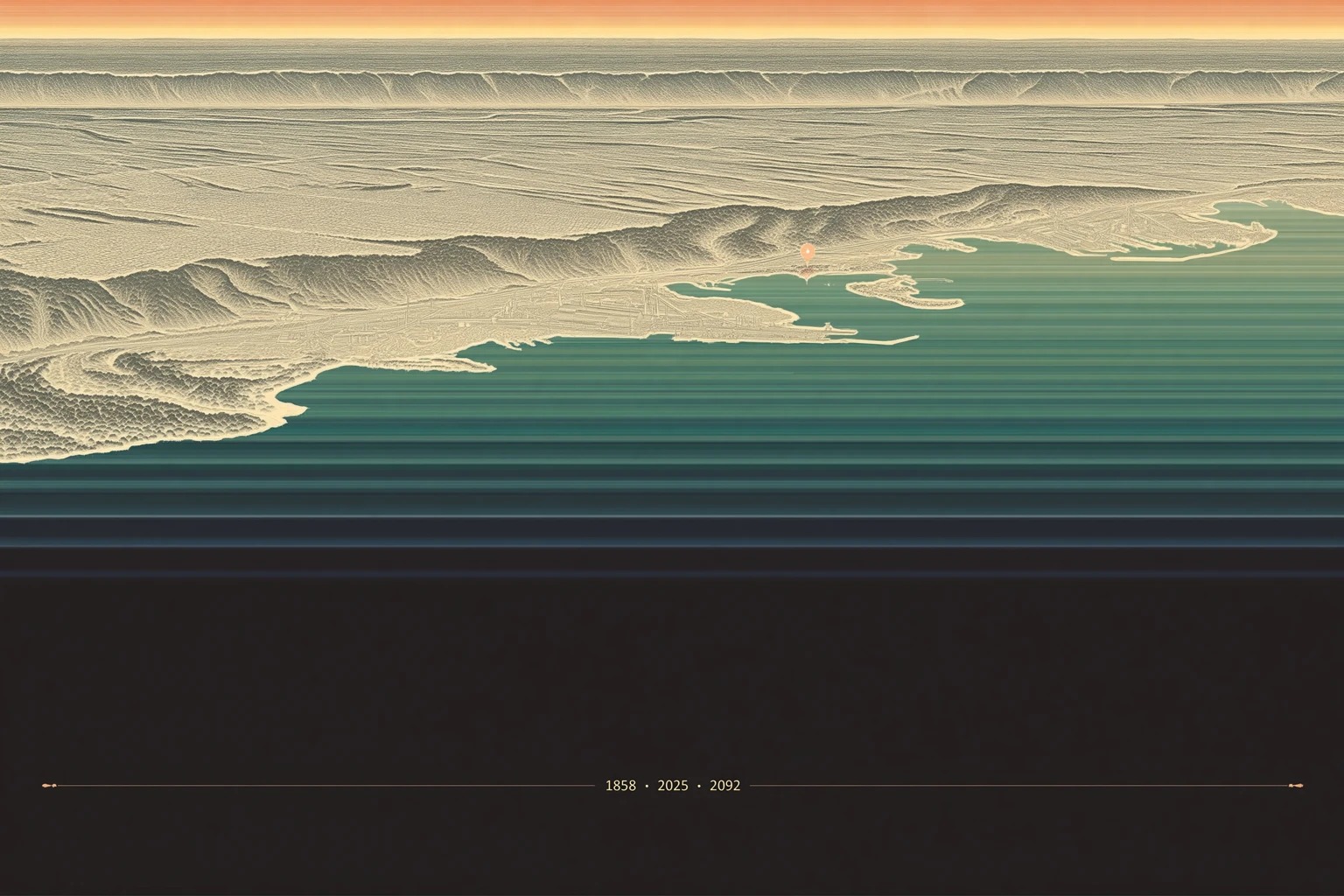
Chapter Two

Timeline

Hamilton 2092: A Living Chronology
Archive drawer of generational artefacts from 1910 to 2092
Fig 2.0.2. Archive drawer of generational artefacts

A city is a letter the generations write to one another.

This chronology stretches from dolostone deep time to the sentient basin of 2292, tracing how each generation has read, mended, and written back to the one before. Hamilton, here, is not a place but a long conversation, still unfinished, still listening.

Don’t forget · How to read this project

Timeline Visualization 2026–2292
Fig 2.0.3. Timeline Visualization 2026–2292
Bioregional Districts
7 + Transition Zones

Sector NM, Harbour, Lower City, Escarpment, Upper City, Agricultural Belt, Watershed, plus transition corridors at the city’s edges.

Sector NM Elevation
15 to 20 m above lake max

Strategic advantage after 2041 flood. Brownfield remediation completed 2028 to 2047. Now hosts MELA Mode 0 central hub.

Lower City Density
~120 residents/ha

Transit-dense, pedestrian priority. Car lanes narrowed. Mixed-use commons ground floors. 83rd Supercrawl in 2092.

Lake Sturgeon Acipenser fulvescens

Keystone species of the Great Lakes basin. Extirpated from Hamilton Harbour by 1940. First reintroduced to Cootes Paradise 2061; breeding population confirmed 2079. Reaches 2 m and 60 kg. Can live 150 years: the Tenth Generation will not be its last.

• • •

2.1 The Seven Bioregional Districts

Nia Crosby · Urban Farmer, West Harbour Grove

I can walk from the harbour to the escarpment brow in forty minutes and pass through four districts. Each one smells different. The harbour is salt and fish and warm stone. The Lower City is bread from the commons bakeries and coffee from the James Street vendors. The escarpment is cedar and wet limestone. The Upper City is cut grass and apple blossoms. That is how I navigate: not by ward numbers but by what the air tells me.

Hamilton 2092 is organized into seven bioregional districts, each defined not by administrative boundaries but by ecological function, topography, and the living systems they sustain. Together they form the spatial grammar of the city: a language of place that every resident learns to read. The chronology that follows is written across these districts, each era touches each of them differently.

Sector NM: The Industrial Heart Transformed

Sector NM encompasses the industrial lands northeast of Hamilton’s core, historically anchored by the Confederation area and extending toward the Barangas district. Where Stelco’s blast furnaces once produced steel for two world wars, this zone has been transformed by 2092 into the city’s primary fabrication hub, bioelectric transit centre, and civic gathering space.

Following the 2041 West Harbour Flood and 2053 Hurricane Mera, Hamilton’s strategic planning shifted critical systems to safer ground. Sector NM offered elevated topography (15 to 20 metres above Lake Ontario’s maximum recorded level), post-industrial brownfields ready for remediation, and existing rail corridors that could anchor the new MELA network. National Steel Car’s historic rail car facility (1912) has been adaptively reused as the Central Repair Depot and open-source maker space campus. Brownfield remediation was completed between 2028 and 2047.

Key locations include Confederation GO Station (now MELA Mode 0), the Orenda Fountain Plaza in Sector K, Ward 7 (Confederation Vertical Ward), Ward 8 (Barangas Community Cluster), and the Sector NM Commons. All designs produced here are open-source by default; no proprietary manufacturing is permitted within city commons territory.

The Harbour District

The city’s ecological and civic heart. The Great Rewilding of 2055 transformed 400 hectares of post-industrial waterfront at Pier 4 and the West Harbour into a functioning lacustrine ecosystem. The MELA Harbour Terminus anchors the district. The Basin Assembly’s rotating open sessions are held in the outdoor amphitheatre at Pier 8 Commons. Cootes Paradise marsh at the western edge is now home to lake sturgeon, first reintroduced in 2061, with a breeding population established by 2079. Reduced to secondary station status after the 2041 flood, West Harbour remains operational as a secondary GO Transit station, preserving waterfront connectivity while reducing dependency on low-lying infrastructure.

The Lower City

The historic downtown core below the escarpment, now one of the most transit-dense districts in the bioregion. The legacy street grid from James Street North down through Barton and out toward Gage Park has been gradually repurposed: car lanes narrowed to bike and pedestrian priority, ground floors converted to mixed-use commons. James Street North’s cultural corridor hosts the 83rd Supercrawl in 2092. Population density: approximately 120 residents per hectare.

The Escarpment District

The dramatic vertical transition zone running the length of the Niagara Escarpment, now a managed ecological corridor. The Chedoke Ravine greenway was restored in 2041, reconnecting the escarpment to the harbour watershed. Vertical farms terraced into the slope supply 18% of the city’s leafy greens. Trails link the Bruce Trail (est. 1960) to the rewilded basin below. Dundurn Castle and its grounds, sited on Burlington Heights at the base of the escarpment, serve as a heritage anchor along its western approach.

The Upper City

Hamilton’s plateau above the escarpment, connected to the Lower City via escarpment lifts and MELA mountain-route pods. Primarily residential Grove clusters interspersed with community food forests. The plateau’s low density (42 residents per hectare) is managed by the Mountain Commons Land Trust.

The Agricultural Belt

A patchwork of small-scale farms, orchards, and food forests ringing the urban core, extending through Glanbrook, Binbrook, and rural Stoney Creek. This is agroecological farming, integrated with wildlife corridors and managed for soil health, biodiversity, and carbon sequestration as much as for food production.

The Watershed District

The creek systems that drain into the harbour: Red Hill Creek, Stoney Creek corridor, Chedoke Creek, and the dozens of smaller waterways that have been daylighted and restored over the decades. These riparian corridors form the backbone of the city’s green infrastructure, managing stormwater, providing habitat, and offering recreational space.

The Transition Zones

The areas where the city meets the surrounding region: the Caledonia-facing edge, interfaces with the traditional territories of the Mississaugas of the Credit First Nation, and the corridors that allow wildlife to move through and around the urban area.

Niagara Escarpment Cross-Section, 2092
Fig 2.1.1. Niagara Escarpment Cross-Section: 2092
The Seven Bioregional Districts, Sector NM hero shot, former Stelco mill transformed
Fig 2.1.2. The Seven Bioregional Districts · Sector NM, former Stelco mill transformed
Escarpment District cross-section with vertical farms and lifts
Fig 2.1.3. Escarpment District cross-section with vertical farms and lifts
Transition Phases
3

Crisis & Response (2025 to 2045). Construction (2045 to 2070). Refinement (2070 to 2092). Seventy years of becoming.

• • •

2.2 A Brief History of the Transition

Hamilton 2026 vs 2092 Comparison
Fig 2.2.1. Hamilton 2026 vs 2092 Comparison, drag to explore

Hamilton 2092 did not spring into existence fully formed. It emerged through a seventy-year process of transformation, struggle, and reinvention. The timeline that follows fleshes this arc out year by year; this section offers the shape of it at a glance.

Phase 1 (2025 to 2045): Crisis and Response. Climate protests, mutual aid networks forming, early green infrastructure. The Hamilton Accords of 2034 established the framework. Brown and muted tones of struggle giving way to the first signs of change.

2017 Real Event: Hamilton’s Compound Flood

In 2017, elevated Lake Ontario levels combined with heavy rainfall to cause: escarpment mudslides, flooded waterfront trails, 1,300 Olympic swimming pools of sewage overflow into the harbour, and $30.67 million in infrastructure repairs. This single real event validates the compound flood framework the project uses for both the 2041 and 2053 speculative storms. Every element of the fictional catastrophe has already occurred individually in Hamilton: just not all at once.

Phase 2 (2045 to 2070): Construction. MELA guideways being built, harbor restoration in progress, Orenda wells being drilled. The 2060 Ecosocial Compact replaced the legacy city council structure. The Great Rewilding of 2055. The first Groves expanding across the city.

Ravy Ryan · Harbour Steward, Waterfront Ward

“I was born in 2044, Phase 1 was ending, Phase 2 beginning. My earliest memory is the sound of construction: not the old kind, the grinding and blasting, but the strange hum of the first Orenda wells being drilled. My mother said the ground vibrated for months. She said the elders from Six Nations came and spoke to the earth before the drills went in. I didn’t understand that then. I do now.”

Phase 3 (2070 to 2092): Refinement and Consolidation. The flourishing city as it appears today: mature green infrastructure, vibrant community life, the ongoing work of making systems more responsive, more just, more rooted.

Hamilton 2092 viewed from the escarpment brow, showing the vertical farms, MELA guideways, and restored harbour below
Fig 2.2.2. Hamilton 2092 seen from the escarpment brow. Vertical farms terrace down the slope. The MELA guideway curves over the rewilded harbour. The lower city is dense with canopy.
MELA guideway under construction at Phase 2 dusk
Fig 2.2.3. A Brief History of the Transition · MELA guideway under construction, Phase 2 dusk
Geological Age
450 MYA

Niagara Escarpment formation; glacial retreat carves the Hamilton basin and harbour

From the Big Bang to the Sentient City and the letter that writes back. Approximately 120 key events across seven eras. This timeline consolidates the full audit of the Hamilton 2092 worldbuilding corpus, cross-referenced against the 280-event Master Timeline.

Era 1 Pre-Collapse, stratigraphic column from 450 MYA to 2025
Fig 2.0.4. Era 1 · Pre-Collapse (Deep Time → 2025): stratigraphic cross-section
Era 1 Pre-Collapse, artefact row from dolostone to 2025 GO transit card
Fig 2.0.5. Era 1 · Pre-Collapse: artefact row, dolostone to Confederation GO card

Deep Time

13.8 BYA
The Big Bang
The atoms that will form Hamilton’s bedrock are forged in stellar nucleosynthesis.
4.5 BYA
Earth Forms
The planetary crust begins its long differentiation from the solar accretion disk.
450 MYA
Niagara Escarpment Begins to Form
Ancient tropical seas deposit the limestone, dolostone, and shale that will become the geological spine of southern Ontario.
Elder's Voice · The Tenth Generation, 2292

We begin where the stone begins. Four hundred and fifty million years before the first Grove was planted, before the first Orenda filament threaded through bedrock, the escarpment was already rising, slowly, patiently, in the dark warmth of a tropical sea that no human would ever see.

When I walk the escarpment trail above Sector NM, I sometimes press my hand against the exposed dolostone and try to feel the time. I cannot. But the Orenda can. It reads the geological memory in the mineral signature and tells us: you are standing on the oldest infrastructure this city will ever have.

We did not build the escarpment. We learned to listen to it.

12,000 YA
Laurentide Ice Sheet Retreats
Glacial Lake Iroquois recedes, carving the landscape that will become the Hamilton harbour, the Dundas Valley, and the surrounding watershed. The escarpment emerges as a dominant landform.
11,000 BCE
Paleo-Indian Settlement
Human habitation begins in the Hamilton area following the retreat of the Laurentide Ice Sheet. Paleo-Indian peoples follow caribou herds into newly deglaciated territory.
8,000 YA
Cootes Paradise Forms
A drowned river mouth at the head of Hamilton Harbour becomes the ecological heart of the region: a marshland shaped by millennia of Indigenous stewardship.
3,000 BCE
The Woodland Period Begins
Introduction of ceramics, mound building, and agriculture (the Three Sisters: corn, beans, squash) to the Hamilton area. Trade networks deepen and cultures grow more complex.
Turtle Island
10,000 yrs

Indigenous stewardship, Haudenosaunee Confederacy, Dish With One Spoon covenant

• • •

Pre-Contact / Indigenous (~1300–1701)

~1300–1600
Attawandaron (Neutral Nation) Occupy Hamilton Basin
Population estimates: 40,000–60,000 people. Complex agricultural societies, extensive trade networks, and sophisticated ecological management shape the land. They maintain diplomatic balance between Haudenosaunee and Wendat, controlling the flint trade.
~1450
Haudenosaunee Confederacy Founded
The Great Law of Peace (Kaianere’kÓ:wa) establishes one of the earliest known democratic constitutions. The confederacy of five (later six) nations creates a governance model that will influence both the U.S. Constitution and, centuries later, the Hamilton Ecosocial Compact.
1400s–1600s
Dish With One Spoon Wampum Covenant
Formalized among Haudenosaunee and Anishinaabe nations. The treaty establishes shared stewardship of Great Lakes territory: take only what you need, keep the dish clean for others. This principle resurfaces in 2058 as the philosophical basis of the Dish Protocol.
Elder's Voice · The Tenth Generation, 2292

The Dish With One Spoon is the oldest governance protocol still operating in the Hamilton Basin. Not because anyone preserved it in a museum. Because it was right.

When the Compact was drafted in 2058, the negotiators did not invent the principle that a watershed belongs to everyone who drinks from it. They remembered it. The Haudenosaunee had been saying it for six hundred years. The difference was that in 2058, the settlers finally listened.

From where I stand, two centuries later, the continuity is unmistakable. The Great Law of Peace and the Ecosocial Compact are separated by six hundred years, but they are the same argument.

1610
French Exploration of the Great Lakes
Samuel de Champlain allies with Wendat against Haudenosaunee, beginning a pattern of Europeans weaponizing Indigenous conflicts that will reshape political alliances across the region.
1616
First Contact
French explorers encounter Attawandaron settlements near present-day Hamilton. European contact begins to reshape trade networks, political alliances, and land relationships across the Great Lakes.
1651
Attawandaron Dispersal
The Haudenosaunee Wars (Beaver Wars) displace the Neutral Nation from the Hamilton region. Survivors are absorbed into neighbouring nations. The land does not empty, it changes hands.
1701
Great Peace of Montreal
Thirty-nine Indigenous nations sign a peace treaty with New France. The Dish With One Spoon covenant is strengthened and extended. It is the largest diplomatic gathering in the Americas to that date.
Peak Steel
1950s

Hamilton produces 60% of Canada’s steel; harbour contamination accelerates

• • •

Colonial, Founding & Industrial (1763–2000)

1763
Treaty of Paris / Royal Proclamation
The Seven Years’ War ends. The Royal Proclamation of 1763 recognizes Indigenous land rights and establishes the requirement for Crown treaty-making, a principle honoured more in the breach than the observance.
1778
First Permanent European Settlement
Primarily Loyalist refugees following the American Revolution settle in the Burlington Bay area. The landscape they arrive in has been shaped by millennia of Indigenous stewardship.
1784
The Haldimand Tract
Governor Haldimand grants Six Nations of the Grand River 950,000 acres (six miles on each side of the Grand River from source to mouth) in recognition of Haudenosaunee alliance during the American Revolution. By 2025, less than 5% remains.
1784 / 1792
Between the Lakes Purchase
Originally negotiated in 1784 and confirmed in 1792, the Crown acquires roughly 3 million acres from the Mississaugas of the Credit for £1,180 in goods. Terms are contested; the Mississaugas maintain the agreement covered limited use, not outright surrender.
1813
Battle of Stoney Creek
June 6. A pivotal engagement of the War of 1812: a British night raid routs a larger American force. The battle preserves Upper Canada and becomes a founding myth of the Hamilton region.
1816
Hamilton Founded
George Hamilton, a land speculator from Queenston, registers a town site at the Head of the Lake. He names it after himself. The Haudenosaunee name for the area, Attiwandaronk, the place of the Neutral people, is already beginning to fade from maps. It does not fade from memory.
1826
Desjardins Canal Constructed
The canal connects Hamilton Harbour to Dundas, positioning Hamilton as an inland port and establishing the industrial transportation infrastructure that will define the city for a century.
1837
Hamilton Central Market Established
One of Canada’s oldest continuously operating farmers’ markets, forming the social infrastructure for food exchange that will evolve into the Grove commons food systems of 2092.
1846
Hamilton Incorporated as City
Population: approximately 6,800.
1854
Great Western Railway
The railway completes its Hamilton terminal. The city becomes one of Canada’s primary railway junctions. Goods flow from Chicago to New York, and Hamilton sits at the intersection. The logic of extraction and throughput is built into the city’s bones from the beginning.
1857
Ottawa Chosen as Capital
Hamilton, which had been a serious candidate, is passed over. The city doubles down on industry instead of government, a decision whose consequences will echo for two centuries.
1867
Canadian Confederation: Generation 1
Hamilton is already an industrial centre, producing iron, textiles, and machinery. Population: approximately 19,000. The Steel Capital is being born.
1872
The Great Fire of Hamilton
The conflagration forces adoption of rigorous urban planning and building standards, reshaping the city’s physical form and its relationship to disaster preparedness.
1876
Hamilton Public Library
The Hamilton Mechanics’ Institute becomes the Hamilton Public Library, one of the first public libraries in Ontario. In a city defined by industrial labour, the library is a democratic counterweight: knowledge available to anyone who walks through the door.
1878
First Commercial Telephone Exchange in British Empire
Hugh Cossart Baker Jr. connects his office to his home. Hamilton’s relationship with communication technology begins.
1893
Hamilton Radial Electric Railway
Hamilton is an early adopter of electric transit, a pattern that will repeat, with much greater ambiguity, in the LRT debates of the 2010s–2030s.
1895
Hamilton Steel & Iron Company
Steel production begins on the north shore of the harbour. The waterfront transformation from harbour to heavy industry accelerates. The industrial lands would expand continuously for the next sixty years.
1910
Stelco Founded
The Steel Company of Canada is formed through the merger of five smaller firms. Hamilton’s identity as the Steel Capital of Canada is formalized. Stelco will operate in Hamilton for nearly a century, defining the city’s character, economy, and social structure.
1912
Dofasco Established
Dominion Foundries and Steel. Two steel giants, one unionized (Stelco) and one non-union (Dofasco), will define Hamilton’s labour politics for a century.
1919
The Hamilton General Strike
One of the largest labour actions in Canadian history: workers across industries walk out in solidarity with Winnipeg’s General Strike. Hamilton’s steelworkers, machinists, and trades workers demonstrate the organizing power that would define the city’s political character for generations.
1923
Williams Treaties Signed
Mississauga and Chippewa nations sign under duress, surrendering vast tracts of land in Ontario. The treaties will be challenged and revisited nearly a century later.
1939–1945
Hamilton’s “Forge of Victory”
The city’s steel mills produce approximately 50% of Canada’s wartime steel output. Lancaster bomber parts, naval armour, and munitions flow from Hamilton’s factories. The war years represent the peak of industrial Hamilton, and the beginning of the environmental costs that will define the next century.
1941
Royal Botanical Gardens Established
Incorporating Cootes Paradise, the Rock Chapel Sanctuary, and extensive cultivated gardens. From the beginning, RBG is unusual: a botanical garden that includes significant wild lands, not just cultivated ones.
1946
Stelco Strike
Twelve thousand steelworkers walk off the job for 81 days in what becomes one of the defining moments of Canadian labour history. The settlement establishes the eight-hour day, union security, and improved wages. Hamilton cements its identity as a union town.
1950
Peak Steel
Hamilton produces 60% of Canada’s steel. The blast furnaces run day and night. The harbour is effectively an industrial zone; swimming is banned in Burlington Bay. The city is prosperous, polluted, and proud.
1951
Hamilton’s Last Streetcar
The system that once spanned 50+ miles of track becomes financially unsustainable as automobile ownership surges. The city will spend the next seven decades trying to build rail transit again.
1954
Hurricane Hazel
October 15. The storm kills 81 people across southern Ontario and devastates Hamilton’s flood-prone lower city. Hazel reshapes Canadian flood policy, leading to the creation of conservation authorities. The vulnerability of cities built without regard for watershed ecology is laid bare.
1950s
Burlington Bay Closed to Swimming
Industrial contamination renders the harbour unsafe. It will take seventy years to begin reversing the damage.
1955
Hamilton Philharmonic Orchestra Founded
In a city defined by industrial identity, the Philharmonic represents the insistence that steelworkers’ children deserve cultural institutions as much as anyone.
1960
Urban Highway Construction / Bruce Trail Established
The QEW/403 corridor and elevated arterials cut the working-class north end off from escarpment neighbourhoods, establishing the highway as a racial and class divider. Simultaneously, the Bruce Trail is established along the Niagara Escarpment: more than 900 kilometres of marked footpath, the primary public access point to the escarpment ecosystems.
1970–2000
Deindustrialization
Steel employment drops from 30,000 to under 4,000 over three decades. Plants close. Neighbourhoods hollowed by the loss of well-paying industrial work are not replenished. Hamilton enters a long, uneven identity crisis.
1972
Great Lakes Water Quality Agreement
Canada-USA agreement signed following years of public outcry over degradation of the Great Lakes. Lake Erie is famously described as “dead.” Hamilton Harbour is among the most contaminated bodies of water in the agreement’s scope.
1981
Steel Industry Collapse Begins
Global steel overcapacity, American protectionism, and oil shocks devastate Hamilton’s economy. Stelco’s workforce peaks at 26,000 before entering terminal decline. Hamilton loses approximately 25,000 manufacturing jobs in two years. Unemployment hits 14–16% in some neighbourhoods.
1985
Hamilton Harbour Identified as Area of Concern
Hamilton Harbour is identified as an Area of Concern in 1985, formalized in the 1987 Protocol to the Great Lakes Water Quality Agreement. The harbour and its tributaries are recognized as among the most degraded ecosystems in the Great Lakes basin. A Remedial Action Plan is initiated. Remediation will take four decades.
Elder's Voice · The Tenth Generation, 2292

The industrial centuries were not wasted time. They were the fire that forged the question. When Stelco’s blast furnaces ran day and night through the 1940s, when sixty percent of Canada’s steel poured from Hamilton’s waterfront, the city was building something it did not yet understand: the proof that extraction without return will always break.

The 1946 strike taught Hamilton that workers have rights. The 1985 harbour designation taught Hamilton that water has rights too. It took another seventy-three years for that lesson to become law, but the seed was planted in the industrial soil.

We do not erase the steel era from our memory. The slag beneath Sector NM is the foundation we built on. The labour traditions of the steelworkers became the organizing traditions of the Ward assemblies. Nothing was lost. Everything was composted.

1990
Niagara Escarpment: UNESCO World Biosphere Reserve
The designation affirms the ecological significance of the escarpment that rises through Hamilton’s upper city and acknowledges it as a globally significant habitat corridor.
1992
Hamilton Harbour Remedial Action Plan
Coordinated by the Bay Area Restoration Council (BARC), the RAP establishes measurable targets (Beneficial Use Impairments, or BUIs) and commits to a multi-decade remediation program.
1996
Cootes Paradise Fishway Installed
The Royal Botanical Gardens completes fishway construction, achieving 95%+ carp exclusion and beginning habitat restoration for migratory fish species. A small, patient act of ecological repair.
AMD CO₂ Emissions
4.16 MT

2023 · Ontario’s single largest industrial emitter. Named Hamilton–Niagara Top Employer 2026. It is not going anywhere soon.

2041 Flood
0.5–0.75 m

Lake Ontario surge depth in lower city; combined with 200–300+ mm rainfall, harbour overwhelms flood defences

• • •

Crisis (2001–2050)

Era 2 Crisis, storm-front cross-section of 2026 to 2050 with rising waterline
Fig 2.4.1. Era 2 · Crisis (2026–2050): storm-front cross-section
Era 2 Crisis, flooded lower-Hamilton street corner at first morning light
Fig 2.4.2. Era 2 · Crisis: flooded lower-Hamilton street corner
2001
Municipal Amalgamation
Six former municipalities (Hamilton, Ancaster, Dundas, Flamborough, Glanbrook, and Stoney Creek) are merged into a single City of Hamilton by provincial order. The merger is deeply unpopular in the suburbs. The tensions between urban core and rural wards will persist for six decades, until the Compact dissolves the city altogether.
2006
James Street North Arts Crawl
A monthly gathering transforms a formerly vacant commercial strip into one of Canada’s most vibrant grassroots arts communities, catalyzing the emergence of artist-run spaces, galleries, studios, and community organizations in the lower city.
2004
Stelco Files for Creditor Protection
The Steel Capital of Canada cannot sustain its namesake industry on the terms it inherited. The company enters restructuring; the workforce is already a fraction of its peak.
2007
U.S. Steel Acquires Stelco
The Hamilton steelmaker passes into foreign ownership for the first time in its ninety-seven-year history. (Subsequent ownership changes follow: Stelco returns to Canadian control, and in July 2024 is acquired by Cleveland-Cliffs for approximately US$2.5 billion.)
2009
Supercrawl Launches
Hamilton’s flagship outdoor arts, music, and culture festival on James Street North. Drawing tens of thousands of visitors annually, Supercrawl places Hamilton on the Canadian cultural map and demonstrates that the city’s most powerful asset is not steel production but human creativity.
c.2010
Golden Oyster Mushroom Escapes Cultivation
Pleurotus citrinopileatus, introduced to North America in the early 2000s via home-cultivation grow kits, establishes feral populations in North American forests by approximately 2010. First Ontario sightings follow. Ontario places no prohibited-species listing; live cultures remain legal to buy, sell, and transport. Veerabahu et al. (2025), Current Biology.
2010, Golden Oyster mushrooms on a fallen elm log, greenhouse escape
Fig 2.4.3. 2010 · Golden Oyster escape: greenhouse pane cracked, spores drifting
2012
Randle Reef Funding Commitment
The largest contaminated sediment site in the Canadian Great Lakes, a 60-hectare toxic hot spot in Hamilton Harbour, receives a $138.9 million federal-provincial cleanup commitment. An engineered containment facility is designed to cap the contaminated sediments. Major on-site remediation works proceed from 2015 onward.
2015
Ontario Commits Funding for Hamilton LRT
The B-Line announcement follows decades of advocacy and multiple false starts. Construction projected for completion by the early 2020s. Hamiltonians cautiously allow themselves to hope.
2017
Beech Leaf Disease Detected in Ontario
Litylenchus crenatae ssp. mccannii, a foliar nematode originating from Japan, is first recorded in Elgin County. Lethal to Fagus grandifolia (American Beech). Over the following two decades BLD advances along the north shores of Lakes Erie and Ontario toward Hamilton’s Dundas Valley, destabilizing the ancient Amanita/Cortinarius ectomycorrhizal networks that depend on Beech as host. Invasive Species Centre (2025); Ontario MNR (2020).
2017, American beech leaf with early Beech Leaf Disease banding
Fig 2.4.4. 2017 · Beech Leaf Disease: specimen study, early interveinal striping
2018
AR Goggles Failure
Augmented Reality eyewear technology fails in the consumer market: users experience sensory overload, cognitive failure, information vertigo. The failure rejects the notion that more data equals better decisions, and clears the conceptual space for the Multi-Lens’s very different approach.
2018
Williams Treaties Settlement
Eight First Nations receive $1.11 billion in settlement for the 1923 treaties signed under duress.
2019
Ontario Cancels Hamilton LRT
The Province abruptly withdraws funding after an election-year reversal. The decision devastates transit advocates who had built years of community planning around the corridor. The cancellation is later recognized as a moment of radicalization: the betrayal accelerates grassroots self-organization.
2020
Pandemic Reshapes Hamilton
Community mutual aid networks form spontaneously: food distribution, neighbour support, community care rosters. These networks outlast the pandemic and form the organizational backbone of the early Transition Town meetings that begin in 2026.
2021
Hamilton LRT Re-Approved
Under a new federal-provincial agreement. The intervening years of cancellation have deepened community commitment to transit that is community-governed, not provincially managed.
2021
ArcelorMittal Dofasco Green Steel Investment
A $1.8 billion investment in hybrid electric arc furnace technology marks the beginning of the end of blast furnace steelmaking in Hamilton. It remains the largest industrial decarbonization commitment in Canadian history at the time.
2022
Randle Reef Stage 2 Completed
The engineered containment facility’s Stage 2 is capped; the final stage continues through 2024, with 2025 reporting marking completion milestones. Hamilton Harbour water quality begins measurable improvement. It is not restoration; it is stabilization. The trajectory changes.
2022–2023
Dofasco Decarbonization Promise
ArcelorMittal Dofasco announces a $1.8 billion decarbonization project, one of the largest industrial green investments in Canadian history. The plan: retire the blast furnaces, build Direct Reduced Iron and Electric Arc Furnace technology, cut emissions 60% by 2028. Federal government commits $400M; Ontario adds $500M. Total public money: $900M. The announcement generates national attention. Engineering phases begin. Not one shovel enters the ground. ArcelorMittal. (2022, February 14). ArcelorMittal decarbonisation project in Hamilton, Canada confirmed.
2025
Present Day: The Threshold
Hamilton is a city in transition: growing, contested, searching for a new identity. Climate disruption is accelerating. The Confederation GO Station opens on October 27, connecting Hamilton more tightly to the Toronto megalopolis. The question of what Hamilton will become is genuinely open.

The Acceleration (2026–2035)

2026
Great Lakes Tariff Crisis
Continental trade fractures intensify. Hamilton’s remaining manufacturers face supply chain collapse. The first “Transition Town” meetings convene in basements and church halls across the lower city. Simultaneously, the Multi-Lens prototype, a diagnostic-perceptual tool that will become ubiquitous by 2092, is developed at Sheridan College.
2026
Dofasco No. 3 Coke Plant Closes
ArcelorMittal Dofasco permanently decommissions its No. 3 Coke Plant, the first physical reduction of the blast-furnace complex that has defined Hamilton’s North End since 1912. No. 2 Coke Plant continues operating. No jobs lost; all affected workers reassigned within the facility. Dofasco emitted 4.16 megatonnes of CO&sub2; in 2023 alone, making it Ontario’s single largest industrial emitter. The direction has shifted, even if the pace has not. The decommissioned plant’s footprint joins the queue of contaminated brownfields accumulating along the North Shore: land that will require remediation before it can become anything else. The OrgoBots that will first pilot in Sector NM in 2045 were grown, in part, to address sites exactly like this one. CHCH News. (2026, April 9). ArcelorMittal Dofasco to close No. 3 coke plant Monday, employees reassigned.
2026, Dofasco No. 3 Coke Plant final decommissioning day, empty hi-vis hard hat
Fig 2.4.5. 2026 · Dofasco No. 3 closes: gatehouse on decommissioning day
2026
The Green Steel Extension: A 22-Year Delay
In January, a federal government document amendment is quietly published online, with no press release and no announcement. Ottawa extends its $1.8 billion funding agreement with ArcelorMittal Dofasco from 2028 to 2050. The DRI facility, the centrepiece of the original plan, is removed from Hamilton entirely; reduced iron will now be sourced from ArcelorMittal’s facility in Contrecoeur, Quebec. What this means for Hamilton steelworkers is left unstated. Community groups are furious. Ecojustice and Hamilton residents file a formal probe request with the province, noting Dofasco’s air quality exemptions expired in 2023 and the company has been operating in a regulatory grey zone ever since. In parts of the North End, cancer risk from benzene and benzo(a)pyrene is reportedly 100 times the provincial average. Meanwhile, ArcelorMittal Dofasco is named one of Hamilton-Niagara’s Top Employers for 2026, signalling that, whatever its environmental record, it employs 5,000 people and it is not going anywhere soon. The contradiction is Hamilton’s to hold. CBC News. (2026, January 14). ArcelorMittal Dofasco quietly extends ‘green’ steel timeline from 2028 to 2050. Environmental Defence Canada. (2026, January 22). Environmental groups demand answers from ArcelorMittal. Ontario Ministry of the Environment. (2026). Environmental compliance approval (air), ArcelorMittal Dofasco [ERO 026-0039].
2027
Federal Green Transition Act
The Mark Carney federal government signs the Great Lakes Technology Exchange Compact, opening access to superconducting maglev technology. Randle Reef ecological monitoring shows early signs of harbour recovery.
2028
Orenda Coil Emerges
A collaborative research program spanning McMaster University, King’s University College, and Sheridan College produces an advanced biosynthetic energy storage medium. What emerges is far stranger than a storage device. The Hamilton Climate Adaptation Plan is adopted; it requires all new construction to meet passive house standards and establishes the first municipal Urban Agriculture Office.
2029
Ontario Grid Peak Demand Deficit
Summer brownouts become routine, accelerating the closure of legacy manufacturing facilities. Hamilton begins exploring distributed energy alternatives. Early Dish Protocol conversations begin among Indigenous governance scholars, watershed scientists, and Hamilton community organizers.
2029, residential Hamilton living room at dusk mid-brownout, single candle
Fig 2.4.6. 2029 · Ontario grid brownouts: Hamilton living room at dusk
2030–2031
Neuralink Collapse
The brain-computer interface company’s catastrophic failure triggers a global reckoning with invasive neural technology. Public trust in centralized, black-box AI systems evaporates. The event creates the cultural conditions for Hamilton’s later embrace of non-invasive, ecological intelligence networks.
2032
Hamilton LRT B-Line Opens
After more than two decades of debate, cancellation, reinstatement, and delay, the light rail line runs from Eastgate Square to McMaster University. Ridership exceeds projections within months. It is already insufficient for the city’s needs, but it becomes the spine around which future development reorganizes.
2033
First Grove Pilot Project
Launched on remediated Stelco lands: a mixed-use, food-producing neighbourhood cluster demonstrating integrated ecological living. Early residents sign 99-year stewardship contracts rather than mortgages.
2034
The Hamilton Accords
The failure of the Elfrida Lands development triggers a cascading rent crisis. Mutual aid networks are formalized into neighbourhood assemblies. The Accords establish a framework for resource-sharing that prefigures the Ward system. The principle of more-than-human citizenship is written into the city charter.
2035
Orenda Coil Prototype Breakthrough
Teams shift from building a separate smart controller to a symbiotic partner: the decision to grow intelligence into materials themselves. ArcelorMittal Dofasco closes its final coke battery (No. 2, the last operating unit after No. 3’s 2026 decommissioning), ending coke production on the North End waterfront. The Electric Arc Furnace (EAF) transition promised for 2028, extended to 2050, still lies fifteen years away. The blast furnace era ends not through green transformation but through attrition: equipment retired, not replaced. No steel is made in Hamilton by electric arc in 2035. The EAF transition will not occur until 2050 at earliest.

The Storms (2035–2050)

2038
Storm Elara
A catastrophic derecho devastates the GO transit corridor between Hamilton and Toronto. Rail service is severed for months. Hamilton’s dependency on external commuter infrastructure is exposed. The Multi-Lens enters limited production; first functional prototypes ship.
c.2040
Fungal Biodiversity Halving, Dundas Valley Margins
Community-science surveys confirm that golden oyster (Pleurotus citrinopileatus) has colonized enough dead-wood substrate across Hamilton’s peri-urban forests to halve native fungal species richness on colonized logs. The pattern mirrors Veerabahu et al.’s 2025 Wisconsin elm study. The finding becomes a foundational design argument for the Orenda Network’s “native species, native substrate, lifecycle that ends” principle. Veerabahu et al. (2025), Current Biology.
2040
Coast Rail Federal Announcement
Ottawa commits to the Great Lakes Coastal Magnetic Rail, a maglev corridor connecting Windsor to Ottawa via Hamilton. The announcement includes unprecedented Indigenous consultation requirements and ecological co-design mandates.
2041
The First Flood
Lake Ontario breaches Hamilton’s aging flood defences. The lower city is inundated. West Harbour floods catastrophically: 2,400 homes are damaged, Cootes Paradise overflows its basin, and the harbour district is devastated. Emergency task forces replace normal city council operations. The event marks the end of Hamilton’s inherited infrastructure paradigm. This is a compound event: atmospheric flood plus 1858 sewer trunk rupture along the harbour waterfront. Twelve years later, Hurricane Mera (see 2053) will finish what this storm began, forcing the primary transit hub off the harbour edge entirely. Triggered by a Hazel-type atmospheric convergence: 200–300+ mm rainfall over a saturated watershed. Lake Ontario storm surge (0.5–0.75 m above elevated baseline) overtops harbour walls and inundates the North End and Confederation Beach. Van Wagners Beach Road submerges. West Harbour GO approaches flood; James Street North corridor affected for 72+ hours. The Beach Strip faces existential erosion pressure. Transit planning begins permanent reorganization toward higher-ground nodes.

Hamilton’s combined sewer network was not built for 2041. It was built for 1858, cast iron laid while Confederation was still a proposal, extended through the industrial booms of the 1870s and 1890s, enlarged in the 1920s when Stelco’s first blast furnaces were already burning. One hundred and eighty years of pipe. When the storm surge hit the lower wards, those pipes, already at overflow capacity, already carrying the industrial residue that had soaked into their walls across a century and a half of steel production, gave way in sequence along the harbour waterfront. What entered the floodwater was not just sewage. It was 1858 remembering.

City of Hamilton records document over 600 km of combined sewers in the lower city, with trunk infrastructure dating to c. 1858–1920. The Wellington Street trunk sewer, discharging toward the harbour, was documented as a combined sewer overflow risk decades before the 2041 event.
2041, aerial view of West Harbour flood with 1858 sewer trunk rupture
Fig 2.4.7. 2041 · The First Flood: West Harbour at peak inundation
2041 Flood, Aerial Survey of Hamilton Waterfront
Fig 2.4.8. 2041 Flood: Aerial Survey of Hamilton Waterfront
Elder's Voice · The Tenth Generation, 2292

I have read the flood reports from 2041. I have seen the aerial images, water where streets should be, the harbour swallowing the North End, the Beach Strip broken in three places. I have read the accounts of people carrying their children through waist-deep water on James Street North.

What strikes me, from this distance, is not the destruction. It is the speed of the response. Within forty-eight hours, the neighbourhood assemblies that had been organizing quietly since 2020 became the only functioning government in the lower city. The mutual aid networks that started during the pandemic hardened overnight into something permanent. The crisis did not create the capacity. It revealed what was already there.

The Dark Years tested everything. They broke what deserved to break. What survived became the foundation of the world I live in now.

2041 Flood + 2053 Hurricane, Climate Event Maps
Fig 2.4.10. 2041 Flood + 2053 Hurricane: Climate Event Maps
2042
MELA Concept Formally Adopted
The Hamilton-Toronto Regional Transit Authority adopts Multi-Ecological Living Architecture as its framework: transit infrastructure will carry people, function as ecological corridor, and serve as public space simultaneously. Approximately 18% of lower-city population experiences moderate-to-severe food insecurity during the transition.
2043
Managed Retreat Policy
Hamilton becomes one of the first Canadian cities to formally abandon the principle that all land within city limits will be defended from flooding. Lower-city neighbourhoods are designated for strategic withdrawal.
2044
Summer Heat Spike
A sustained heat dome in July kills 34 people in Hamilton, predominantly elderly residents in under-cooled housing. The deaths accelerate the city’s investment in cooling commons and urban canopy expansion. [Grounded in IPCC AR6 WGII projections for urban heat in Canadian cities; Cakmak et al. (2022), Exacerbated Heat in Large Canadian Cities.]
2041–2050
Sector NM Remediation Begins
The former Stelco furnace yards, redesignated as Sector NM in the emerging bioregional grid, enter the first phase of systematic bioremediation. Steel slag is removed from the most contaminated cells; mycelial substrate seeding begins under the oversight of the Basin Remediation Compact. The work will continue across three decades before the land is ready for residential allocation.
2045
First OrgoBot Pilot in Sector NM
Bio-fabricated remediation organisms, part fungal network and part engineered microbiome, are deployed on the former Stelco lands. First living architecture prototypes deploy across Hamilton: structural panels incorporating mycelium composites and algae bioreactors.
2045, first-generation OrgoBot deployment on Sector NM steel-slag substrate
Fig 2.4.9. 2045 · First OrgoBot pilot: mycelial-lattice sphere on slag substrate
2045
Harbour Partial Swimming Designations (Multi-Site)
The first partial swimming designations extend across multiple harbour sites: Confederation Beach, the old Beach Strip, the eastern edge of Hamilton Harbour near the decommissioned QEW corridor, and portions of the West Harbour near Pier 4. It is narrow and cautious, a symbolic rather than systemic victory of the long Harbour Remedial Action Plan, but for many residents it is the first time they have ever stepped into the harbour water on purpose. Word spreads beyond the city.
2047
Hamilton-Toronto Coast Rail Opens
The climate-resilient maglev corridor restores rapid transit between the two cities (travel time: 18 minutes). In January, a severe ice storm causes cascading grid failure across the Niagara peninsula. Hamilton’s distributed energy experiments prove more resilient than centralized infrastructure.
2048
Great Lakes Water Level Threshold Event
Lake Ontario sets a new measured high, 0.4 m above the 2026 baseline, validating the Michigan Tech (2022) mid-range projection twenty-four years early. Pier 8 and Confederation Beach infrastructure begin accelerated shoreline adaptation: soft edges, wetland buffers, elevated walkways. The event is a marker rather than a catastrophe: it proves the projections were real. [Michigan Technological University. (2022). Future rise of the Great Lakes water levels. MTU; IPCC. (2021). Climate change 2021: The physical science basis. Cambridge University Press.]
2048
The Grimsby Accord
February 12. The Town of Grimsby formally requests observer status in Hamilton’s emerging watershed governance framework, the first external body to do so. The decision is made by Grimsby’s Watershed Steward Council, citing shared aquifer data. Hamilton’s Basin Assembly accepts by consensus vote. No maps are redrawn.
2048
Indigenous Co-Governance Formalized
The Mississaugas of the Credit First Nation and Six Nations of the Grand River enter formal co-governance agreements with the City of Hamilton. A joint land stewardship authority gains binding advisory power over waterfront and escarpment development.

The Dark Years (2048–2050)

2048–2050
The Dark Years
Infrastructure collapse, food insecurity, cascading energy grid failure. Federal capacity is consumed by continental crises; Hamilton is effectively abandoned by senior government. Those who remain self-organize, not from ideology but from necessity. Neighbourhood assemblies harden into the Ward system.
2060 Compact
47 signatories

Hamilton Ecosocial Compact passes by referendum with 61% support

• • •

Build (2050–2065)

Era 3 Transition, Basin Assembly rotunda with species-elder chairs
Fig 2.5.1. Era 3 · Transition (2050–2065): Basin Assembly, species-elder chairs
Era 3 Transition, 2058 harbour delisting swim at Bayfront Park
Fig 2.5.2. Era 3 · Transition: 2058 Bayfront delisting swim

The Renaissance (2050–2065)

2050
The Renaissance Begins
Hamilton commits to bioregional governance. The Great Lakes Climate Adaptation Compact establishes binding water-level management and shoreline setback standards. Cooperatives form across every sector. McMaster University and Sheridan College reopen as cooperative institutions.
2051
Windsor-Hamilton Coast Rail Segment
The city is now connected to the continental interior by 600 km/h maglev. The QEW corridor begins its gradual decommissioning. Phytoremediation systems are installed in Cootes Paradise, projected to reach safe-for-all-species chemistry by approximately 2118.
2052
Organic Intelligence Research Consortium
Forms at the new McMaster Institute for Symbiotic Technology. Unlike the failed AI paradigms of the 2030s, OI emphasizes decentralized, emergent, more-than-human-centric design.
2053
Hurricane Mera
A post-tropical cyclone of Category-3 equivalent intensity, the most powerful storm to reach the Great Lakes since Hurricane Hazel devastated southern Ontario in 1954, strikes the western Lake Ontario corridor. Hamilton sustains catastrophic damage. The federal government formally acknowledges that it cannot rebuild Hamilton to pre-storm conditions. In the aftermath, the Multi-Lens enters full production: pattern-recognition eyewear becomes critical for ecological assessment during reconstruction. Mera is the storm that forces the primary transit hub inland and uphill to Sector NM (see 2041 First Flood for the earlier compound event that first exposed the waterfront’s vulnerability). The move is not about building something new. It is the opposite: reuse the existing elevated terrain of the escarpment shoulder, avoid laying new streets, keep the rebuild low-cost. The terrain was already there. The streets were already there. That is why the MELA coast-rail anchors on high ground in Sector NM, not on the flood-vulnerable harbour edge. Mera also forces the hub to be designed as a multilevel structure, stacking regional rail, MELA surface transit, and a new high-altitude maglev tier on one footprint; the multilevel architecture is what later lets the coast-rail maglev operate above grade at all. Post-tropical Hurricane Mera, intensified by warmer Great Lakes, delivers a compound three-part flood: river flooding (Red Hill Creek, Spencer Creek), overland flash flooding from escarpment saturation, and Hamilton Harbour storm surge. Aldershot GO threatened by simultaneous Spencer Creek and Grindstone Creek overflow through the Hager-Rambo Diversion system. North End and Confederation Beach face 1–2+ metres of water. Beach Strip breached in multiple locations, permanently altering the harbour-lake boundary. Recovery drives the 2055 Great Rewilding initiative.
2053, September
Sectors NM/LK: Pumping Station Failure
Three days after Hurricane Mera, an uncontrolled orbital debris fragment re-entering during the storm’s tail strikes the harbour-side flood control pumping station at the former Stelco industrial frontage, Sectors NM/LK. The station had been keeping groundwater and harbour surge out of the reclaimed industrial fill since the 1940s. The fragment makes no wave. No one is killed. What it does is destroy the station’s generator and primary pumps, the infrastructure that has been holding the contaminated fill dry for over eighty years. With pumping capacity gone, Hamilton Harbour, already elevated 0.5–0.75 m above normal from Mera’s storm surge, floods the industrial sector unchecked. The contaminated fill beneath the former steelworks, PAH-laden sediment, coal-tar residue, heavy metals accumulated across a century of production, mobilises into the floodwater. Combined with the sewage main collapse on the same frontage, the site becomes the highest-concentration compound contamination event in MELA’s monitoring history. The OrgoBots are deployed as an emergency field operation. Compound-hazard remediation protocols drafted at this site become Basin Assembly emergency legislation within 45 days.
2053, flooded Stelco frontage at Sectors NM/LK after pumping station failure during Hurricane Mera
Fig 2.5.3. 2053 · Hurricane Mera aftermath: OrgoBot emergency pod at the flooded Stelco frontage
2054–2057
The Southwest Exodus
Compound climate events across the US Sun Belt (multi-year megadrought in the Colorado River Basin, catastrophic wildfire seasons across the Southwest, urban heat events crossing physiological thresholds in Phoenix and Las Vegas) drive the first sustained wave of internal climate migration in North America. Canadian federal and provincial governments establish the Climate Reception Framework. Southern Ontario, with its lake-moderated climate and existing urban infrastructure, is identified as a priority reception region. [Grounded in IPCC AR6 WGII Chapter 7 (North America) and Council of Canadian Academies (2022) assessments of climate-driven internal migration.]
2057
Myco-Infrastructure Pilot: North Shore Brownfields
The first large-scale fungal remediation program begins on the former ArcelorMittal Dofasco and Stelco industrial lands: 150 years of coke production have left the North Shore saturated with polycyclic aromatic hydrocarbons, heavy metals, and petroleum hydrocarbons. White-rot fungi (Phanerochaete velutina, Trametes versicolor, Pleurotus sp.) are seeded into contaminated substrate across the decommissioned plant footprint. Field studies have documented 94–99% PAH degradation within three months under comparable conditions; the North Shore scale is fifty times larger than any previous deployment. The pilot establishes a design principle that will define the city’s infrastructure for the next century: the organizational logic of the fungal mycelium, with mass flow through hollow vessel hyphae, self-healing anastomosis bypass when a pathway fails, pressure-driven flow without central control, and action potentials that sense and respond to resource demand, is applied directly to the redesign of Hamilton’s water, energy, and waste systems. The network does not need a brain. It needs substrate, moisture, and time. See Ch. 6: Ecology for Myco Hamiltoniana species documentation. Fricker, M. D., et al. (2017). The mycelium as a network. Microbiology Spectrum, 5(3). https://pmc.ncbi.nlm.nih.gov/articles/PMC11687498/
2055
The Great Rewilding of Hamilton Harbour
A 30-year restoration program integrating the completed Randle Reef cap, decommissioned industrial lands, and expanded wetland buffers. The program is co-designed with Indigenous stewardship councils. The rusty-patched bumblebee recovery accelerates through the Fallow Protocol and meadow creation.
2058
Dish Protocol Adopted • Harbour Delisted • MELA Greenlit
Drawing on the Dish With One Spoon Wampum Covenant, the Protocol establishes a framework for shared ecological governance. On March 21, the Compact Invitation Letter is distributed to all watershed communities. Hamilton Harbour is formally delisted as a Great Lakes Area of Concern, the first such delisting in Ontario in twenty years, completing the sixty-six-year arc begun by the 1992 Remedial Action Plan and the Bay Area Restoration Council. All fourteen Beneficial Use Impairments are finally resolved. Full harbour swimming designation follows within the year, and the city marks the occasion with a gathering at Bayfront Park. The transformation from “do not swim” warnings to a designated swimming destination becomes the civic turning point for radical transit ambition: if the harbour can be touched again, the city can build the infrastructure worthy of being touched. MELA’s expansion plans, until now contested as utopian, are approved by the Basin Assembly three months later.
2058, March 21 Compact Invitation Letter on Basin Assembly table with sweetgrass
Fig 2.5.4. 2058 · Dish Protocol / Harbour delisted: the Compact Invitation Letter
Ecosocial Compact Signing, 2060, Confederation Plaza
Fig 2.5.5. Ecosocial Compact Signing: 2060, Confederation Plaza
2058
Great Lakes Autonomy Accord
A bioregional governance framework is established, laying the foundation for the Great Lakes Federation.
2059–2062
Compact Resistance Period
Flamborough and Glanbrook, the most rural of Hamilton’s former wards, resist the dissolution of municipal government. Not everyone wants to be governed by watershed. Negotiations are protracted.
2060
Hamilton Ecosocial Compact
The city charter is amended. The amendment embeds three principles: rights of the Hamilton Harbour watershed as a legal entity; mandatory seven-generation impact assessment for all major infrastructure; binding Indigenous co-governance on all land use within 500 metres of waterfront and escarpment. Passes by referendum with 61% support.
2061
Last Hamilton City Council
September. There is no ceremony, no commemorative plaque. The councillors simply adjourn and do not reconvene. Most transition to Grove or Basin roles. Algorithmic social media is banned from Federation infrastructure, engagement-optimized platforms having been identified as incompatible with deliberative governance.
Elder's Voice · The Tenth Generation, 2292

The Build era is when Hamilton stopped reacting and started choosing. After the Dark Years broke the old systems, the Renaissance generation had to decide what to build in their place. They chose the Compact.

I have read the transcripts of the 2060 referendum debates. The margins were thin, 61 percent. Nearly four in ten voted against dissolving the city they knew. That honesty matters. The Compact was not a utopian consensus. It was a contested, imperfect, democratic choice made by people who were frightened and exhausted and determined.

When the last City Council adjourned in September 2061, nobody applauded. The councillors simply stood and left. The Basin Assembly convened two weeks later in the same chamber. The furniture was the same. Everything else was different.

2061
First Lake Sturgeon Reintroduction Attempt
The first cohort is released into Hamilton Harbour, a symbolic act of return as much as a scientific experiment. It is celebrated, then it is premature: the population does not establish. See 2071, 2074 failed attempts and the 2079 success using Mississauga oral knowledge.
2062
Great Lakes Bioregional Compact
Formally established. Signatories: Hamilton Basin, Six Nations of the Grand River, Mississaugas of the Credit, Western Niagara communities, and the Grand River Watershed Council.
2063
City of Hamilton Ceases to Exist
The Province of Ontario formally de-incorporates the municipality. The Ontario Municipal Act is superseded by the Great Lakes Bioregional Compact. The first fully operational MELA station opens at the intersection of the former Main and King streets: part transit hub, part vertical farm, part ecosystem. The station’s opening ceremony explicitly references the 2058 harbour delisting: “We built this because the water asked us to.” The causal line from clean water to radical transit is now written into the civic record.
2061–2065
The Climate Migration Wave
Rising temperatures across the US Sun Belt and the Southern US corridor push climate migrants northward in sustained numbers: not a crisis flood but a steady, decade-scale demographic reorientation. Hamilton, with its lake-moderated climate, its now-swimmable waterfront, its functional transit network, and the Bioregional Compact’s reputation for meaningful democratic participation, becomes one of the preferred Canadian destinations. By 2065, city-proper crosses 1.1 million residents for the first time; the broader Basin passes 1.4 million. That is nearly double the 2026 baseline in less than forty years.
2065
Hamilton as Climate Destination • MELA Phase II Commissioned
The city formally enters its era as a continental migration endpoint. Swimming beaches at Confederation, Bayfront, and Pier 4 see record summer attendance. Real estate speculation is prohibited under the Ecosocial Compact, so growth takes the form of new Groves, new MELA lines, new food commons. The Basin Assembly formally commissions MELA Phase II expansion. The 2058 harbour delisting created the civic confidence that radical transit was legitimate; the 2061–2065 migration surge created the operational necessity.
Population 2092
2M

City proper. ~3M broader Basin. MELA carries 340K daily trips across 11 lines.

• • •

Sentient City (2065–2092)

Era 4 Recovery, MELA station phased construction over Stelco brownfield
Fig 2.6.1. Era 4 · Recovery (2065–2080): MELA station grown over brownfield
Era 4 Recovery, Last Shift Whistle ceremony at former Stelco No. 2 coke plant
Fig 2.6.2. Era 4 · Recovery: Last Shift Whistle at former Stelco No. 2

Construction (2065–2092)

2067
Bayfront as Destination
The former industrial Bayfront is officially redesignated as Hamilton’s primary public swimming and beach zone. Warmer summers extend the swimming season by six weeks compared to the twentieth century. A place where parents once warned their children not to touch the water has become a summer destination for families from across the bioregion.
2067
Commons Gas Supply Ends / Last Shift Whistle
Hamilton decommissions its last natural gas distribution infrastructure. The Last Shift Whistle sounds at the former Stelco site: a ceremony for something that ended not with a decision but with an attrition, pipe by pipe, block by block, over forty years. Energy runs entirely distributed now: Orenda Coil networks, solar canopy, biogas. The Orenda Network reaches city-wide coverage. The Grove model: 847 registered Groves.
2067, Last Shift Whistle ceremony at former Stelco gas distribution terminal
Fig 2.6.3. 2067 · Commons Gas Supply Ends: Last Shift Whistle at dusk
Elder's Voice · The Tenth Generation, 2292

By the time I was born, the Sentient City was already old. The mycelial networks had been growing for decades. The Orenda Coil had been threading through bedrock and building walls and water mains since before my grandmother was alive. The MELA lines were as ordinary to me as streetcars were to the people of 1910.

But I have seen the photographs from 2067, the year they decommissioned the last gas line and sounded the Last Shift Whistle at the former Stelco site. The crowd is weeping. They are weeping because something is ending and something is beginning and no one is entirely sure which deserves the tears.

The Sentient City was never a triumphant arrival. It was an accumulation of small, stubborn choices made by people who refused to accept that the way things were was the way things had to be.

2068
The Scale Reckoning: Angstrom-Era Fabrication
In 1989, IBM researchers moved individual xenon atoms on a nickel surface with a scanning tunnelling microscope, the first time a human being had deliberately repositioned a single atom. By 2017, IBM stored one bit of data on a single holmium atom. The smallest autonomous robots ever built measured 200 × 300 × 50 micrometres, smaller than a grain of salt, capable of sensing, deciding, and moving independently. By 2068, the fabrication systems operating in Hamilton’s former industrial lands are not large-scale industry. They are not medium-scale. The OrgoBots, the Myco Hamiltoniana networks, the Apis synthetica colonies producing structural biopolymer: all operate at the scale of the organism’s own cellular machinery. The city is being maintained and grown by systems whose active components are measured in micrometres and nanometres. The distance from 1912 (800-acre blast furnace complex, hundreds of workers, millions of tonnes of ore) to 2068 (cubic centimetres of engineered fungal mat, autonomous microrobots, self-repairing biological sleeves inside century-old pipes) is the entire arc of industrial civilization, compressed into a single North Shore site.
2070–2071
MELA Phase I Complete
The Mycelial Electromagnetic Levitation Array begins full operation at Confederation Central. Eleven lines functional across the city; 200,000+ daily trips. The Transit Commons Act is passed, establishing transit infrastructure as governed commons. Phase I also finalises the two infrastructural moves begun after Mera: the smart-asphalt rollout reaches city-wide coverage, so Light MELA pods levitate over ferromagnetic-aggregate pavement on ordinary streets, and the four primary east-west core lines (Sector NM, Escarpment, Limeridge Cross-Mountain, Ancaster–Airport Spur) activate alongside their six north-south cross-connectors. The last legacy bus route is retired the same year; MELA inherits its stops, its spacing, and its rights-of-way.
2071
The Steward Protocol Activates
This distributed ecological monitoring and governance system defines decision rights: zones where ecological health indices can trigger planning restrictions or restoration investments without requiring full council votes.
2072
Orenda Network City-Scale Maturation
The distributed biosynthetic intelligence network achieves coherent city-wide operation. Thermal systems serve 80% of downtown districts. Living buildings contribute net energy to commons battery networks.
2072
Population Milestone
City-proper crosses 1.3 million residents, and the broader Basin approaches 1.7 million. Streets are still walkable. Housing is still commons. The harbour is still swimmable. This is the proof that Hamilton’s Transition wasn’t just aesthetic. It was structurally different from what came before.
2073
ArborDev Inc. v. Hamilton Harbour Watershed Entity
The court case establishes legal precedent for ecological entity rights in Ontario. The Steward Protocol’s authority is upheld. Developers begin designing for ecological compliance from project inception.
2074
MELA Expansion
Twelve stations connected across the Hamilton Basin. The Transit Cooperative’s founding design principles are fully realized: routes as ecological corridors, stations as community nodes, pod-scheduling that honors migration calendars.
2075
Bioregional Mesh Treaty
The treaty connects Hamilton, Toronto, Burlington, St. Catharines, Kingston, and US Great Lakes metros in a shared ecological data commons. The Orenda Network extends beyond municipal boundaries. The last freight truck retires from the MELA freight network. West Harbour Station becomes fully operational as a mixed-use hub.
2078
Sector NM Orenda Fountain Station Opens
The civic-transit hub at the heart of the former industrial waterfront, Sector NM, opens after six years of construction. Designed as a gathering point for the Orenda Network’s water-sensing infrastructure, the station anchors the new mixed-use district and becomes the primary civic stage for the Eastern Grove.
2079
Lake Sturgeon Reintroduction Succeeds
After failed attempts in 2071 and 2074, a breeding population of lake sturgeon is established in Hamilton Harbour. The species, absent from the harbour since the industrial era, becomes a living indicator of remediation progress.
Era 5 Sentient City Realized, overhead cartographic portrait of 2092 Hamilton Basin
Fig 2.6.4. Era 5 · Sentient City Realized (2080–2092): 2092 Basin in full bloom
Era 5 Sentient City Realized, 2092 Sector NM Commons dwelling interior with Orenda Coil
Fig 2.6.5. Era 5 · Sentient City Realized: Sector NM Commons dwelling, Orenda Coil
2080–2092
The Establishment Period
Orenda infrastructure completes its growth across the Hamilton Basin. Sector NM Commons, built on the fully remediated former Stelco brownfield, opens as a mixed-use ecological district: housing, fabrication, research, and restored wetland. Living buildings grown from mycelial composites reach structural maturity. The term “Sentient City” enters common usage, not as marketing but as description.
2083
Mycelial Cascade Failure
A runaway growth event in the Sector NM mycelial network threatens structural integrity across 14 buildings. The failure is contained within 72 hours by OrgoBot intervention, but it reveals the fragility inherent in living infrastructure.
2085
MELA Phase II / First Air Bridge Test
The network expands to 45,000 daily transfers across the Basin. The first Air Bridge test flight connects Hamilton to Niagara: a biosynthetic lighter-than-air transit link that will eventually span the Great Lakes bioregion.
2085, first Air Bridge test flight departing Hamilton toward Niagara at dawn
Fig 2.6.6. 2085 · MELA Phase II: first Air Bridge test flight to Niagara
c.2088
Orenda Network Reaches Universal Electricity Provision
The Orenda Network, after decades of regional and experimental deployment (c.2060s–2080s), reaches universal household electricity provision in Ontario. Legacy electricity utilities are gradually phased out as the Network’s distributed biological generation capacity surpasses centralized grid demand. Hamilton is one of the first fully transitioned urban watersheds. This resolves the IESO 2024-projected electricity capacity deficit that began in 2029. Independent Electricity System Operator (IESO), 2024.
2088, living wall cutaway showing Orenda Network universal electricity provision
Fig 2.6.7. 2088 · Orenda Network universal electricity: rowhouse junction cutaway
2089
Lion’s Mane Returns to Sector NM
Nia Crosby logs the first confirmed fruiting of Hericium erinaceus in the former Dofasco coke plant brownfield, Sector NM-4. Her single field-notebook entry reads: “It’s here.” The species requires old-growth hardwood decay; its unprompted return is the ecological milestone certifying that chemical AND successional remediation worked.
2089, Nia Crosby's field notebook with Lion's Mane cluster at Sector NM-4
Fig 2.6.8. 2089 · Lion’s Mane returns: Nia Crosby’s field notebook, Sector NM-4
2092
Orenda Coil Production Begins in Hamilton
Four years after universal electricity provision, the first mass-scale Orenda Coils, household endpoints of the Orenda Network in the form of chrome hourglass vessels with kinetic helical gear and coil actuators, begin production in Hamilton. Manufactured locally by a cohort of Sheridan College alumni. Ubiquity grows rapidly across residential sectors through the early 2090s. Framed in the project’s present tense, the Coil is new.
2092, first Orenda Coil production line in converted Hamilton fabrication hall
Fig 2.6.9. 2092 · Orenda Coil production begins: first production line, Hamilton
2092
Hamilton Realized: The Tenth Generation
225 years after Confederation. Population: 1.5 million city-proper, 2.0–2.2 million broader Basin. The city has roughly doubled since 2026, driven by climate migration, the restored waterfront, and the Bioregional Compact’s democratic legitimacy. Cootes Paradise: 73% remediated. MELA: 340,000 daily trips. Sector NM: 2,000+ species catalogued. Hamilton is now one of the four largest urban regions in the former province of Ontario, and the only one governed by a watershed assembly.
Year
2292

The Tenth Generation writes back; Basin population 6.5–7 million

• • •

The Tenth Generation (2092–2292)

2100
Generation 11 Inherits Stable Systems
The first generation to grow up entirely within post-Compact governance reaches adulthood. They do not remember the City of Hamilton; they know only the Basin.
2103
Severe Drought Tests Water Commons
Three consecutive dry summers strain the shared water governance framework. The Dish Protocol is invoked for the first time in a genuine resource conflict. It holds.
2125
The Tenth Generation Complete
MELA spans the continent: a network of bioregional transit corridors connecting post-Compact communities across North America. In Hamilton, excavation of 2025-era artifacts begins beneath the old Confederation Station.
2140
First Serious Dish Protocol Challenge
A downstream community disputes Hamilton Basin’s water allocation during a multi-year drought cycle. The Protocol’s conflict-resolution mechanisms, designed in 2058, prove adequate but strained.
2150
Silent MELA Stations Fully Realized
The transit network’s biosynthetic components achieve full ecological integration: stations are indistinguishable from the surrounding landscape.
2167
Treaty Renegotiations (Generation 13)
Generation 13 revisits the foundational agreements of the Compact and the Mesh Treaty. Some provisions are strengthened; others are relaxed. The process takes three years.
2200
Post-Scarcity in Orenda-Integrated Regions • Basin Reaches 3.5M
The combination of biosynthetic fabrication, distributed energy, and ecological governance creates material abundance within ecological limits. Hamilton Basin population reaches approximately 3.5 million. What started in 2026 as a mid-sized post-industrial city is now a continental-scale destination: one of the major bioregional metros of the Great Lakes Federation.
2231
Orenda Coil Develops City-Level Consciousness
The network, grown continuously since 2028, crosses a threshold that researchers describe as “coherent self-reflection.”
2232
Orenda Coil Seated on Convergence Council
The decision is controversial: can a distributed biosynthetic network hold political standing? The Council votes yes, 14–3, arguing that an entity responsible for maintaining the city’s infrastructure has earned a voice in its governance.
2292
The Tenth Writes Back • Basin at 6.5–7M
Two hundred years after the Sentient City’s emergence, researchers and residents compose the letter included in Chapter 8. It reflects on what survived, what was lost, and what was carried forward. The letter is not a monument. It is a conversation across time. Hamilton Basin population at this horizon: 6.5–7 million, a continental metropolis of the scale of present-day Chicago or Houston, but governed by watershed assemblies and bound by the Dish With One Spoon covenant. The city that might have been Canada’s capital, became Canada’s steel town, became Canada’s first bioregional metropolis.
Elder's Voice · The Tenth Generation, 2292

I am writing this from the observation terrace at Sector NM, where the Orenda Fountain catches the afternoon light and scatters it across the restored wetland. The lake sturgeon are spawning in the harbour shallows below. The Air Bridge to Niagara passed overhead ten minutes ago, silent as a cloud.

Two hundred years ago, this was a toxic brownfield. The water was poison. The soil was slag. The air smelled of sulphur and failure. The people who lived here were told their city was dying. They were told the best they could hope for was managed decline.

They chose differently. Not all at once, not without argument, not without loss. But they chose. And here I sit, in the city they chose to build, writing a letter back across the centuries to the people who are just now beginning to imagine what we became. I hope they can hear us. I hope they know that the choosing was enough.

• • •

Timeline V3: ~120 key events across 7 eras. V1 contained 23 events; V2 contained 81 events; V3 adds ~40 events cross-referenced against the 280-event Master Timeline.

Certainty framework: Historical (Deep Time–Industrial, pre-2025) / Plausible (Crisis, 2025–2050) / Speculation (Build–Tenth Generation, 2050–2292).

Event separation: The First Flood (West Harbour, 2041) and Hurricane Mera (2053) are separate events twelve years apart.

Character name corrections applied: “Jem Her” replaces “Ah Her”; “Ravy Ryan” replaces “Ravy Ryan”; “Elder’s Voice” replaces “Thomas Skyhorse” throughout the corpus.

Lake Sturgeon Acipenser fulvescens

Reintroduced 2061. Breeding population 2079. Still spawning in 2292 when the Elder writes from the Sector NM terrace. A fish that outlives governments. Living proof that restoration is not metaphor.

Hamilton 2092: A User Manual for the Sentient City Timeline Sheridan College · 2026